

AI Voice Agents - The Complete Guide to Voice Chat (2025)
Learn everything about an AI voice agents, its benefits, implementation tips, and the AI voice chat applications for business success.
Longer wait times, high call volumes, and language barriers in call centers often frustrate customers. Complex interactive voice response (IVR) menus only add to the problem, leading to customer dissatisfaction. That’s why companies are adopting smarter self-service solutions like artificial intelligence (AI) voice agents. In fact, experts predict the voice bot market will reach $98.2 billion by 2027, showing a clear trend toward smarter solutions to improving customer experience.
AI voice agents technology combines Natural Language Processing (NLP), machine learning, and voice recognition to transform customer interactions. It provides quicker, more efficient service and improves the overall customer experience.
In this guide, we'll explore what AI voice agents are, their key features, practical use cases, and tips on how to implement a voice agent in your business.
What is an AI voice agent?
An AI voice agent is a two-way conversational tool that communicates with the customer. It automates inbound and outbound calls without human intervention and transfers calls to a human agent when needed.

The biggest advantage? Callers can navigate an IVR by speaking naturally, without listening to long, complex menus or pressing numbers on a keypad.
Popular AI voice agent examples include Apple's Siri, Google Assistant, and Amazon's Alexa. These tools simplify interactions, provide instant answers, and automate tasks. In contrast, advanced bots like IBM’s Watson Assistant and Microsoft’s Cortana handle customer support, sales inquiries, and internal communications.
Types of AI voice agents
Here’s a breakdown of the four main types of AI voice agents and how they can benefit your business:
Rule-based AI voice agent
Rule-based voice agent use predefined sets of questions and rules to offer answers or perform tasks. Such voice agents handle routine tasks and customer FAQs. They answer all queries that fall under the if-this-then-that logic.
For example, an e-commerce site using a bot to guide customers in checking their order status or a banking site handling routine inquiries like balance checks, bill payments, transaction histories, etc.
AI-assisted voice agent
AI-assisted voice agents use machine learning and natural language to interpret conversations so they can analyze the context and grasp what the speaker means. This makes them far more capable and user-friendly than the conventional, rule-based voice agents.
Let’s suppose a user asks Alexa, 'What's the weather tomorrow?' and then follows up with, 'How about next week?' it remembers the context. This adaptability means customers don’t have to repeat themselves, creating a more contextual customer experience.
Conversational AI voice agent
Conversational voice agents make conversations using natural language. They’re more nuanced than AI-assisted voice agents as they can handle complex conversations using everyday language to create more personalized interactions.

Google Duplex, and IBM Watson Assistant, are examples of conversational voice agents. They can make phone calls, make reservations, and handle natural conversations with a human-like tone.
Voice-activated voice agent
These bots use voice commands to answer practical questions and perform routine tasks. They are more flexible than personal voice agents that adapt to speakers and perform customized tasks.
Such bots serve as digital assistants to AI-assisted bots like Siri.
How does an AI voice agent improve customer engagement?
A customer calling your sales team wants to feel valued and understood. An AI voice agent does that. It puts the customer at the center, creating a better experience and driving business benefits as a result. Let’s understand it with a few use cases.
Use case: Get a quick update on order status, 24/7

Assuming the AI voice agent is integrated into your CRM, it greets the customer by name. Instead of navigating through a branched IVR to get their order status, the customer can simply say ‘order status’ and the voice bot pulls out the order details from the CRM and gives the user a real-time update within seconds.
Sheraz Ali, the Founder of HARO Links Builder states that their voice agent managed over 30% of customer interactions in one of their company projects and drastically reduced wait times.
“It also improved our response efficiency and led to a 20% increase in customer satisfaction scores and a reduction in operational costs within three months.”
Benefits:
- Decreased waiting time.
- Limited IVR menu navigation.
- No human intervention is required.
- Quick response times.
- Reduced business costs.
- Tangible increase in customer satisfaction.
Use case: Improve language learning for students

A language learning platform uses a voice agent to provide real-time translations and personalized tutoring. So the voice agent instantly supports students in any subject by translating and clarifying complex terms in their preferred language.
Benefits:
- Reduced requirement for multilingual staff.
- Increases inclusivity as the bot answers in the user’s preferred language.
- Language barriers are removed.
Use case: Improve patient outcomes in healthcare

It's easy to miss appointments or forget to deliver prescriptions to the patient’s home timely. A healthcare service can employ a voice agent to deliver personalized care and offer preliminary health assessments, medication reminders, and easy appointment scheduling, all according to the individual patient's needs.
Benefits:
- Saves time by streamlining appointment bookings.
- Ensures medication adherence with timely reminders.
- Reduces workload for healthcare providers with automated support.
Use case: Streamline routine financial services

Once integrated with the banking system, the voice agent automates routine financial tasks, provides instant account information, processes transactions, and delivers personalized financial advice around the clock.
Benefits:
- 24/7 access to financial services without wait times.
- Improves customer experience with quick, accurate responses.
- Automates routine tasks, freeing up staff for complex queries.
- Provides personalized advice to improve financial decision-making.
Use case: Get personal shopping assistance

An e-commerce platform can use a voice agent to assist customers with product selection, provide personalized recommendations, and automate the sales process from start to finish.
Benefits:
- Delivers a personalized shopping experience 24/7.
- Boosts sales with customized recommendations.
- Reduces cart abandonment by guiding customers to checkout.
- Improves customer satisfaction with fast, accurate service.
Features of an AI voice agent
To understand why voice agents are so effective, let’s look at the key features that improve the overall customer service experience while streamlining business operations.
The best voice agents for businesses come equipped with:
Natural language understanding (NLU)
An AI voice agent understands user queries by converting speech into text using AI and NLP. It then forms an appropriate response and converts it back into speech using text-to-speech (TTS) technology. This ability to understand and respond in natural, conversational language sets AI voice agents apart from traditional IVR systems, which rely on rigid, menu-based responses.

Personalization capabilities
Customers want quick, personalized responses to their queries, unlike complex IVR systems that frustrate them with lengthy menus. An AI voice agent offers contextual conversations, adapting to the user’s intent. It detects speech cues, skips irrelevant interactions, and also transfers calls to the right agent.
Hence, when comparing voice agents to IVRs, the bot's ability to offer personalized interactions like a human outshines communication systems that follow even the best IVR practices.
Multi-language support
AI voice agents break down language barriers, supporting multiple languages to provide a more inclusive and accessible customer experience. Businesses can easily connect with diverse customer bases across the globe.
For instance, Plivo supports speech recognition in 27 languages and their regional variants.
{{cta-style-1}}
Integration with other platforms and services
AI voice agents easily integrate with platforms like customer relationship management (CRM) systems, Enterprise resource planning (ERP) tools, and ticketing software. They access and update customer data in real time to ensure accuracy.
These bots also pull relevant details, automate follow-up actions, and sync with communication channels like email or chat. This creates a personalized and consistent customer experience across all touchpoints.
Benefits of voice agents
Let’s now look at the benefits of AI voice agents.
Enhanced user experience
Many businesses have concerns over the quality of a voice agent for customer service. However, a voice agent answers queries quickly regardless of the time of the day. Speedy, reliable answers are important to providing excellent service, making voice agents an invaluable tool for businesses looking to improve customer satisfaction.
Additionally, businesses can:
- Handle routine queries and common tasks faster than human agents.
- Remove the need for users to navigate complex IVR menus.
- Manage high-volume calls without errors.
Better cost efficiency
An AI voice agent doesn’t just save time, it also saves money. It boosts user satisfaction and reduces support times by automating repetitive queries. This frees up staff for higher-value tasks, and interacting with customers after hours has improved lead conversion.
The direct benefits to businesses are:
- Reduces the need for a larger customer support team.
- Allows human agents to focus on complex, high-value inquiries.
- Engages users outside business hours to boost marketing return on investment (ROI).
- Lowers training costs and minimizes the risk of providing incorrect information.
Accessibility for users with disabilities
With over one billion people living with disabilities worldwide, voice agents make services more inclusive. They enable hands-free, accessible interactions, allowing customers with visual, motor, or cognitive impairments to engage with the business easily. This not only improves customer satisfaction but also broadens the company’s reach to a more diverse audience.
Data collection and analysis for improved services
Voice agents don’t just serve customers — they also gather insights. Use this data to analyze data and improve services, personalize marketing efforts, and make more informed business decisions.
24/7 availability
Unlike human agents, voice agents are always accessible. They ensure customers get help whenever they need it, contributing to a more consistent and reliable customer experience.
Future of AI voice technology
As IBM's data engineer, Chris Hay puts it, "We're entering an era where every mom-and-pop shop can have the same level of customer service as an enterprise." This statement captures the transformative potential of voice recognition technology.
AI voice chat applications benefit businesses of all sizes by delivering top-tier customer experiences. Tech giants are already paving the way. Microsoft has updated its Copilot AI with advanced voice capabilities, allowing it to handle complex queries with natural language reasoning, while Meta has introduced voice AI to its messaging apps.
AI voice assistants will move beyond smartphones, integrating into wearable devices like the recently unveiled Meta Orion augmented reality glasses. For businesses handling sensitive client relationships, this could mean smarter, empathetic bots that mirror the tone and approach of a human assistant.
Key upcoming trends:
- Hyper-personalization: Customized voices and targeted recommendations.
- Advanced problem-solving: Managing complex queries using natural language.
- Real-time analytics: Analyzing customer tone for deeper insights.
Yet, challenges remain. Arvind Rongala, the founder of a skill-management solution provider, shares, “There are still issues, especially with data privacy and ensuring interactions are human-like. In addition to resolving problems with bias in training data and regulatory compliance, businesses must strike a balance between automation and personalization. For example, adhering to GDPR regarding the storage of voice data can be challenging, but doing so is essential to fostering trust.”
Ultimately, businesses need to prioritize data security, explore multi-device integration options, and develop stronger contextual understanding for natural interactions.
Launch an AI voice agent with Plivo
Any scaling business needs a voice agent that's easy to integrate, globally accessible, and cost-effective without sacrificing quality.
Plivo checks all these boxes, offering seamless integration, seven global points of presence for low-latency interactions, and competitive rates starting at just $0.0040 per minute. It's ideal for businesses willing to scale while keeping operational costs in check.
In fact, Plivo can reduce operational costs by up to 40%.
Moreover, its commitment to reliability is backed by a 99.99% uptime guarantee, with failover capabilities that switch within two seconds if any disruptions occur.
You can launch voice agents with Plivo using just a few lines of code.
- Log in to your OpenAI Account: Secure your API key and RealTime API access.
- Log in to your Plivo Account: Sign up and get a voice-enabled number.
With integration options for leading speech-to-text (STT) and TTS providers like Deepgram and ElevenLabs, you can launch AI voice agents in multiple regions, including India, using local numbers.
Use Plivo-powered voice agents for:
- Personal shopping assistance: Offer personalized recommendations, go through product selections, and close sales.
- Healthcare automation: Improve patient outcomes with medication reminders, and appointment scheduling, and offer preliminary health assessments.
- Inclusivity in education: Break language barriers in learning with real-time translations and personalized tutoring across multiple subjects.
- Routine financial services automation: Provide instant account information, personalized financial advice, transaction processing status, etc. to customers.
With a 24/7 AI voice agent, your business can handle these tasks around the clock, ensuring that customers are never left waiting. Want to improve customer experience with Plivo? Contact us today.

8 Best AI Voice Automation Platforms in 2026
e Automation Software for Sales & Support (2026) Meta Description: Explore the 8 best AI voice automation platforms in 2026. Compare enterprise-ready tools for sales, support, scheduling, and intelligent call handling.
8 Best AI Voice Automation Platforms in 2026
The era of "Press 1 for Sales" is effectively over. In 2026, customers expect immediate, intelligent conversation, and businesses that stick to rigid keypad menus are actively losing revenue.
Modern voice automation has evolved far beyond simple call routing. Today's best platforms enable you to deploy infinite agents that sound, think, and react like your top employees, handling complex sales objections, scheduling appointments, and resolving support tickets without a human ever picking up the phone.
But with hundreds of new tools flooding the market, finding one that actually delivers low latency and stability is a challenge. We have analyzed the top contenders to bring you the 8 platforms that are truly enterprise-ready.
Here is the list.
How to select the best AI voice automation platforms
To ensure this list serves both technical engineering teams and non-technical business owners, we evaluated eight platforms based on four critical performance metrics:
- Latency & Human-Likeness: We prioritized platforms that minimize the "awkward pause" (sub-1000ms response times) and offer voices that capture human nuance, including the ability to handle interruptions and "barge-ins" naturally.
- Integration Capabilities: A voice agent is only as good as the data it can access. We selected tools that offer deep, native integrations with major CRMs (HubSpot, Salesforce) or robust APIs that allow the agent to trigger complex backend actions.
- Reliability at Scale: We looked for infrastructure capable of handling hundreds of concurrent calls without degrading audio quality or crashing, ensuring stability for high-volume campaigns.
- Flexibility (Code vs. No-Code): We purposefully included a mix of "developer-first" APIs (for maximum control) and "no-code" visual builders (for rapid deployment) to cater to different organizational needs.
Also Read: AI Voice Agents-The Complete Guide to Voice Chat
A Quick Overview of the Best AI Voice Automation Platforms
Top 8 AI Voice Automation Platforms
Plivo
Best for: Businesses that need to automate actual customer phone calls with high reliability and low latency, scaling from simple no-code workflows to complex, programmable enterprise solutions.
Plivo is a voice-first AI agent and cloud communications platform that distinguishes itself by owning and operating its entire telephony, messaging, and AI stack. Unlike many tools that rely on third-party carriers like Twilio, Plivo's single-stack approach significantly reduces latency and improves reliability, boasting 99.99% uptime and compliance with standards like HIPAA, GDPR, and PCI DSS. Small businesses can start quickly with its no-code builder, "Vibe," using plain English instructions, while enterprises can leverage powerful programmable APIs to build complex, multi-channel workflows that share context across voice, SMS, and WhatsApp without ever switching platforms.
Key features
- Built-In Telephony: Native phone numbers, global connectivity, and SIP trunking without dependence on external carriers.
- Real-Time Audio Streaming: Streams live call audio via WebSockets for low-latency speech recognition and natural turn-taking.
- Multi-Channel AI Conversations: Extends agent logic and context across voice, SMS, and WhatsApp for consistent interactions.
- No-Code AI Agent Builder (Vibe): Allows users to create and deploy voice agents by defining goals and workflows in plain English.
- Programmable APIs & Integrations: Full control over workflows with well-documented APIs and webhooks to connect with CRMs and internal systems.
Pros
- Reduced Latency: Owning the telephony infrastructure eliminates hops to third-party carriers, ensuring faster response times.
- Production-Grade Reliability: Trusted by Fortune 500 companies with a 99.99% uptime guarantee.
- Seamless Scalability: Start with a small no-code workflow and scale to a fully programmable production system without rebuilding.
Cons
- Overkill for Basic Needs: Not ideal for businesses that only require a simple IVR or voicemail system with no AI logic.
- Configuration Required: Not suited for users seeking a pre-scripted, vertical-specific agent with zero configuration.
Pricing
Plivo offers pay-as-you-go pricing on our Professional plan with no monthly commitment, while Enterprise plans start at $1,000 per month for teams that need higher scale and dedicated support.
Bland AI
Best for: Hyper-scalable, enterprise-grade automated phone calls and voice agent workflows where large call volumes and deep customization matter most.
Bland AI is a voice automation platform focused on handling both inbound and outbound phone interactions using realistic conversational AI. Built with enterprise needs in mind, it provides programmable call flows, voice synthesis, and integration hooks that let teams automate complex telephony use cases, such as sales outreach, customer support, appointment reminders, and high-volume engagement, without relying on large human call center teams.
Key features
- Realistic, human-like voice agents capable of sustaining natural phone conversations.
- Developer-first APIs and webhook access for custom call logic and integration with CRM/telephony systems.
- Support for high concurrency and massive call volume automation.
- Voice cloning and multilingual voice customization options.
- Pathways or programmable conversation flows to define logic, routing, and call outcomes.
Pros
- Handles large call volumes reliably without degradation
- Strong customization through APIs and programmable logic
- Voice quality is more natural than many competitors
Cons
- Steep learning curve for non-technical teams
- Costs can escalate quickly with high usage
Pricing
Bland AI does not publish pricing publicly, and you need to contact their sales team for current plans and quotes.
Vapi
Best for: Developers who want a low-latency orchestration layer to mix and match the best AI models (BYOK) for their specific needs.
Vapi is a dedicated infrastructure that glues together various AI components rather than offering a single black-box solution. It handles the difficult mechanics of voice conversation, such as turn-taking, endpointing (knowing when someone has finished speaking), and latency optimization, while allowing you to plug in any provider you want. This means you aren't locked into a specific voice model; you can use Deepgram for transcription, OpenAI for intelligence, and ElevenLabs for speech, all orchestrated seamlessly by Vapi.
Key features
- Developer APIs and SDKs for full workflow control
- Real-time voice orchestration with low latency (sub-600 ms)
- Plug-and-play with multiple STT, LLM, and TTS providers
- Support for inbound and outbound voice agents via telephony or web embeds
- Multilingual support and customizable conversation logic
Pros
- Allows instant swapping of LLMs, voices, or transcribers as better models hit the market
- "Bring Your Own Key" model avoids the usage markups typical of all-in-one platforms
- Clean, modern API with excellent documentation tailored specifically for software engineers
Cons
- Not beginner-friendly or no-code
- Costs increase as external services scale
Pricing
Usage-based, pay-as-you-go pricing with a free $10 credit, plus custom enterprise plans via annual contract.
Retell AI
Best for: Developers seeking the fastest route to convert an existing LLM into a low-latency voice agent.
Retell AI is an AI voice agent platform that lets businesses build, deploy, and manage conversational phone agents that sound human, handle inbound/outbound calls, and automate routine workflows with low latency and high reliability. It combines speech-to-text, LLM intelligence, and telephony integration into a unified system for customer service, lead qualification, scheduling, and more.
Key features
- Connects to any custom LLM backend (OpenAI, Anthropic) via WebSocket
- Visual dashboard for testing prompts and voices without code
- Built-in noise cancellation for clear audio transcription
- Supports both phone numbers and web-based audio streaming
- Detailed post-call analytics including latency breakdowns
Pros
- Visual playground enables testing ideas in minutes
- Industry-leading latency (often <800ms) for natural pacing
- Removes the need to build complex VoIP infrastructure
Cons
- Complex logic requires hosting and managing your own server
- Creates a dependency on their proprietary gateway
Pricing
No platform fees with pay-as-you-go usage pricing, plus a custom enterprise plan for high-volume teams.
Synthflow
Best for: Agencies and non-technical teams who need a no-code visual builder to automate appointment setting and lead intake.
Synthflow AI is a voice automation platform designed to help businesses automate inbound and outbound phone interactions using intuitive visual builders and enterprise-grade telephony. It combines speech recognition, natural language understanding, and human-like voice synthesis to create AI agents capable of handling real customer conversations at scale.
Key features
- Visual drag-and-drop flow builder for designing conversation paths
- Native deep integrations with GoHighLevel, HubSpot, and Zapier
- One-click appointment booking and real-time calendar syncing
- White-labeling capabilities allowing agencies to resell the software
- Pre-built templates for niche industries like real estate and dental
Pros
- Enables rapid deployment of functional agents without any coding knowledge
- Seamlessly automates post-call tasks like updating lead status in CRMs
- Agency-focused features simplify client management and resale
- Huge library of templates drastically reduces setup time
Cons
- Lacks the granular control and flexibility of code-based solutions
- Customizing complex backend logic beyond standard integrations is difficult
Pricing
Synthflow's pricing consists of a usage-based "Pay as you go" model that is free to start and a custom "Enterprise" tier for teams handling more than 10,000 minutes per month.
Poly AI
Best for: Large consumer brands (restaurants, hospitality, banking) needing human-like voice assistants that handle messy, complex conversations.
PolyAI distinguishes itself by building voice assistants designed for "customer-led" conversations—meaning the caller can speak freely, interrupt, tell stories, or mumble, and the AI will still understand. Unlike developer-focused tools (like Vapi) or sales-focused tools (like Air.ai), PolyAI is a managed enterprise solution. They use proprietary speech recognition models trained specifically on billions of seconds of conversational data to handle heavy accents and background noise better than off-the-shelf models.
Key features
- Proprietary speech recognition tuned for names, addresses, and noisy backgrounds
- Enables free-flowing, customer-led conversations without rigid IVR menus
- Detects frustration to trigger seamless handoffs with full context
- Native support for 120+ languages and accents in a single assistant
- Pre-built voice modules for hospitality, banking, and dining
Pros
- Handles interruptions and messy speech significantly better than competitors
- Resolves 80-90% of calls autonomously due to superior understanding
- Managed service model eliminates hallucination risks for enterprise brands
Cons
- High cost makes it unsuitable for small businesses or startups
- Closed "black box" system requiring their team for all changes
Pricing
Poly AI does not publish pricing publicly, and you need to contact their sales team for current plans and quotes.
Cognigy
Best for: Large enterprises automating complex contact centers with a mix of precise NLU and Generative AI.
Cognigy is an enterprise-grade platform designed to sit directly on top of existing contact center infrastructure (like Genesys or Avaya). It distinguishes itself with a "Hybrid AI" approach, allowing businesses to combine rigid NLU for compliance-heavy tasks (like payments) with Generative AI for natural conversation. This ensures high-stakes customer service interactions are both fluid and strictly controlled.
Key features
- Visual low-code flow editor for designing complex conversational logic
- Native integration with major CCaaS platforms (Genesys, Avaya, NICE)
- Hybrid engine combining traditional NLU with Large Language Models
- Seamless "Agent Handover" that transfers full call context to human reps
- Enterprise-grade security and compliance certifications (GDPR, SOC2)
Pros
- Safely automates highly regulated enterprise processes
- Preserves context perfectly when transferring calls to humans
- Deep integrations with backend systems like SAP and Salesforce
- Scales effectively to handle massive enterprise call volumes
Cons
- Implementation is complex and often requires professional services
- Pricing and architecture are overkill for SMEs or simple use cases
Pricing
Cognigy does not publish pricing publicly, and you need to contact their sales team for current plans and quotes.
Talkie AI
Best for: Medical clinics and healthcare providers automating patient scheduling and front-desk triage.
Talkie.ai specializes in voice assistants for the healthcare industry, serving as an intelligent virtual receptionist that handles high call volumes without human intervention. The platform focuses on simplifying patient access by autonomously managing appointment bookings, prescription refills, and routing urgent calls, while offering a user-friendly interface for non-technical staff to manage flows.
Key features
- Specialized modules for appointment booking and patient triage
- No-code visual builder for designing conversation scripts
- Seamless handover to live agents for complex medical queries
- Multi-language support to serve diverse patient populations
- Integrations with medical scheduling systems and calendars
Pros
- Drastically reduces front-desk workload and missed patient calls
- Pre-trained on healthcare scenarios for better medical context understanding
- Rapid deployment compared to general-purpose enterprise voice tools
- Ensures 24/7 availability for patient inquiries
Cons
- Heavily optimized for healthcare, making it less ideal for general retail sales
- Advanced custom integrations usually require enterprise-tier setups
Pricing
Talkie AI does not publish pricing publicly, and you need to contact their sales team for current plans and quotes.
How to choose an AI voice automation platform for your business
Choosing the right AI voice automation platform comes down to understanding how it will fit into your team, your workflows, and your growth plans. These questions will help you evaluate options in a practical, business-focused way.
1. Will your team need a no-code tool or a developer-first platform?
This matters because the people building and maintaining the system determine how quickly you can launch and improve it. If your team is non-technical, a no-code platform lets you move faster. If you have engineers and need deep customization, a developer-first tool gives you more flexibility long term.
2. How many calls do you need to support now and as you grow?
Call volume affects both cost and performance. A platform that works well at a small scale may become expensive or unreliable as usage increases, so it is important to choose something that can grow with your business without surprises.
3. How complex do your conversations and workflows need to be?
Some businesses only need straightforward call flows, while others require integrations, branching logic, or real-time actions. The more complex your workflows are, the more important it is to choose a platform that can handle real conversations rather than rigid scripts.
4. How important are voice quality and response speed for your use case?
Natural speech and quick responses make a big difference in how callers perceive the experience. If the AI sounds robotic or pauses too long, it can reduce trust and engagement, especially in customer-facing roles like sales or support.
5. Does the pricing model align with how you plan to use the platform?
Pricing structures vary widely between platforms. Understanding whether you are paying per minute, per call, or per feature helps you estimate costs accurately and avoid unexpected increases as your usage grows.
Try Plivo Free
Exploring AI voice automation should feel straightforward and low-risk. Plivo lets you start with a free trial and complimentary credits so you can test real voice automation use cases without any upfront commitment.
You can create and run AI-driven phone calls using Plivo’s visual tools or APIs, allowing you to see how automated voice interactions behave in real conditions. This includes testing inbound call handling, outbound call flows, and multi-channel automation across voice, SMS, and WhatsApp, all using your own workflows and data.
Starting with a free trial gives you the flexibility to validate performance, reliability, and fit before deciding how extensively you want to adopt AI voice automation across your business.
Start your free trial and build your first AI voice automation experience today.

8 Best AI Voice Agents for Recruitment in 2026
Discover the 8 best AI voice agents for recruitment in 2026. Compare features, use cases, and pricing to automate candidate screening and hiring.
8 Best AI Voice Agents for Recruitment in 2026
Recruitment teams don’t struggle because they lack applicants. They struggle because every job post brings in hundreds of responses, many of them unqualified, and screening them all takes time recruiters don’t have.
AI voice agents help by handling the repetitive, early-stage conversations - screening candidates over the phone, asking the right questions, and routing qualified applicants forward - so recruiters can focus on real hiring decisions.
In this guide, we’ve curated the top AI voice agents for recruitment, based on what actually matters. Let’s begin.
A Quick Overview of the Top AI Voice Agents for Recruitment
Top 8 AI Voice Agents for Recruitment
Plivo
Best for: Recruitment teams and hiring platforms that want to run real AI voice agents on actual phone calls, not demos or chat-only experiences.
Plivo is a voice-first AI agent and cloud communications platform built to automate real phone conversations at scale. Unlike many AI voice tools that depend on external telephony providers, Plivo owns and operates its telephony, messaging, and AI layers as a single stack. This gives teams more consistent call quality, lower latency, and better reliability as volume increases.
For recruitment use cases, this matters because screening calls, qualification conversations, and candidate follow-ups need to work predictably. Teams can start quickly using Plivo’s no-code AI agent builder, Vibe, and then add deeper programmable control through APIs as workflows grow more complex, without switching platforms.
Plivo is trusted by Fortune 500 companies worldwide, delivers 99.99% uptime, and complies with standards such as HIPAA, GDPR, SOC 2, PCI DSS, and STAR, making it suitable for high-volume and regulated hiring environments.
Key features
- Build AI voice agents on real phone calls: Plivo lets teams build AI agents that answer, route, qualify, and complete conversations on inbound and outbound phone calls using its native voice infrastructure.
- No-code AI agent builder (Vibe): Vibe allows teams to create and deploy AI voice agents using plain-English instructions. Recruiters can define goals, workflows, and actions without writing code, then iterate as hiring needs evolve.
- Built-in telephony (not third-party): Phone numbers, global connectivity, call routing, recording, and SIP trunking are native to Plivo. This avoids reliance on external carriers and helps maintain low latency and high uptime.
- Real-time audio streaming: Plivo streams live call audio over WebSockets to AI runtimes, enabling low-latency speech recognition and responses, natural turn-taking, and interruption handling during conversations.
- Programmable voice and messaging APIs: Well-documented APIs and SDKs give teams full control over calls, messages, verification, number masking, and workflows, making it easy to integrate AI agents with ATSs, CRMs, and internal systems.
- Multi-channel AI conversations: The same agent logic can run across voice, SMS, WhatsApp, and chat, with shared context across channels so candidates do not have to repeat themselves.
Pros
- Reliable performance at scale: Users consistently cite stability and uptime, even with high call volumes.
- Strong telephony control: Teams value having direct ownership of routing, numbers, and call behavior.
- Flexible for both no-code and API users: Works well for recruiters and engineering teams alike.
Cons
- More capability than very simple use cases require: Smaller teams may not use the full platform depth.
- Advanced workflows benefit from upfront planning: Complex agent logic requires thoughtful setup.
Pricing
Plivo offers pay-as-you-go pricing on the Professional plan with no monthly commitment, while Enterprise plans start at $1,000 per month for teams that need higher scale and dedicated support.
Lindy
Best for: Recruiting teams that want a flexible, AI voice agent to handle candidate calls, follow-ups, and interview scheduling without heavy engineering work.
Lindy is an AI agent platform that lets recruiters deploy voice-enabled AI assistants to manage candidate communication across phone calls, calendars, and workflows. Rather than being a pure telecom infrastructure provider, Lindy focuses on task-oriented AI agents that can talk to candidates, coordinate schedules, and take action across tools like email and calendars. This makes it especially useful for lean recruiting teams that want automation without building everything from scratch.
Key features
- Place and receive natural-sounding phone calls with candidates for screening, follow-ups, and confirmations
- Coordinates availability and books interviews directly on connected calendars
- AI agents can call candidates, send emails, update records, and trigger next steps automatically
- Connects with calendars, email, and internal tools to keep recruiting workflows in sync
- Escalates conversations to a recruiter when the AI detects uncertainty or complex questions
Pros
- Recruiters can launch AI voice workflows without deep technical setup
- Especially effective for scheduling, rescheduling, and candidate follow-ups
- Can reason across steps instead of just asking static screening questions
Cons
- Lacks deep hiring metrics or ATS-native reporting
- Less granular call routing and voice infrastructure control than CPaaS platforms
Pricing
Lindy offers a free plan with 400 credits per month. Paid plans start at $49.99 per month.
Twilio
Best for: Engineering-led recruiting teams that want to build highly customizable AI voice agents on top of enterprise-grade voice and messaging infrastructure.
Twilio is a cloud communications platform that provides programmable APIs for voice calls, SMS, and messaging. In recruitment, it’s often used as the underlying infrastructure for AI voice agents that handle candidate screening calls, interview scheduling, reminders, and follow-ups. Rather than offering ready-made recruiting agents, Twilio gives teams the building blocks to design custom voice workflows tailored to their hiring process.
Key features
- Twilio lets you design exactly how calls are placed, routed, recorded, and escalated, giving full control over the candidate calling experience.
- Built-in support for international phone numbers, SMS, and voice delivery makes it suitable for distributed or global hiring.
- Twilio integrates cleanly with speech-to-text, text-to-speech, and large language models to power conversational AI agents.
- Voice events can trigger downstream actions in ATSs, CRMs, calendars, or internal systems.
Pros
- You’re not constrained by predefined workflows—every part of the voice experience can be tailored to your hiring process.
- Designed to handle high call volumes with strong uptime and telecom stability.
- Suitable for advanced or global recruiting operations where off-the-shelf tools fall short.
Cons
- Building an AI voice recruiter with Twilio requires technical resources and ongoing development.
- As call volume and automation increase, usage-based pricing can become expensive.
Pricing
Usage-based, pay-as-you-go pricing starting at roughly $0.008–$0.014 per minute for voice calls, with additional costs for phone numbers and advanced features.
HeyMilo
Best for: Recruiters and staffing teams that want AI-powered voice interviews and automated candidate screening at scale.
HeyMilo is a recruitment platform built around conversational AI voice and multimedia interviewing, designed to automate candidate engagement, screening, evaluation, and structured interviews. Instead of just asking preset questions, HeyMilo’s AI adapts dynamically to candidate responses and delivers data-backed insights tailored to each role.
Key features
- Natural two-way spoken interviews that adapt to candidate responses and assess fit.
- Contacts applicants via phone, web voice/video, SMS, email, and WhatsApp.
- Provides structured interview reports and scoring to inform hiring decisions.
- Works with existing applicant tracking and HR systems to sync data.
- Enables interviews and outreach in multiple languages for global recruiting.
Pros
- Can conduct hundreds of interviews simultaneously, easing burden on recruiters.
- Automated scoring and structured interviews help reduce manual variation.
Cons
- AI may struggle with very open-ended or highly contextual responses that a human interviewer would catch.
- Teams need to configure questions and scoring to fit specific roles and workflows.
Pricing
HeyMilo does not publish pricing publicly, and you need to contact their sales team for current plans and quotes.
Synthflow
Best for: HR departments at mid-sized companies looking to automate interview scheduling and FAQ handling.
Synthflow is a no-code conversational AI platform that lets users design, launch, and manage AI voice agents to automate phone interactions. Rather than providing a ready-made recruiter bot, Synthflow gives teams a visual builder where they can create custom voice workflows. It emphasizes flexibility and usability, making it suitable for recruiting teams that want to own their own voice agent logic without writing code.
Key features
- You can design modular voice flows with a no-code builder where specialized "subflows" act as independent agents to manage complex logic, such as a "Verification Agent" for candidate ID or an "Appointment Agent" for booking interviews.
- Provides enterprise-grade telephony integrations to ensure reliable inbound and outbound calling.
- A dedicated environment to test recruitment scripts and agent responses before they go live with real candidates.
- Offers live insights into active calls, allowing recruitment managers to track performance and candidate engagement as it happens.
- Allows for the refinement of the AI’s underlying data to ensure the recruiter's brand voice and industry-specific terminology are accurate.
Pros
- Teams can build and iterate voice agents without engineering resources.
- Works for screening, candidate engagement, follow-ups, and scheduling.
- Built to manage higher call volumes as hiring needs grow.
Cons
- Requires manual building of hiring-focused flows and templates.
- Deep conversational logic and integration workflows benefit from thoughtful design and testing.
Pricing
Synthflow's pricing consists of a usage-based "Pay as you go" model that is free to start and a custom "Enterprise" tier for teams handling more than 10,000 minutes per month.
CloudTalk
Best for: Teams that need a cloud-based calling platform with AI voice agents and automation.
CloudTalk is a cloud call center platform that combines VoIP calling with AI-powered automation and voice agents. While it’s not built exclusively for recruitment, its AI voice agents, smart dialers, and call routing features make it well-suited for hiring teams that rely heavily on phone communication. Recruiters can use CloudTalk to automate outbound candidate calls, handle inbound inquiries, and track call performance through built-in analytics and conversation intelligence.
Key features
- Virtual voice agents that can autonomously answer and place calls, handle routine interactions, and support self-serve caller experiences.
- Dialers, automated routing, IVR menus, and parallel dialing to manage large outbound and inbound call volumes.
- Local numbers in 160+ countries with VoIP calling, SMS, and messaging options.
- Connects with CRMs, helpdesks, and workflow systems for synced activity and inbox-to-call continuity.
Pros
- Combines calling, campaign automation, and AI workflows in a single system.
- Support for international numbers and multi-region operations.
- Built-in conversation intelligence and analytics help teams understand patterns and coach more effectively.
Cons
- It’s primarily a call center and sales/support voice platform, so recruiters may need extra configuration for hiring use cases.
- Broad call center capabilities can overwhelm teams only seeking simple voice agent recruiting tools.
Pricing
CloudTalk offers user-based subscription plans for its core calling platform, starting at $25 per user/month when billed annually, with higher tiers adding advanced features like analytics and automation.
Talvin
Best for: Hiring teams that want an AI voice recruiter focused on structured screening and automated reference checks, not just interview scheduling or call automation.
Talvin is an AI recruitment platform built around voice-based candidate screening and reference checks. Its AI conducts structured, conversational interviews over voice to assess communication, experience, and role fit, then follows up with automated reference calls to gather standardized feedback. Talvin is positioned less as a general-purpose voice agent and more as a screening and validation layer that helps recruiters qualify candidates before human interviews.
Key features
- Talvin conducts structured phone interviews to assess candidate fit early, so recruiters aren’t reviewing unqualified applicants.
- Instead of manual follow-ups, Talvin collects reference feedback automatically and delivers it in a standardized format.
- Interview questions and scoring are tailored to each role, keeping evaluations consistent across candidates.
- Recruiters receive clear interview and reference reports rather than raw call recordings.
Pros
- Designed specifically to screen and validate candidates, not just move them through a funnel.
- Eliminates one of the most time-consuming and error-prone steps in hiring.
- Standardized interviews and references make it easier to compare candidates objectively.
Cons
- Not intended for outreach campaigns, scheduling-only workflows, or high-volume dialing.
- Often paired with an ATS or sourcing platform rather than used end-to-end.
Pricing
Talvin’s plans start at $175/month and scale up to $750/month, based on interview volume and hiring needs.
VoiceFlow
Best for: Product-led recruiting teams that want to design and control the logic of AI voice conversations before deploying them on phone calls.
Voiceflow is a collaborative platform where teams design, develop, and launch AI agents using their preferred models and integrations. In practice, you build an agent by first creating a knowledge base, then adding workflows that define what the agent should do, integrating third-party tools through APIs, and finally launching the agent through Voiceflow’s web chat UI or the Dialog API.
For recruitment, this is useful when you want an agent that can answer candidate questions, guide screening conversations, and trigger workflow steps like collecting details, confirming availability, or handing off to a human, all while staying consistent with your hiring process.
Key features
- Import documents and data so the agent answers using curated, controlled information rather than guessing.
- Create multi-step tasks the agent can complete, so conversations can lead to actions, not just responses.
- Connect the agent to third-party services using Voiceflow Functions and API blocks.
- Deploy using Voiceflow’s web chat UI or build your own interface using the Dialog API.
- Designed for teams to build and iterate together, rather than working in isolated scripts.
Pros
- Strong control over how screening and interview conversations are structured.
- Teams can refine conversations without touching telephony systems.
- Recruiters, designers, and product teams can work together on flows.
Cons
- Requires a telephony platform to place and receive calls.
- Teams must design screening logic from scratch.
Pricing
Voiceflow offers a free Starter plan, with paid plans starting at $60/month (Pro) and $150/month (Business), while Enterprise pricing is custom for high-volume teams.
Questions to ask before choosing an AI voice agent for recruitment
1. Who actually owns the calling infrastructure?
When evaluating an AI voice agent, one of the first things to understand is how calls are handled behind the scenes. Some platforms rely heavily on third-party telephony providers, while others manage their own calling infrastructure more directly.
This distinction matters because it affects call quality, routing control, and reliability as usage grows. Tools with tighter control over their telephony stack tend to behave more predictably, especially when call volume increases or issues need to be diagnosed quickly.
2. Does the agent respond quickly enough to feel natural?
Voice conversations depend on timing. Even small delays between a candidate’s response and the agent’s reply can make the interaction feel uncomfortable or disjointed.
A well-designed AI voice agent should respond promptly and consistently throughout the conversation. This usually reflects how well speech recognition, language processing, and voice generation work together in real time. If responses feel slow or uneven during a demo, that friction will likely show up even more in real recruiting scenarios.
3. Is the product actually designed for recruitment conversations?
Recruitment is not a generic use case. Screening candidates requires structured questions, follow-ups based on previous answers, and clear decision points about what happens next.
Some voice agents are flexible but require significant customization to support hiring workflows. Others are built with recruitment logic in mind from the start. The difference shows up in how easily the agent can handle screening, availability checks, and smooth handoffs to human recruiters.
4. How does it handle things going off script?
Real conversations are rarely perfect. Candidates interrupt, misunderstand questions, or give incomplete answers.
An effective AI voice agent should be able to handle these moments without breaking the experience. This includes asking for clarification, continuing the conversation naturally, or exiting gracefully when needed. Systems that cannot manage these situations tend to feel fragile in real-world use.
5. Will it still work when hiring volume increases?
Hiring needs fluctuate. A tool that performs well for a small number of calls may struggle when activity ramps up.
It is important to understand how the platform behaves under higher load, both technically and operationally. This includes call quality, reliability, and whether usage scales in a predictable way. A system that handles growth smoothly allows recruiting teams to expand outreach without introducing new problems.
Try Plivo free
Getting started with AI voice agents for recruitment doesn’t need to be complicated or risky. With Plivo, you can sign up for a free trial account and get free credits to test real AI-powered phone calls, without committing upfront or changing your existing hiring workflows.
You can experiment with live screening calls, candidate follow-ups, and interview coordination using Plivo’s no-code tools or APIs. This lets you simulate real recruiting scenarios with your own data and logic before deciding how deeply you want to scale automation across voice, SMS, and WhatsApp.
Get started with your free trial today and begin building your first AI voice agent for recruitment.
FAQs
What is an AI voice agent in recruitment?
An AI voice agent is a system that conducts phone conversations with candidates to handle tasks like screening, availability checks, and interview scheduling.
Can AI voice agents replace recruiters?
No. They are designed to support recruiters by automating repetitive early-stage tasks, not to replace human decision-making.
Are AI voice agents reliable for candidate screening?
They work well for structured, rule-based screening, but nuanced evaluation and final decisions should still be handled by humans.
What should companies look for when choosing an AI voice agent?
Key factors include call quality, response speed, recruitment-specific workflows, and the ability to scale reliably with hiring volume.
Best AI Voice Agents for E-commerce (2026): Top Platforms Compared
Compare the best AI voice agents for e-commerce in 2026. See which platforms handle real calls, integrate with your stack and scale reliably.
Best AI Voice Agents for E-commerce (2026):
Top Platforms Compared
E-commerce brands don’t lose customers because of poor products, they lose them because conversations aren’t fast enough. Buyers now expect real-time assistance for order status, delivery issues, returns and payments, often beyond business hours.
That’s where AI voice agents help. Unlike IVRs or basic bots, modern voice agents can understand natural speech and intent, answer calls instantly, pull order data from your systems, resolve common issues and hand off to humans when needed. For e-commerce teams, this means fewer missed calls, lower support costs, and faster resolution.
This list has analysed the best AI voice agents for e-commerce in 2026, focusing on how they actually perform in production, what role they play in your stack and which types of teams they truly fit.
Platform Comparison
Top 10 AI voice agents for E-commerce (2026)
Plivo
Primary Role in Your E-commerce Stack
- Acts as a backbone for customer-facing automation across order status, delivery issues, returns, COD confirmations and payment follow-ups.
- Replaces basic IVRs and overflow call handling with actual AI-driven conversations that feel natural and can resolve issues or escalate intelligently.
- Serves as an AI voice agent platform and a communications layer, not just a pre-programmed bot or a basic call tool.
How It Works in Practice
- Runs on native, carrier-grade telephony not dependent on third-party calling plugins, thus reducing latency and call failures.
- Supports real-time inbound and outbound voice, including barge-in, transfers, call recording and queueing.
- Lets you build custom voice agents using no-code instructions (Vibe) or programmatically via Voice, SMS and WhatsApp APIs.
- Handles multi-channel engagement from one platform, making it easier to maintain customer context.
- Integrates into backend systems via webhooks and APIs, so agents can fetch order data, update CRMs, trigger refunds or log tickets.
- Scales globally with direct carrier connectivity and 99.99% uptime, which matters during sales spikes and seasonal traffic.
- Offers easy integrations with CRMs and data tools and e-com apps like Shopify and WooCommerce.
Smart choice if you
- Need reliable, real-time voice automation for customer support or sales in e-commerce.
- Need HIPAA, GDPR, PCI DSS, SOC 2 compliance.
- Want to avoid handling different telephony, AI and messaging vendors.
- Expect call volume spikes during promotions, launches or holidays.
- Plan to expand beyond voice into SMS or WhatsApp without changing platforms.
Not a fit if you
- Only want a simple chatbot or basic call routing with no backend logic.
- Need a fully packaged, zero-configuration voice bot with no customization.
- Don’t plan to use voice as a serious support or revenue channel.
- Want built-in analytics dashboards without integrating your own reporting tools.
Aircall
Primary Role in Your E-commerce Stack
- Aircall is a cloud-based business phone and customer communications platform that encapsulates voice calls, messaging, contact-center workflows and AI-powered tools to help sales and support teams manage inbound and outbound customer conversations from a single hub.
- Designed to replace traditional desk phones and stand-alone VoIP systems with a modern unified system that supports direct calling, routing, conferencing and analytics without infrastructure.
- Aircall’s AI Voice Agent sits within the platform to automate basic call handling, answer inbound calls using natural language, capture caller details and hand off to humans with customer context.
How It Works in Practice
- Its AI Voice Agent can handle inbound calls 24/7, respond using natural language, capture caller details or FAQs, and escalate with context.
- Aircall’s broader AI tooling (often sold as an add-on) includes call summarization, transcription, sentiment analysis, action items, key topic recognition and real-time coaching insights to boost team performance and intelligence.
- Aircall integrates deeply with CRMs and helpdesk tools such as Salesforce, HubSpot, Zendesk, Shopify, Gorgias, Intercom, Zoho, Slack and more.
- Supports smart call routing, IVR menus, queueing, power dialers and contextual pop-ups that help agents see caller history and reduce manual steps.
- In addition to voice calls, Aircall can connect WhatsApp messaging with your phone numbers, allowing teams to manage calls, texts, voicemails and WhatsApp messages from one unified workspace.
Smart choice if you
- Want a cloud phone system that replaces traditional telephones and integrates voice + messaging + CRM in one place.
- Are an SMB or mid-market team looking for easy setup and deep CRM/helpdesk integration with real-time call logging and analytics.
- Want AI insights such as call summaries, sentiment analysis and action items tagging to support coaching and quality.
Not a fit if you
- Are looking for standalone, autonomous voice agents that can handle complex transactional workflows (like order lookup, 2-way payment flows, or deep e-commerce logic) without human reliance. A lot of features in Aircall are paid add ons.
- Want carrier-grade telephony control with full low-level API access.
- Require multi-channel unified conversational state that seamlessly moves between voice, SMS, WhatsApp, and web chat without separate configurations. Aircall integrates channels but isn’t designed as an omnichannel conversational AI platform at the same depth as standalone bot stacks.
Dialpad AI
Primary Role in Your E-commerce Stack
- Dialpad is an AI-enhanced unified communications and contact-center platform built on VoIP telephony that combines voice calls, messaging, meeting tools and AI insights into one app.
- Its AI layer focuses on increasing support and sales team productivity by transcribing calls, summarizing conversations, analyzing sentiment and providing live assistance to human agents rather than purely replacing them.
- For e-commerce teams, Dialpad helps streamline customer support calls, sales conversations and agent workflows.
How It Works in Practice
- Dialpad’s AI layer is built into its communications platform so transcription, summaries, sentiment tagging and insights happen automatically during calls and meetings.
- Live coaching and assist cards support tailored guidance during conversations, helping teams improve performance and consistency.
- Its AI Agent and Generative AI features can provide answers from integrated knowledge bases and assist with repetitive tasks like scheduling or information lookups. Although this operates within a supervised environment rather than as a fully autonomous consumer voice bot.
- Dialpad integrates with CRMs and support systems such as Salesforce, Zendesk, and others allowing call data and AI insights to sync into broader e-commerce workflows but developers/administrators need to configure these links during setup.
Smart choice if you
- Want a combined AI-assisted communications and contact-center platform that brings voice, meetings and messaging into a single system with powerful transcription and insights.
- Run a support or sales team that benefits from live coaching, post-call summaries, sentiment analysis, and automated QA workflows.
- Are okay with a human-centric workflow where AI helps agents rather than fully automates customer calls end-to-end.
Not a fit if you
- Want a standalone autonomous voice agent that handles inbound and outbound calls entirely without human support.
- Need native telephony automation APIs for deep programmatic control or highly customized voice bots.
- Require multi-channel conversational continuity across voice, SMS, WhatsApp and other messaging in a single automated AI experience.
Voiceflow
Primary Role in Your E-commerce Stack
- Voiceflow is a collaborative low-code/visual AI agent platform that helps teams build and deploy custom voice and chat agents without heavy engineering. Designed to automate customer conversations from support to transactional workflows using drag-and-drop flows and business data logic.
- Voiceflow puts the workbench in your hands, giving you control over conversational design, logic, and integrations across channels.
- In e-commerce, Voiceflow is often used for support hotlines, FAQ automation, lead qualification, virtual assistants and prototype voice interactions especially where you want custom behavior tied to backend systems.
How It Works in Practice
- You design conversations using a visual workflow canvas that supports branching logic, variables and external API calls making it easier to map complex dialogues.
- Agents can be trained on your business data like product info, order records, policies via a scalable vector database.
- Voiceflow doesn’t host telephony itself; instead it connects through providers like Twilio or Vonage so your voice agent can receive inbound calls and make outbound calls.
- Voiceflow supports team collaboration, shared templates and component reuse so designers and developers can iterate rapidly.
Smart choice if you
- Want a no-code/low-code platform to design voice and chat workflows without deep engineering.
- Need highly customized conversational logic tied to your backend systems or data.
- Run cross-functional teams that must collaborate on agent design and iteration quickly.
- Plan to automate support workflows, order inquiries, FAQs or lead capture across voice and chat.
Not a fit if you
- Need out-of-the-box telephony automation with native phone infrastructure. Voiceflow relies on third-party telephony providers.
- Want a fully autonomous voice agent that runs on phone lines without manual integration setup.
- Require production-ready voice performance metrics or carrier-grade latency guarantees.
- Are focused on voice only without chat or UI context.
Cognigy
Primary Role in Your E-commerce Stack
- Enterprise grade conversational AI platform designed to automate complex customer interactions across voice, chat and messaging by building intelligent AI agents that understand, decide and resolve user intent.
- It’s commonly used in contact centers, service automation and omnichannel workflows where customers use multiple channels (voice, text, social) and expect consistent responses.
- For e-commerce, Cognigy helps automate service touchpoints like support conversations, order inquiries, returns handling and FAQs with AI agents that can grasp intent and navigate conversations dynamically.
How It Works in Practice
- Cognigy uses Generative AI, NLP and machine learning to build agents that do more than keyword matching. They can reason through dialogue, recall context and pursue goals within interactions.
- Agents can be deployed across voice calls, chat widgets, messaging and social platforms with shared logic, enabling seamless context.
- Cognigy supports multilingual interactions supporting 100+ languages and large concurrent loads of 25K+ interactions, making it suitable for global e-commerce brands managing peak traffic.
- Built-in dashboards and data feeds (OData) let teams monitor performance metrics, conversation flows and optimize based on real usage.
Smart choice if you
- Need robust omnichannel AI automation across voice, chat and messaging with shared logic.
- Operate a large, international e-commerce operation with high volume and multilingual support requirements.
- Want enterprise-grade integration with existing contact center systems, CRM, ticketing tools and backend APIs.
- Have a technical team or partner to configure, train and maintain sophisticated AI workflows.
Not a fit if you
- Need a standalone plug-and-play voice bot.
- Your priority is simple, requiring phone-only automation.
- You want the fastest path to production with zero customization, setup and customization of NLU, dialogs and backend connections take planning and expertise.
Talkdesk
Primary Role in Your E-commerce Stack
- Talkdesk is a cloud contact center and customer experience automation platform that helps businesses manage and optimize customer interactions across voice, chat, SMS and digital channels from one unified system. It’s a full CX automation ecosystem with AI agents layered in for intelligent self-service and agent support.
- The platform’s core mission is to automate customer experience workflows end to end, reducing manual work and improving resolution times while keeping context and empathy in place.
- For e-commerce teams, Talkdesk is often used to handle support hotlines, returns calls, order inquiries, live agent augmentation and self-service using both human and AI capabilities.
How It Works in Practice
- Talkdesk’s Autopilot and AI Agents use generative AI and conversational intelligence to automate self-service across voice and other channels 24/7. They can interpret customer intent, respond naturally and escalate when needed.
- Built-in tools like Talkdesk Navigator help with real-time routing and prioritizing inquiries based on context and integrations with CRMs and backend systems let agents retrieve and update order or customer data during automation.
- The platform includes call monitoring, analytics, sentiment scoring and performance insights to help teams improve support quality and train agents more effectively.
Smart choice if you
- Need an enterprise-grade contact center platform that blends automation with human support across channels.
- Want AI-assisted self-service and agent augmentation rather than just basic scripted bots.
- Run support or service teams with high call volumes where routing, analytics and quality management are key.
Not a fit if you
- Are looking for a standalone e-commerce voice bot system. Talkdesk is primarily a contact center platform with AI layers.
- Want simple phone automation without broader CX complexity.
- Need lightweight plug-and-play voice bots with minimal integration work.
Five9
Primary Role in Your E-commerce Stack
- Five9 is a cloud-based contact center platform aimed at automating and optimizing customer service interactions across voice, chat, SMS and other channels. At its core, it helps brands deliver connected, personalized experiences at scale using AI and unified CX tools.
- Its Intelligent Virtual Agent (IVA) and AI Agents are conversational automation layers that can handle self-service interactions like routine inquiries.
- For e-commerce, Five9 is typically used to automate order status, FAQs, returns and basic support calls, functioning as shared infrastructure for AI support rather than a standalone voice-only bot.
How It Works in Practice
- Five9’s AI Agents and Intelligent Virtual Agent (IVA) use conversational AI and natural language understanding to automate routine interactions across voice and digital channels.
- AI Agents combine generative AI, NLP and conversational logic to detect intent, extract key details, tap knowledge integration and deliver customized responses reducing the need for human intervention on routine issues.
- Five9’s IVA builder offers no-code visual workflows and templates so non-technical teams can configure self-service paths for common scenarios like order lookup, appointment scheduling and password resets.
- Voice quality and presentation are improved with tools like Virtual Voiceover, which can generate high-fidelity, human-sounding speech prompts on the fly, including custom branded voices.
Smart choice if you
- Need a cloud contact center platform that can centralize voice and digital support and automate repetitive inquiries across channels.
- Want conversational AI that blends generative responses with scripted logic and can escalate smoothly to human agents.
- Care about multi-modal customer journeys that span across voice, chat, SMS and rich media in a unified experience.
Not a fit if you
- Are looking for a standalone, lightweight voice‐only AI bot that you can launch with minimal integration.
- Want to own telephony infrastructure or programmable telephony APIs. Five9 is a packaged cloud service, not a telephony-centric CPaaS.
- Need simple DIY voice automation for a small e-commerce team without contact center context.
Kore.ai
Primary Role in Your E-commerce Stack
- Enterprise grade conversational AI platform designed to build, deploy and manage intelligent AI agents across voice, chat and digital channels with focus on service automation, workflow orchestration and customer support experiences.
- It supports brand-aligned, natural voice interactions capable of understanding context, interruptions and topic changes for realistic conversations.
- For e-commerce, Kore.ai offers Retail-focused AI solutions that help deliver 24/7 self-service, answer product and order queries and assist with purchase decisions without human agents.
How It Works in Practice
- Agents can operate on voice calls, chat, messaging apps and contact center systems while preserving conversation context across channels.
- The platform includes a visual AI agent builder and orchestration tools, letting both business users and developers design and manage intelligent workflows.
- Kore.ai provides a marketplace with 200+ pre-built enterprise templates to speed up deployment and reduce development time.
- Supports deep integrations with data sources, CRM and backend systems so agents can retrieve, update and act on real business data.
Smart choice if you
- Want a powerful, enterprise-grade conversational platform that lets you build custom, complex voice and chat automations across channels.
- Need deep integrations with backend systems, CRM or order management data so AI can handle conditional logic in real customer workflows.
- Have technical resources to configure, extend and govern AI agents for complex business logic.
Not a fit if you
- Want a prebuilt, lightweight plug-and-play AI voice bot for simple e-commerce queries with minimal integration.
- Need standalone telephony infrastructure or a voice bot you can launch in minutes without orchestration tooling.
- Are looking for pure voice automation without multichannel context or engineered workflows.
Replicant
Primary Role in Your E-commerce Stack
- Replicant is an enterprise-grade conversational AI platform designed to automate routine customer interactions across voice, chat and SMS. Supports worflow in high-volume support environments where call center load is heavy and manual handling slows response times.
- Its AI agents aim to resolve inbound customer interactions autonomously using natural language understanding and context-aware dialogue to mimic human responders.
- For e-commerce, this means it can handle order inquiries, returns, delivery status, account questions and FAQs without human agents for the bulk of interactions, freeing up seniors for complex cases.
How It Works in Practice
- The platform’s “Thinking Machine” uses speech recognition (ASR), natural language understanding (NLU) and agentic reasoning to interpret and act on customer speech in real time.
- Replicant can automatically handle inbound voice calls by listening, replying, asking for follow-ups and escalating when needed, aiming to resolve up to 80% of interactions without human intervention.
- The platform encapsulates conversation intelligence, automated Q&A along with insights into performance, turning every conversation into actionable data to offer better service quality and AI behavior over time.
- Replicant projects often go from pilot to production in weeks with pre-built conversational components.
Smart choice if you
- Need 24/7 automation of high volumes of inbound customer calls and messages with a single conversational engine.
- Have complex support workflows including returns, order changes, delivery status, account questions and need reliable voice automation without building from scratch.
- Operate at mid-to-enterprise scale where automation can dramatically cut handling times and want to reduce load on human agents.
Not a fit if you
- Only need lightweight or simple automation. Businesses that want a basic interactive voice bot with minimal backend integration may find Replicant overbuilt.
- Don’t plan to integrate with existing CRM/order systems.
- Want an extremely cheap, no-setup-required solution.
Ada
Primary Role in Your E-commerce Stack
- Ada is an AI customer experience platform built to automate service interactions using AI customer service agents that resolve inquiries across channels such as chat, voice, email and messaging. It’s designed as an omnichannel self-service automation platform rather than a simple scripted bot.
- The core platform lets brands deploy AI agents that autonomously resolve questions, reducing reliance on human agents for repetitive support and freeing up teams to focus on complex e-commerce tasks.
- Unlike narrow chatbots, Ada’s agents are built to interpret context, manage multi-step processes and handle inquiries across multiple languages and channels.
How It Works in Practice
- Users can build Playbooks (guided SOPs) that instruct AI how to handle specific multi-step processes at scale and refine these based on testing and feedback.
- Supports 50+ languages and is designed so that agents learn and improve through simulations, real-world performance analysis and optimization tools.
- You can simulate conversations, test variations, analyze outcomes and optimize agent behavior before and after launch, giving more control over performance outcomes.
- Though it doesn’t have telephony-native to its own, Ada provides open APIs and backend connectors for integrating CRM, order systems and e-commerce platforms to fetch and act on real customer data during interactions.
Smart choice if you
- Want AI customer service automation across channels with the same logic and context continuity.
- Need to reduce support costs and handle volume spikes without scaling human teams.
- Value multilingual support and contextual reasoning above rigid script-based replies.
- Prefer tools with visual Playbooks and optimization workflows that don’t require deep coding.
Not a fit if you
- Want true telephony-native voice automation. Ada typically integrates with voice channels rather than running native telephony infrastructure.
- Are looking for a simple, lightweight voice bot with minimal configuration.
- Need ultra-low-latency, call-centric performance guarantees.
FAQs
- What can an AI voice agent realistically handle today?
AI voice agents can handle order status checks, delivery updates, return/refund questions, COD confirmations, appointment scheduling, basic FAQs and call routing. Complex disputes, escalations or edge cases are recommended to move to a human agent.
- Do I need to replace my entire support team to use AI voice agents?
No. most teams use AI voice agents as a first line of response to handle volume and after-hours calls. Human agents step in only when needed with full context delivered from the AI conversation.
- How hard is it to set this up for an e-commerce business?
It depends on the platform. Some tools require stitching together telephony, bots and integrations. Others provide native voice, APIs and messaging in one system. Expect anything from a few days for basic flows to a few weeks to make deep integrations.
- Can AI voice agents connect to my order system or CRM?
Yes, if the platform supports APIs or native integrations. This is critical for real use cases like fetching order status, logging calls or updating tickets. Without backend access, voice agents are limited to surface-level conversations.
- Is voice really better than chat for e-commerce support?
Voice may not be better for everything but it’s prompt and efficient for urgent issues. Customers call when orders are delayed, payments fail or something goes wrong. AI voice agents help you answer instantly instead of losing the customer to hold music.
The Most Practical Path to Voice Automation at Scale
Most AI voice tools look impressive in demos but struggle when real customers call at high volumes. The difference comes down to infrastructure. Platforms that rely on stitched-together telephony, bots and messaging often break under load or add operational complexity.
Plivo works because it starts at the network layer. With native telephony, global carrier connectivity across 190+ countries and AI agents that run across voice, SMS, WhatsApp and chat, it’s built for real customer conversations. You can launch fast with no-code tools, integrate deeply via APIs when needed and scale on usage-based pricing without any long-term lock-ins.
If your e-commerce team wants reliable voice automation that actually works in production, not just another tool to manage, this is the most balanced and future-proof choice going into 2026.
Try Plivo Free
Getting started with Plivo is simple, quick and comes with no strings attached. You can sign up for a free trial account and get free credits to explore the platform’s voice, SMS, chat and WhatsApp capabilities before buying credits or subscribing to the platform.
You can experiment with API calls, add phone numbers and build or test workflows using Plivo’s no-code tools helping you simulate real-life use cases like AI voice agents, automated messaging or multi-channel engagement with your own data and logic.
Get started with your free trial now and begin building your first insurance agent today.


The Power of Multilingual Customer Support: 7 Must-Know Strategies
Multilingual customer support enhances user experience and expands global reach. Let’s explore its benefits and best practices for implementation.
It’s ten minutes past 2 pm. A new high-value customer submits a technical complaint—but, in Spanish. The problem? None of your service reps speak Spanish.
Now, you have only two options.
First, you say, “Thank you for reaching out. We currently accept queries only in English. Please resend your message in English so we can assist you. Thank you for your understanding!"
Or, you scramble from Google’s translator to other free versions of online interpreters, which might give you an inaccurate response.
Whichever you choose, your customer will likely not find it encouraging. Your inability to efficiently serve customers in their native language passes a message; that they’re not a valued part of your brand.
According to Hyken’s report, 65% of consumers want to be treated valuably. Failure to deliver this expectation results in a poor support experience, increased churn rates, and a negative brand reputation.
To avoid such outcomes, you need to implement multilingual customer support, and this article will show you how to do that.
What is multilingual customer support?
Multilingual customer support is the ability to provide consistent, high-quality assistance in multiple languages to your customers while accounting for geographical, cultural, and contextual differences that influence communication.
As your business scales, there is also an increasing need to serve a diverse market audience. This mandates your support team to be capable of sustaining interactions with individuals of different languages outside your native business borders.
Even within your business borders, you’re bound to interact with customers of different linguistic needs. According to the United States Census record, the number of residents who utilize other languages besides English has nearly tripled in the last decade.
So, you must be ready to cater to this diversity once necessary.
Benefits of multilingual customer support
Multilingual support increases customer satisfaction, boosts retention, and ensures you can tap into diverse markets for more opportunities. Here’s how it does that:
Improved customer satisfaction
According to Unbabel’s 2021 multilingual CX report, one in three global consumers cite a lack of multilingual support as their top concern in localized customer experience.
Uni- or bilingual provisions lead to frustration since your customers can’t express themselves the way they want, and this culminates in a bad customer experience.
On the other hand, providing multilingual support can enhance customer satisfaction and boost your customers’ LTV. This explains why 64% say they will pay more for a service or product if the brand offers a multilingual support service.
Higher customer retention
57% of global consumers see it as a bias when a brand fails to offer multilingual support. Two in three will also switch to another brand if their current brand does not offer broader language support.
But what happens if you fill up this communication gap? 73% of respondents in Unbabel’s survey say they will remain loyal.
This means multilingual provisions can help you retain your existing customers and also gain an edge over your competitors in attracting new ones.
Interestingly, 40% of consumers will likely overlook poor customer service many times if it is offered in their native language. This gives you enough time to address issues plaguing your support delivery before customers bounce.
Broader reach and competitive advantage
Scaling your business often requires crossing borders and serving new audiences. Multilingual support ensures you can easily resolve the issues coming up in these regions, eliminate communication barriers, and rapidly build a robust brand reputation.
Also, multilingual support can serve as the spearhead of your competitive advantage in new markets. That’s because your potential customers will likely choose you over competitors who do not offer multilingual support, all things being equal. So, you can make it a focus of your marketing strategy.
7 must-know strategies to implement multilingual support
One in four consumers say they will not spend more than $500 on brands offering limited language support. You can avoid this by implementing a sturdy multilingual support system.
Let’s go through how you can do that.
1. Be upfront about your available language options
First, inform your customers and audience about your current capacity. Include the languages you support on your website, applications, social media profiles, and customer support pages.

This helps to manage customer expectations and reduce frustrations pending the time you make provisions for multiple languages.
2. Embrace diversity in recruitment
The most direct approach to creating a multilingual support system is to recruit multilingual customer service reps. These reps are especially crucial for managing L2 and L3 tiers of requests that AI might not be able to handle.
Ensure you have at least one native or non-native representative for each region you serve. You can also organize language training for your existing service reps instead of overhauling the entire team.
This reduces your employee acquisition cost and helps you work with people already in tandem with your support operations.
3. Use AI chatbots to provide multilingual support
Advanced AI chatbots use ML and NLP to analyze user inputs such as complaints and provide appropriate responses while leveraging customer data. This is like having an inbuilt translation system, making them a good fit for handling multilingual L1 requests regardless of the language.
As an omnichannel platform designed to scale your support team, Plivo CX offers an OpenAI-powered chatbot capable of handling multilingual tickets and addressing your customers in the language they choose.

4. Integrate multilingual voice support
According to a 2024 report from Statista, 54% of customers prefer to resolve issues via phone calls over other digital channels and email. To cater to this group, you need to integrate multilingual voice support technology.
An example is Plivo CX’s voice software, which prompts your customers to choose their preferred language from over 27 supported languages right on the call.
With an integrated programmable IVR, your callers can self-select options for quicker routing, shorter wait times, and faster resolution.

5. Offer language preferences in self-service options
Self-service options include FAQs, knowledge bases, chatbots, AI-powered virtual assistants, and community forums. Your customers must be able to choose their preferred language of interaction on all of these platforms in order to cater to their needs.
Additionally, ensure that automated responses, IVR systems, and in-app customer support are available in multiple languages.

6. Train support agents in cultural sensitivity
Multilingual support should cater to lingua-cultural nuances that affect communication. Otherwise, you risk irking your customers.
For instance, there are certain words or expressions that might be normal in American English but seen as aggressive in British English.
One example is the word “sure.” To an American, it’s simply a means of acknowledgment. But it could come off as passive-aggressive to a non-American.
Train your support reps to understand these nuances and avoid them when speaking with individuals of different cultural backgrounds.
7. Localize knowledge base and FAQs
Language location refers to adapting your website content to a visitor’s regional language based on factors like their browser settings, IP address, or geographical location.
o do this, you first need to translate your knowledge base and FAQs into the different languages you support. You can do this manually or with AI. Then let your web development team handle the transitioning.
This method spares customers the hassle of manually selecting their preferred language. However, you should still offer a visible option on your support pages for them to adjust language preferences if needed.
Deliver modern multilingual support with Plivo CX
Language differences stifle quality support delivery and effective communication.
To help you, Plivo CX offers a multilingual omnichannel support system through its Unified Agent Desktop, OpenAI-powered agentic chatbot, and inclusive voice support to help you overcome these challenges.
We also offer:
- Seamless integrations: Connect Plivo CX with your existing tools, including CRM, ERP, helpdesk, and more.
- Data-driven optimization: Track real-time analytics and generate custom reports to gain insights into customer interactions and agent performance.
- AI-enhanced efficiency: Prioritize urgent tickets, ensure brand consistency, and adapt quickly to changes with AI-powered support.
- Rich communication: Enhance interactions with multimedia support, including images, videos, and documents.
- Increased productivity: Streamline workflows with message templates, internal notes, and skills-based routing.
- Comprehensive features: Leverage call recording, IVR, multi-language support, and robust security features for a complete solution.

SMS Lead Generation: Everything You Need to Get Started
Struggling with SMS lead generation? Learn how Plivo CX's AI-powered SMS marketing helps e-commerce brands drive conversions, automate campaigns & boost ROI.
Let’s be real—getting leads isn’t the problem. Getting them to engage? That’s the real challenge. You can have the best offer, but if your message is not seen, it won’t get results.
The good news is that SMS is breaking through the noise. In fact, 76.2% of consumers say SMS is more effective at generating actions that lead to a purchase than email.
Why? Because texts land directly in your customer’s hands—no spam filters, no distractions, just instant, personal communication.
SMS lead generation is quickly becoming a cornerstone of modern marketing. In this article, we’ll dive into why SMS lead generation is rapidly becoming a must-have for businesses looking to engage, convert, and grow their customer base.
Why SMS is an effective lead generation tool
SMS marketing is a powerful tool for lead generation. It helps businesses build and nurture a qualified audience directly through SMS. Here are some key advantages that make SMS so effective for lead generation:
High open rates & immediate attention
Text messages are almost always read – often within minutes. Studies confirm SMS open rates around 98%, higher than email. The immediate visibility means your lead-gen offers (coupons, event invites, etc.) get seen right away, capturing customer attention in real time.
💡 Pro tip: Time your SMS campaigns strategically—sending messages when customers are most active can increase engagement and conversions.
Direct & personal communication
SMS creates a direct and personal connection between brands and potential customers. With the ability to personalize messages based on customer preferences, past interactions, or purchase history, SMS helps brands build stronger relationships and trust.
Example: "Hi [Name], your favorite moisturizer is back in stock! Shop now before it’s gone: [link]."
💡Pro tip: Use first names, purchase history, or location-based offers to make SMS messages feel even more relevant and personal.
Real-time engagement
SMS enables businesses to engage with customers instantly. This makes SMS a preferred medium for promotions, updates, and limited-time offers. It allows for two-way conversations, where businesses can answer questions and send timely reminders when a lead is most interested.
💡 Pro tip: Use SMS for flash sales or time-sensitive deals—customers are more likely to act quickly when they receive an offer with a clear deadline.
Cost-effective marketing
SMS campaigns are a cost-effective way to engage potential customers and increase sales. With message costs ranging from $0.015 to $0.050 per SMS, businesses can reach large audiences without significant money spent.
Despite the low cost, SMS generates high response rates and a strong return on investment, making it an excellent text message lead generation tool for lead nurturing, promotions, and customer retention. For budget-conscious marketers, SMS offers maximum impact with minimal expense.
Example 1: A boutique clothing store replaces printed discount flyers with SMS promo codes, saving on printing costs while directly reaching active shoppers.
Example 2: Instead of investing in costly retargeting ads, a home décor brand uses SMS flash sale alerts to attract customers for exclusive discounts and limited-time offers
Automation & scalability
With SMS automation, businesses can send messages to thousands of customers efficiently. Automated workflows allow brands to set up welcome messages, abandoned cart reminders, or follow-ups without manual effort.
Whether you’re targeting a small segment or a nationwide audience, SMS can scale to meet your needs
💡 Pro tip: Set up an automated drip campaign to send SMS messages over time. This helps to guide potential customers toward a purchase.
Together, these advantages explain why more businesses are leveraging SMS for lead generation.
Proven SMS techniques for lead generation
You know SMS works—but how do you use it to drive more leads? Here are some tested strategies that top brands rely on to turn texts into conversions.
Offer exclusive content or discounts
People love getting something extra, especially when it feels exclusive. By offering discounts, special deals, or early access to new products via SMS, you create an immediate incentive for customers to respond.
Make sure your offer is time-sensitive to create urgency, which further motivates recipients to act quickly. Phrases like “For you only,” or “Exclusive offer just for our subscribers” can make recipients feel valued and increase the chances of conversion.

Create compelling CTAs for immediate action
Create your SMS messages with a clear, strong call-to-action (CTA) that urges instant response. Since texts are typically read quickly and have a character limit, use that brief moment to spark action.
Pro tip: Use action-oriented language like “Claim your offer now,” “Get started today,” or “Shop while stocks last” to prompt immediate responses.

Lead generation through SMS thrives when your CTA is clear, direct, and compels the recipient to act fast.
Use opt-in keywords and shortcodes
Simplify the process of joining your SMS list through keywords and shortcodes. For instance, you might advert JOIN to 12345 for updates.” This text-to-subscribe approach makes opt-ins instant. A customer sends a one-word text and is automatically added to your campaign.
Example:
A fitness apparel brand wants to grow its SMS list. They advertise:
“Text FIT to 56789 for 15% off your first order and exclusive updates!”
By texting “FIT” to 56789, customers are instantly added to the SMS list. This quick, frictionless opt-in process allows leads to sign up easily with just one text.
Pro tip: Make sure to choose an easy-to-remember keyword related to your campaign (e.g., text SALE, VIP, DEMO, etc.).
Segment your audience for targeted campaigns
One-size-fits-all messaging yields mediocre results. Instead, segment your SMS leads based on factors like demographics, purchasing behavior, and engagement history.
Example:
An online clothing store wants to send targeted offers. They segment their audience into two groups: frequent shoppers and seasonal browsers.
- Frequent shoppers: Receive exclusive offers like “Thanks for being a loyal customer! Enjoy 25% off your next order.”
- Seasonal browsers: Receive a message like “Welcome back! Get 15% off your next purchase, just for you.”
Businesses that segment their SMS campaigns see higher conversion because the messaging is more personalized and on-point.
Utilize SMS automation for timely follow-ups
Don’t rely on manual texting, set up automated SMS workflows that send follow-up messages, reminders, or abandoned cart notifications. These automated texts can remind customers about products they’ve left behind, share additional offers, or provide updates on the status of their orders.
SMS automation ensures no customer is left unattended and helps move prospects down the funnel with well-timed nudges.
Example:
An online home goods store uses SMS automation to follow up with leads.
- Welcome message: As soon as a customer subscribes, they receive an immediate “Welcome! Get 10% off your first order. Shop now!”
- Follow-up offer: If the customer hasn’t made a purchase within two days, they receive a reminder: “Still thinking it over? Here’s 15% off your first order!”
By implementing these techniques, you can steadily grow your list of SMS leads and keep them actively engaged.
Best practices for SMS lead generation
While SMS is powerful, success largely depends on how you use it. Here are some best practices to ensure your SMS lead generation campaigns are effective and well-received:
Personalize and be relevant
Treat SMS leads like individuals, not numbers on a list. Use personalization wherever possible—greet recipients by name and tailor messages to their interests or past interactions.
For example, if you know a customer’s preferred product category, mention it. Personalization shows that your texts are for them, which improves response rates.
In this SMS (image below), they address the customer by name (Elizabeth) and highlight their status as a “Platinum Comfort Crew member.” Personal touches like this make the recipient feel special and valued.

Optimal timing and frequency
A staggering 90% of consumers respond to a text within 30 minutes, which underscores the importance of reaching your audience at the right moment.
To maximize engagement, aim to send texts between 10 AM and 8 PM, avoiding early mornings before 8 AM, late evenings after 9 PM, Mondays, and rush hours. Mid-afternoon often works best.
When it comes to frequency, it’s all about balance. Nearly 60% of smartphone users opt out of a brand’s messages when they feel overwhelmed by too many updates.
Pro tip: Space out your messages and keep them meaningful—aim for one or two valuable texts per week to avoid overwhelming your audience and maintain engagement.
Keep messages concise and clear
SMS has a character limit, which means you must communicate your message clearly and concisely. Your text should get to the point quickly, without any unnecessary fluff.
Focus on one core message in each SMS, whether it's an offer, update, or reminder. Use short, direct language, and avoid long sentences or paragraphs.

For example, instead of saying, “We have a new collection of products that we think you might like, and it’s available on our website,” say, “New collection just dropped! Shop now and get 10% off!”
If more detail is needed, include a link to a mobile-friendly landing page for the lead to learn more.
Track and analyze performance
Treat SMS campaigns like any other marketing effort – track the results and adjust the strategy accordingly. Monitor key metrics such as open rate, click-through rate, response rate, and conversion rate.
Also, pay attention to unsubscribe rates after each SMS campaign. Analyzing these data points will tell you what’s working and what isn’t. You can experiment with A/B testing for different CTAs, message lengths, or timing to see what drives the best results
For instance, you may find that messages sent on Friday evenings receive higher engagement or that one offer generates more conversions than another. Use this insight to refine your approach, perhaps adjusting send times, wording, or segment targeting.
The role of SMS marketing automation in lead generation
Automation simplifies lead generation by handling manual tasks, ensuring no lead slips through the cracks. With SMS marketing automation, businesses can send the right message to the right lead at the right time—without manual effort for each interaction. This makes capturing and nurturing leads easier, faster, and more efficient.
Here’s why SMS automation is so important and how it works:
Key benefits of SMS marketing automation
✅ Instant follow-ups: Automatically send a welcome message as soon as a lead opts in, keeping them engaged from the start.
✅ Personalized offers: Use customer data to send relevant offers, product recommendations, and reminders tailored to their interests.
✅ Higher conversion rates: Schedule automated follow-ups to nurture leads, recover abandoned carts, or re-engage inactive customers.
✅ Timely touchpoints: Ensure leads receive timely updates, promotions, and reminders without manual effort.
✅Scalable communication: With the right SMS lead generation tool, you can manage high volumes of leads with automated workflows. This frees up your team while maintaining consistent outreach.
As a robust omnichannel customer engagement tool, Plivo CX checks all the boxes for a reliable and efficient SMS lead generation platform.
With its user-friendly interface and powerful analytics tools, Plivo CX optimizes your SMS marketing for maximum impact and streamlines your lead generation and conversion process with automation.
As a testament to its efficiency, Deckers Brands found Plivo's queuing system to be a game-changer. Jacob Martine, project manager at Deckers Brands, states,
"With fewer worries about rate limits and batch sizes, our developers face less burden. If we need to send 50,000 messages, we simply send them all—Plivo handles the rest, delivering without us worrying about the process."
Drive more leads with SMS marketing powered by Plivo CX
E-commerce managers face a tough challenge—reaching customers at the right time is harder than ever. Manual campaign management takes too long, and generic messages don’t drive conversions. Without automation and personalization, it’s easy to miss opportunities to connect with potential buyers
Plivo CX is an all-in-one customer engagement platform designed to maximize SMS lead generation results. It brings together real-time delivery, intelligent automation, and data-driven insights so businesses can capture and convert more leads via SMS.
Here’s how Plivo CX can get more leads by elevating your SMS marketing:
- Powerful audience targeting: Build highly focused campaigns by syncing your e-commerce platform data or importing contacts. With the Audiences feature, segment audiences based on purchase behavior, engagement data, and demographics to send highly personalized SMS campaigns.

- Multi-channel engagement: Connect with your customers on their preferred channels—whether it's SMS, MMS, or Email. This increases the chances of meaningful interactions and conversions.
- AI-powered SMS personalization: Use the Copywriter AI to generate compelling, data-driven SMS messages instantly. Fine-tune your messages to resonate with your audience instantly.

- Send messages at the ideal time: Automate and schedule messages to align with optimal timings across different time zones, ensuring they reach customers when they are most likely to engage, maximizing impact.

- E-commerce integrations: Effortlessly connect with e-commerce platforms like Shopify, WooCommerce, BigCommerce, and Magento to personalize and send SMS directly from your e-commerce platforms.
- Track conversions & optimize ROI: Gain valuable insights into what resonates with your audience and continuously optimize your campaigns for maximum ROI.

With Plivo CX’s robust global messaging network covering 220+ countries, businesses can scale their SMS marketing effortlessly, reducing costs by up to 70% while tripling ROI.
Plivo CX users generate an average of $71 for every $1 spent, making it a must-have for data-driven, high-impact SMS campaigns.
Don’t let missed opportunities hold your business back—start driving more leads and conversions today with Plivo CX.

How to Use WhatsApp for Customer Service: A Step-by-Step Guide
Learn how to set up WhatsApp for business, automate responses, and improve customer interactions with Plivo CX.
56% of customers abandon purchases because businesses take too long to respond. That’s more than half of your potential sales lost.
That’s why 69% of users prefer brands that offer WhatsApp as a support option. It’s fast, familiar, and available right where your customers already chat.
In fact, brands like Amazon and Zappos use WhatsApp for fast, hassle-free support. No long wait times, no back-and-forth emails, just quick answers when customers need them.
This guide will show you how to set up WhatsApp for customer service, automate responses, and improve customer satisfaction without increasing costs.
What is WhatsApp Business?
WhatsApp Business is a free and specialized messaging tool that helps SMBs and companies connect with their customers on WhatsApp. It allows businesses to answer questions, send updates, and provide real-time customer support with tools such as quick replies and automated messages.
To understand why WhatsApp Business has become essential for modern customer service, let's examine its key features and how they benefit your business operations.
Features & benefits of WhatsApp for customer service
Now that you understand the powerful features WhatsApp Business offers, let's walk through how to set it up and optimize it for your customer service needs.
How to set up WhatsApp for customer service
Whether you’re a small business just starting out or an established brand, follow these steps to set up your WhatsApp business account and start assisting customers in real time:
1. Create a WhatsApp for business
Start by downloading the WhatsApp Business app from the Play Store or App Store, depending on your device type. Once you’ve done this, sign in with your phone and create your business profile.
The app will guide you through the basic setup where you have you mention your registered business name, its description, contact information, and working hours.
Review the terms of service that includes allowing access to contacts and photos, and fill out the relevant fields.

2. Link your online store and product catalog
After you are done setting up your account, it’s time for customization. This includes the following:
- Profile photo: Use your business’s logo for clarity
- Cover photo: Upload product pictures or customers with your products
- Business description: Briefly describe what your business offers and what sets it apart
- Business category: Select up to three categories to help customers understand your services
- Address: Add your location if you have a storefront
- Email contact: Provide an email option for customers who prefer it
- Website link: Direct customers to your website for more information
- Phone support: Include a contact number if you offer voice support
- Verification badge: Apply for WhatsApp verification to earn the green checkmark
- Product catalog: Display your top products with high-quality images and descriptions
- Collections: Group products into categories for easy browsing
- Business hours: Specify when a live agent is available to respond. Set up automated away messages to inform customers of response times outside these hours

3. Integrate with your existing business framework
Connect WhatsApp with existing business frameworks to track and manage all interactions from a single, centralized system.
For example, when you use an omnichannel customer service platform like Plivo CX, you can seamlessly switch between voice, chat, SMS, and WhatsApp. What’s more, it allows you to integrate custom knowledge bases, including business documents like SOPs, FAQs, and blog posts, enabling your support team to automatically and accurately respond to customer queries.
4. Use automation to handle common questions
You can use AI chatbots from third-party providers or opt for Meta’s Business AI to interact with customers.
However, it’s important to note that WhatsApp’s built-in Business AI is limited. It’s only available in select countries, supports just two languages (English and Spanish), and is restricted to certain businesses. That means many brands can’t entirely rely on it for automated customer support.
Instead, integrating AI chatbots from specialized platforms like Plivo CX offers greater flexibility, broader language support, and advanced automation. With the OpenAI-powered AI agents, you can:
- Converse with a natural human-like tone
- Answer common questions instantly to reduce wait times
- Guide customers to self-service resources like FAQs and order tracking
- Schedule appointments and process simple transactions without human intervention
- Scale support across multiple languages to serve a global audience
5. Send proactive notifications with WhatsApp templates
Using customer service templates saves time and ensures consistent and compliant responses. With WhatsApp, you can create Message Templates to reach out to customers proactively.
However, WhatsApp has strict rules. You must submit templates for approval, and they’re limited to specific topics like account updates, shipping notifications, and issue resolutions. Marketing messages aren’t allowed.
If you use Plivo CX, you can submit templates for approval and send proactive messages directly through WhatsApp.
6. Gather insights through customer feedback
The last and most important step is to track key metrics to measure performance. This helps you identify strengths and spot areas for improvement to refine your customer support.
Most support tools provide detailed reports with visual insights, but if you’re focusing on just a few key metrics, start with:
- Response time: Monitor how quickly your team replies to prevent long wait times
- Resolution time: Track how long it takes to resolve customer issues fully
- Customer satisfaction (CSAT): Gather CSAT scores to understand if customers are happy with your support
- Customer feedback: Actively collect and document feedback to refine your service and better meet customer needs
Best practices of using WhatsApp for customer service
Follow these best practices to ensure quick responses and personalized interactions and get the most from WhatsApp:
Respond quickly
Needless to say, customers expect fast replies. Chatbots provide instant support 24/7, handling common questions and freeing up agents for complex issues. AI-powered assistants can resolve service requests without preprogrammed responses.
To speed up replies, use quick replies or message templates. Always personalize messages and double-check for accuracy before sending.
Use images and videos for clarity
Visuals improve customer support. Share screenshots, product images, or tutorial videos to make solutions clearer. Adding emojis can also make messages more engaging.
Personalize your responses
You can link WhatsApp to your CRM to access customer history and tailor responses. Customers expect agents to have their past interactions on hand, as 70% say they want consistent service across all agents. Avoid frustrating them by ensuring they never have to repeat themselves.
With its unified agent desktop, Plivo CX lets your agents have a complete understanding and context of the problems customers could be experiencing.
Let customers know you’re on WhatsApp
Customers may not reach out if they don’t know you’re available on WhatsApp. Make it easy by:
- Adding a WhatsApp chat button on your website
- Including WhatsApp on your Contact Us page
- Promoting it through newsletters, marketing emails, and social media
Keep customers updated on their orders
Send a confirmation message on WhatsApp as soon as a customer places an order. Include the order number, item details, and estimated processing time.
Share timely updates as the order moves through different shipping stages, such as processing, shipping, or being out for delivery. Provide tracking details and estimated delivery times to keep customers informed.
Gather customer feedback
Encourage customers to share their thoughts on their purchase by sending a quick message on WhatsApp. You can collect feedback in several ways:
- Send a short survey with multiple-choice or rating options
- Ask open-ended questions for detailed responses
- Use quick-reply buttons to make it easier for customers to respond
Offer 24/7 WhatsApp support with Plivo CX
Plivo CX simplifies WhatsApp customer support by offering a feature-rich platform designed for automation, scalability, and ease of use. Whether you’re handling peak volumes, sending order updates, or automating responses, Plivo’s AI agents ensure a smooth experience for both your team and your customers.
Why choose Plivo CX for WhatsApp support?
- Engaging Conversations: Share images, videos, and documents to provide clear and helpful responses
- Scalability: Handle thousands of chats at once, even during high-traffic periods
- Real-time tracking: Get instant delivery reports to monitor message performance
- Faster troubleshooting: Use detailed logs to quickly identify and fix issues
- Multilingual support: Automatically detect and reply in 28 languages
- Efficient messaging: Broadcast updates to multiple customers at once
- Interactive responses: Add quick reply buttons to streamline interactions
- Consistent communication: Use pre-approved message templates for faster responses
Book a demo now to learn more.
A Complete Guide to SMS Appointment Reminders
Increase your appointment attendance and improve booking efficiency with SMS reminders. Automate & personalize appointment reminders to ensure customers never miss an appointment with Plivo CX.
Dealing with missed appointments can be a headache for any business, as it means revenue loss and wasted resources. No-shows in a business are a significant issue across industries like healthcare and salons, where every appointment counts. Missed appointments disrupt business schedules, leave time slots unfilled, and require time-consuming follow-ups.
This is where SMS appointment reminders can make a real difference. With one of the highest engagement rates, SMS ensures that appointment reminder messages reach customers instantly and effectively. Integrating it into your workflow can reduce no-shows, enhance scheduling efficiency, and improve customer satisfaction.
In fact, the U.S. SMS marketing industry is expected to reach $37.45 billion by 2031, signaling the growing importance of SMS in business operations.
In this article, let’s explore why SMS appointment reminders are so effective and how you can simplify your business operations.
Why businesses need SMS appointment reminders
Missed appointments have a significant financial and operational impact on businesses. When customers fail to show up, businesses lose the opportunity to fill those time slots with other paying customers, leading to revenue loss.
This can be especially damaging in industries like healthcare, beauty, and wellness, where each appointment directly translates into revenue. The impact includes:
- Lost revenue: No-shows result in empty time slots, leading to significant income loss, especially in industries like healthcare and beauty.
- Decreased efficiency: Last-minute cancellations create disorganized schedules, leaving staff unproductive.
- Wasted resources: Manually following up with no-shows consumes time and staff resources. This reduces overall business productivity.
Common challenges without SMS appointment reminders
Without SMS appointment reminders, businesses face several operational hurdles that can impact their efficiency and profitability. Here are some of the common issues:
1. Manual follow-ups are time-consuming
Without automated appointment reminders, businesses often rely on staff to manually contact customers to confirm or reschedule appointments.
This process is time-consuming and prone to human error, leading to inconsistent communication and wasted administrative resources.
Pro tip: Automating appointment reminders saves staff time, reduces errors, and allows them to focus on other important tasks.
2. Customers forget appointments due to a lack of reminders
Customers often forget their appointments, which results in more no-shows. This leads to lost revenue and chaos in scheduling for businesses.
Without reminders, customers miss their scheduled times, leaving businesses scrambling to fill the empty slots.
Pro tip: Sending automated reminders well in advance ensures customers are prepared and helps minimize no-shows.
3. Inefficient scheduling leads to wasted resources
When appointments are missed or rescheduled without proper reminders, businesses face scheduling inefficiencies.
Empty time slots or overlapping appointments waste staff time and resources, which could otherwise be used more effectively to serve paying customers.
Pro tip: By reducing cancellations and optimizing schedules with SMS reminders, businesses can ensure resources are used efficiently and staff time is maximized.
How SMS appointment reminders work
SMS appointment reminders are an essential tool for businesses that rely on scheduled appointments.
These reminders help reduce no-shows, simplify operations, and enhance customer satisfaction by providing timely notifications about upcoming appointments.
There are two main types of SMS reminders: Automated and manual.
Automated SMS reminders are more efficient, cost-effective, and scalable than manual ones. They reduce human error, creating a smoother, more reliable workflow for businesses and customers.
How businesses can integrate SMS appointment reminders into their workflow
Integrating SMS appointment reminders into a business’s workflow can simplify operations and improve customer communication. Here's how businesses can get started:
- Step 1: Connect with scheduling software: Link your SMS reminder system with your booking platform to automate reminders when appointments are booked.
- Step 2: Customize reminder messages: Tailor the content of SMS reminders to include customer names, appointment details, and even personalized offers.
- Step 3: Set timing intervals: Choose when your reminders will be sent, such as 24 hours before the appointment and again a few hours before. This helps ensure customers are reminded at the right time.
- Step 4: Track performance: Track the performance of your reminders to fine-tune timing, frequency, and message content for better engagement.
By following these steps, businesses can easily integrate SMS appointment reminders into their workflow, saving time and reducing no-shows.
Key benefits of SMS appointment reminders
SMS appointment reminders are a simple yet effective way to boost operational efficiency. As a case in point, Denver Health sent over 250,000 reminders, achieving a 73% attendance rate for those who received texts compared to 66% for those who didn’t. This shows how SMS reminders can significantly improve appointment attendance.
Here are the key benefits that make SMS reminders essential for modern appointment management:
1. Reduces no-shows
Sending timely SMS reminders before appointments helps customers remember their bookings, significantly reducing the chances of no-shows.
With clear notifications, customers are more likely to confirm or reschedule, ensuring businesses maintain a full schedule and reduce revenue loss.
Pro tip: Send a reminder 24-48 hours before the appointment and a final reminder 1-2 hours before. This two-step approach ensures customers have ample time to confirm or reschedule, reducing last-minute cancellations.
2. Enhances customer experience
SMS reminders provide a quick and convenient way for customers to stay informed about their appointments.
By offering easy-to-read, actionable messages, businesses create a smoother, more enjoyable experience that meets customers' preferences for simplicity and efficiency.
A simple "Reminder: Your appointment is at [Time] on [Date] at [Location]" keeps things straightforward and easy to understand.
3. Optimizes resource allocation
With fewer last-minute cancellations and no-shows, businesses can better plan their resources, such as staffing and equipment, based on actual appointment schedules.
This leads to more effective use of time, fewer idle periods, and improved overall efficiency.
Pro Tip: Analyze no-show patterns and appointment trends to adjust staffing schedules accordingly. For example, if you notice frequent cancellations in the afternoon, consider adjusting shift hours or offering incentives for customers to book in less busy periods.
4. Strengthens customer retention
Regular and reliable communication through SMS reminders helps foster trust and keeps customers engaged.
When customers feel that businesses are organized and attentive, they are more likely to return for future appointments, increasing long-term customer loyalty.
Bonus: Personalize your SMS reminders with the customer's name or a thank-you message for choosing your business. This small gesture can make a big difference in customer loyalty and satisfaction.
5. Boosts revenue & brand reputation
By reducing no-shows and cancellations, SMS reminders directly contribute to higher attendance rates. More customers attending their scheduled appointments translates to increased revenue.
Additionally, a consistent, reliable reminder system strengthens the brand's reputation for professionalism and customer care.
Insight: Consistent reminders allow businesses to highlight promotions or add-on services, increasing revenue opportunities during each appointment.
For e-commerce businesses looking to increase sales using SMS, read our guide on boosting sales with SMS reminders to learn how you can leverage SMS for higher conversions and customer engagement.
Best practices for effective SMS appointment reminders
When crafting SMS appointment reminders, the goal is to make sure your messages are clear, timely, and easy for your customers to act upon. Here are some key strategies to ensure your appointment reminders are effective:
1. Personalize the appointment reminder message
Personalization can significantly improve customer engagement. Addressing customers by name in text messaging reminders makes them feel valued and grabs their attention. 31% of consumers sign up for SMS to receive personalized messages, showing how effective tailored communication can drive better responses.
For example, instead of a generic reminder, try like this:

This personal approach shows customers that you value them, enhancing the overall experience and increasing the likelihood of them showing up.
Pro Tip: Add a personalized detail like past service preferences for an even stronger connection.
Bonus: If you want to improve payment collection processes with SMS, check out our guide on friendly payment reminders via SMS to further enhance your customer communication strategy.
2. Send at the right time
Timing is everything when it comes to appointment reminders. Sending reminders too early or too late can be ineffective, while well-timed reminders ensure better engagement. Here’s when you should send an appointment reminder:
- 24 hours before the appointment: A reminder the day before allows customers enough time to prepare and make adjustments if necessary.
- A few hours before the appointment: A last-minute confirmation reminder serves as a final nudge, ensuring the customer is still committed to the appointment.
- Follow-up messages post-appointment: After the appointment, send a quick thank you or feedback request. You can even encourage them to reschedule if needed, keeping the cycle of engagement alive.
Pro tip: Test different sending times to find what works best for your audience.
3. Provide clear appointment details
Provide all essential appointment details to avoid confusion. Be clear and concise. Include the exact date, time, and location of the appointment.
This helps reduce no-shows due to unclear information. You should also mention what action the customer needs to take, whether it's confirming, rescheduling, or just showing up.
For example:

Bonus tip: Include a map link for your business location to make it easier for customers to find you.
4. Include a CTA
A strong call-to-action (CTA) is essential in your SMS appointment reminders. Make it as easy as possible for your customers to confirm or reschedule their appointments.
Use clear instructions, such as replying with a simple "YES" to confirm or providing a link for rescheduling.
For example:

Pro tip: Use a clickable link for quick confirmation instead of just a phone number.
5. Compliance considerations
When sending SMS reminders, it's crucial to stay compliant with regulations such as the Telephone Consumer Protection Act (TCPA) in the U.S. and the General Data Protection Regulation (GDPR) in Europe.
Always ensure that your customers have opted in to receive text messages from you and provide them with an easy way to opt out. This shows respect for their privacy and helps protect your business from legal issues.
For example:

Bonus tip: Include a brief note explaining why they’re receiving the reminder for full transparency.
By following these best practices, businesses can reduce no-shows and enhance the overall customer experience, making their appointment scheduling process efficient.
Plivo CX, a top-tier omnichannel customer engagement platform, simplifies SMS appointment reminders with automated scheduling, personalized messages, and real-time tracking.
With advanced segmentation and AI-powered insights, businesses can reduce no-shows, optimize scheduling, and enhance customer satisfaction effortlessly.
Maximize appointment reminder efficiency and ROI with Plivo CX
Managing appointments efficiently and minimizing no-shows is crucial for any business. Traditional reminder methods, like phone calls or emails, often fall short and can be time-consuming, leading to missed opportunities and inefficiencies.
With Plivo CX, you can automate SMS appointment reminders that are timely, personalized, and impactful. Whether it’s a reminder 24 hours before an appointment or a last-minute confirmation, SMS appointment reminders ensure your customers are always informed and engaged.
Here’s why Plivo CX is the perfect go-to platform for appointment reminders:
- Customizable audience segmentation: Using the Audiences feature, you can segment your customer base by appointment history, preferences, or other key attributes.
- E-commerce integrations: Connect with e-commerce platforms such as Shopify, BigCommerce, WooCommerce, Magento, and more to send direct appointment reminders from your e-commerce system.
- Craft personalized reminders with Copywriter AI: Use our AI-powered Copywriter AI to generate personalized SMS reminders, tailored to the needs of your customers. Review, refine, and send the perfect message in just minutes.

- Engage with customers at the right moments: With Journeys, you can set up automated SMS reminders based on appointment schedules or customer actions. Plus, Plivo’s no-code interface lets you build and manage these workflows without needing technical expertise.
- Timely and optimized engagement: Schedule your SMS reminders to send before, during, or after the appointment, ensuring they reach customers at the ideal time, even across different time zones.
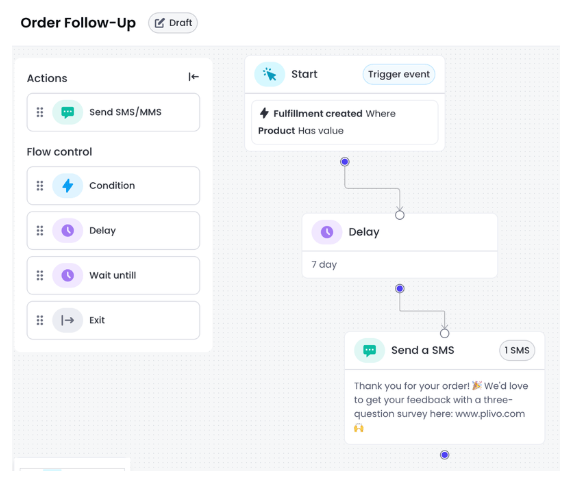
- Seamless appointment reminders: Automate SMS reminders based on appointment dates, customer behavior, or specific triggers, ensuring timely follow-ups that reduce no-shows.

Businesses using Plivo CX for appointment reminders report an average ROI of $71 for every $1 spent, along with a significant reduction in no-shows and improved scheduling efficiency.
With Plivo’s global carrier network, businesses can reduce SMS marketing costs by up to 70% while enhancing their appointment reminder strategy.
Increase your booking efficiency, improve customer satisfaction, and drive better results with automated SMS reminders from Plivo CX.

7 Examples of SMS feedback surveys (With Templates & Best Practices)
Get actionable feedback fast! Learn the top 7 SMS surveys with free templates, best practices, and a simple tip to automate the entire survey process
Getting customer feedback not only gives you the right insights to improve customer experiences and operations but also brings more credibility to your store.
In fact, 91% of consumers read feedback regularly. So, having a product line with limited reviews becomes the first bottleneck in sales.
To help you avoid such issues and boost operations, we will look at different types of SMS surveys you can run along with best practices for maximum response.
SMS feedback survey types (with sample feedback request message)
The most common types of SMS surveys are:
1. Abandoned cart SMS survey
Abandoned cart SMS surveys give good insights into what's affecting conversion rates in your business.
More than 70% of online shoppers leave products in their carts. These shoppers are high-intent leads, and understanding what's preventing them from making a purchase is valuable data.
To collect this data, you can drop a quick abandoned cart SMS survey with options to choose the reason behind the drop.
Sample abandoned cart SMS survey template:
Hi [Customer Name], [Product name] is waiting in the cart. What's holding you back? Reply 1 for Price, 2 for Long delivery wait time, 3 for Slow checkout, 4 for Just browsing, or 5 for Found Elsewhere.
2. Post-purchase feedback SMS survey
Post-purchase feedback surveys help you assess customers' shopping experience. At least one in five customers drop products due to a complex checkout process.
Conducting these surveys gives you regular insights into the current checkout process and how it can be further improved.
Sample post-purchase feedback SMS survey template:
Thank you for your recent purchase! We'd love your feedback on your checkout experience. Reply with a number: 1 for Smooth, 2 for Slow, or 3 for Poor. Your input helps us improve!
3. Delivery feedback SMS survey
Delivery feedback SMS surveys gather customer feedback on the experience. 88% of US shoppers said that online retailers failed to meet their expectations at least once. Late deliveries are one of their primary frustrations.
Conducting regular delivery feedback SMS surveys and improving the delivery experience is one of the first steps in becoming a trusted eCommerce store.
Sample delivery feedback SMS survey template:
Woohoo! Your product just arrived. Rate the delivery experience! Reply with numbers: 1 for Fast delivery, 2 for Delayed delivery, or 3 for Poor packaging.
4. Product feedback SMS survey
A product feedback SMS survey helps to gather customer opinions about products delivered. It gives actionable data to improve your existing product, de-list the products that are getting poor feedback, and double down on what's catching up with customers.
74% of consumers say it only takes up to three bad experiences with a brand for them to abandon it. So, while customers are willing to give another chance, continuous poor product experience can lead to losing a customer.
In that case, product feedback surveys become a goldmine to keep optimized inventory for products that are hitting a chord with customers.
Sample product feedback SMS survey template:
Hi [Customer Name]! Your order [Product name] got delivered. Earn loyalty points by dropping a quick review: [Review Link].
5. Return and refund process feedback SMS survey
Return and refund process feedback SMS survey helps to identify bottlenecks in your return process.
A Statista survey found that almost 80% of shoppers won't return to shop from a store that doesn't provide a good return experience.
Continuously improving the return process is an integral part of running an eCommerce store. Gathering data from return and refund process feedback SMS surveys is the first step to doing that.
Sample return and refund SMS survey template:
Hi [Customer Name], Thank you for your recent return. On a scale of 1-5 (1=Very Dissatisfied, 5=Very Satisfied), how satisfied were you with the return process? Reply with 1-5.
6. Customer service feedback SMS survey
Customer service feedback SMS surveys are quick surveys sent to customers whenever they interact with customer service. It's a short survey to quickly gather how they would rate the interaction and quality of support they received. Good customer service support is one of the top drivers of customer loyalty.
Tracking these survey numbers will help you identify how many customers are happy with the customer service and if customer support team members require additional training.
Sample customer service feedback SMS survey template:
Hi [Customer Name], thanks for reaching out to [Company Name] support. How helpful was the interaction with our customer service executive? Rate from 1 to 5 (1=Not Helpful, 5=Very Helpful). Reply 1-5.
7. Net promoter score SMS survey
Net Promoter Score (NPS) SMS surveys are a quick way to gather an NPS score. NPS score is a metric used to gauge how likely customers are to recommend your brand to others.
An NPS score higher than 30 indicates that your company is doing great and has far more happy customers than unhappy ones. An NPS over 70 means your customers love you, and your company is generating a lot of positive word-of-mouth from their referrals. The average NPS score for eCommerce brands is 52 in 2024.
While you have multiple metrics to track as an eCommerce brand, an NPS score can be one of the most valuable metrics to work upon.
Sample net promoter score SMS survey template:
Hi [Customer Name], on a scale of 0-10, how likely are you to recommend [Brand Name] to a friend? (0=Not Likely, 10=Very Likely) Reply with your score.
5 Best practices for SMS feedback surveys
Follow these best practices to ensure your surveys get maximum response:
1. Ask one question at a time
Don't overload the survey with multiple questions. Have it within the character limit (160 characters) and with one question at a time. An ideal SMS is one that customers can read on the go.
2. Offer an incentive
Offer incentives to customers for surveys requiring a considerable effort from customers. For instance, giving coupons to customers for writing elaborate reviews helps you in both ways.
You build a credible store and acquire the next order from an existing customer at a relatively low marketing cost.
3. Brand your request
Customers should be able to quickly recognize that the SMS is from your brand. You can add a brand name at the beginning or end of the SMS or send it from a registered branded sender ID.
4. Personalize the message
Include customer name, order number, and product name in the SMS so customers can easily identify which order the survey is about.
5. Send it at the relevant time
Send surveys at the right time within 24-48 hours of the relevant event. The following timing guidelines for different SMS feedback messages will help:
- Abandoned cart: Within two to four hours after abandonment
- Post-purchase: Within one hour of placing order
- Delivery: Within one hour of product delivery
- Product: Within 24 hours of product delivery
- Return and refund: 24 hours after return confirmation
- Customer service: Within one hour of interaction
- Net promoter score: After a purchase
An SMS marketing platform automates the entire process to help you send surveys at the right time based on customer interaction.
Automate the feedback surveys with Plivo CX
Plivo CX simplifies the entire SMS survey processing for eCommerce businesses. Our no-code journey builder feature allows you to run SMS surveys on autopilot. Seamlessly integrate Plivo CX with Shopify and schedule automated SMS surveys using a simple drag-and-drop interface—no coding required.

Plivo CX Journey feature
Apart from the effective SMS survey creation, Plivo CX also supports:
✅Getting customers to opt-in
✅Creating campaigns with in-built templates and AI copywriter
✅Scheduling marketing campaigns with AI assistance
✅Launching ad-hoc campaigns with ease
✅Building reports of campaigns
You get a complete solution that complies with all industry and government regulations. Further, we do not rely on external carriers. Instead, we use our internal premium carrier network that ensures high deliverability.
Our internal premium carrier network enables you to send messages to over 220 countries/territories with higher deliverability for as little as $0.0065. You can easily cut your SMS marketing costs by up to 70%.
Want to run SMS surveys seamlessly? Schedule a demo today to explore the powerful features of Plivo CX.

10 Effective Strategies to Improve Agent Productivity in Customer Support
Discover actionable methods to improve agent productivity in customer support, including AI integration, unified workspaces, and self-service tools.
Your support agents are overwhelmed. High ticket volumes, slow resolutions, and repetitive tasks drain their time and energy. Without the right tools and strategies, productivity nosedives, and so does customer satisfaction.
The challenges are real, but so are the solutions. What if you could cut response times in half? What if your agents had more time to help customers with their tricky problems?
The data backs this up. A company using AI automation can resolve tickets 52% faster. Using AI results in a 37% drop in first response times compared to those without automation.
This guide provides ten practical strategies for boosting agent efficiency, reducing burnout, and improving customer service.
Why do agents struggle with productivity?
With tools like IVR systems, chatbots, and customer support platforms, you’d think agent inefficiency wouldn’t be a problem. Yet, many customers still deal with slow responses and unresolved issues.
Here’s what might be holding them back:
High ticket volumes
Your agents spend too much time answering the same basic questions. Instead of focusing on complex issues, they get stuck handling repetitive requests.
Without automation, ticket queues pile up, leading to longer wait times and frustrated customers.
Lack of proper training
Even the best tools won’t help if agents don’t know how to use them. Many struggle with outdated training programs that don’t prepare them for customer interactions.
Without ongoing coaching, they waste time searching for answers instead of resolving issues quickly.
Disorganized workflows
An inefficient system slows everything down. When agents jump between multiple platforms or manually sort tickets, productivity drops. Poorly structured workflows lead to mistakes, unnecessary escalations, and longer resolution times.
Burnout
The constant pressure to meet performance targets can wear agents down. Long shifts, stressful calls, and unrealistic expectations can also lead to disengagement and high turnover.
This leads to agent burnout, which ultimately impacts productivity. In fact, approximately 59% of call center employees are at risk of burnout, with 28% nearing acute burnout syndrome. And note, replacing a call center employee can cost between $10,000 and $15,000.
10 strategies to improve agent productivity in customer support
To tackle these problems and improve agent productivity, you have to go back to the basics while using expert-recommended measures. Remember, small and targeted improvements can make a big difference.
Here’s how you can help your team work smarter and deliver faster support:
1. Implement AI and automation for repetitive tasks
AI and automation can help your agents work faster and more efficiently. Instead of manually handling every request, they can focus on solving complex issues that need a human touch.
Think about a customer asking for a refund. An AI agent can process the request instantly so that your agent doesn't have to handle the same inquiry repeatedly.
Also, if a customer asks a detailed question, AI can gather relevant information from its training dataset, saving your agents the time they’d waste searching through documents.
The best thing is that advanced AI agents in customer service can detect urgency, like a frustrated customer complaining about a failed payment, and route the ticket to the right agent immediately.
2. Use a centralized knowledge base
Creating a single source of truth for all your knowledge resources makes it easier for agents to find information. This way, they will spend less time hunting for information and will focus on delivering faster, superior support to your customers.
A unified knowledge hub may include FAQs, product manuals, troubleshooting guides, and company policies. This may benefit your agents in the following ways:
- Quick resolutions: Since agents can get information at their fingertips, it can reduce response times and improve metrics like average handling time
- Consistency: All agents provide the same level of service and accurate information that can enhance customer satisfaction
- Faster onboarding: Recruits can learn faster from a well-organized, comprehensive resource
3. Adopt a unified agent workspace
47% of digital workers struggle to find the appropriate information to perform efficiently. An all-in-one agent workspace can solve this problem by bringing everything from customer history and tickets to communication channels into one place.
So, when an agent needs to look at the history of a customer order, instead of digging through emails or asking another team, the unified workspace instantly provides information about order details, past conversations, and resolution options in one dashboard.
4. Use analytics for performance insights
Regularly measuring agent performance metrics can help you quickly identify what’s lacking and create strategies to improve it.
Advanced data and analytics tools can document agent performance and customer service metrics, such as first call resolution, average handling time, and average wait time.
Once you have this information, review it and discuss it with your agents. If necessary, create targeted training sessions to educate agents on proper call center etiquette and strategies. This will motivate agents to do better and deliver better service.
5. Introduce self-service options and tools
Self-service tools, especially AI agents, can significantly improve agent productivity by handling repetitive tasks and reducing ticket volume. Moreover, the majority of respondents in a recent survey indicated they are open to chatting with an AI chatbot first.
AI agents can act as the first point of contact, answering FAQs, assisting with password resets, and helping with order placements.
Instead of agents handling every minor request, these resolve common issues instantly. If a customer needs further assistance, the AI agent connects them to the right human agent, ensuring a smoother workflow.
There are even sales-focused AI agents that can guide customers through the shopping process and offer product recommendations based on browsing history or past purchases.
For example, H&M’s chatbot asks users about their style preferences to suggest matching outfits. This can significantly reduce the burden on the sales team while improving conversions.
6. Establish clear expectations
Now, let’s come to the granular level of tackling productivity management in customer service. A classic move—setting clear and specific expectations will alert agents to meet their goals. This will also allow agents to plan and manage their time while completing daily tasks.
Without clearly defined expectations, agents may be confused or even get distracted by unnecessary tasks.
For this, you can use KPIs to set goals for your agents that may include:
- Average handle time
- First reply time
- First contact resolution rate
- Number of tickets handled per hour
- Customer satisfaction score
7. Provide continuous learning and upskilling
Well-trained agents work faster, make fewer mistakes, and provide better customer service. A lack of proper training can make the agents confused and overwhelmed, unable to manage interactions as they should.
Highly skilled agents are more likely to feel confident and engaged in their roles, resulting in higher job satisfaction. You can utilize Interactive training methods, like role-playing or real-time feedback, to prepare agents for real-world scenarios.
8. Empower agents with decision-making autonomy
Working in a contact center can become monotonous. Agents usually follow a set system of responses and processes that can make them feel repetitive and lethargic.
You can turn this around by giving your agents a certain degree of autonomy and some leeway to make independent decisions. This can feel empowering and can boost their productivity to a huge extent.
9. Gather and implement agent feedback
We all want to feel valued and heard. Periodic surveys collecting agent feedback sends a good message. This can also bridge the gap between management and customer service team members.
These surveys can generate many new ideas and act as quality control for customer service teams during times of high agent turnover. In most cases, agent feedback can identify problems early before an internal problem gets out of control.
10. Promote work-life balance
According to The Hartford, 63 % of employees report that their overall health and wellness impact their productivity at work. Prioritizing agent well-being leads to higher job satisfaction and efficiency.
Consider the following actions:
- Offer regular breaks: Short, frequent pauses help maintain focus and reduce stress
- Keep work schedules flexible: Allowing your team to adjust their working hours can help them manage personal commitments and reduce stress
- Manageable workloads: Distribute tasks evenly to avoid overwhelming your agents
Focusing on these areas creates a positive environment where agents remain engaged and productive.
Improve agent productivity with Plivo CX
Plivo CX is an AI-driven omnichannel customer service platform that can offer the right support to your agents to amplify their productivity. It integrates seamlessly with your existing systems to provide accurate and context-aware responses.
Key features include:
- Unified agent desktop: Provides a single interface where agents can manage all communication channels—such as voice, SMS, MMS, email, and WhatsApp—streamlining workflows and giving agents full context to resolve issues faster.
- System integration: Connects effortlessly with CRM, billing, ticketing systems, and knowledge bases for precise responses
- Specialized AI agents: Tailored for sales, customer engagement, retention, and support
- Self-service chatbot: Powered by OpenAI, the chatbot offers 24/7 support, automating responses to common customer queries across multiple channels. It can handle up to 70% of inquiries, freeing agents for more complex tasks.
- Personalized interactions: The AI leverages customer data and interaction history (via integrations with tools like Salesforce or Zendesk) to provide tailored replies, boosting engagement and support quality.
- Automated workflows: Automates tasks like ticket routing, follow-up messages, or proactive notifications (e.g., order updates, appointment reminders), enhancing engagement and retention.
- Intelligent Escalation: When the AI can’t resolve an issue, it seamlessly escalates the conversation to a human agent, attaching detailed notes about the interaction. This ensures continuity and reduces resolution time.
- Compliance and security: Meets SOC 2 and GDPR standards for secure customer interactions
Book a demo now to learn more.

What is a landline number?
Understand what a landline number is, its role, types, and reliable benefits. Learn about modern VoIP alternatives and their advantages. Click to know more!
What is a landline number? A landline number is tied to a fixed-line network, like traditional home or office phones. It connects to the Public Switched Telephone Network (PSTN) using physical cables to transmit voice communication, unlike mobile phones that rely on radio signals and cell towers.
For businesses, landlines offer clear call quality and reliable emergency services. However, with mobile phones and internet-based calling on the rise, understanding the pros and cons of landlines is essential in today’s communication landscape.
How do landline numbers function?
What is a landline number, and how does it work in practice? While landlines may seem dated in a world dominated by mobile phones and VoIP systems, they remain highly reliable. Here’s a breakdown of how they function:
- Voice Transmission: When you make a call on a landline, your voice is converted into electrical signals, which travel over the physical wires (copper or fiber optic cables) to reach the recipient. This conversion ensures that the voice remains clear and intelligible, unaffected by issues like weak signal strength.
- The PSTN: The landline’s connection to the Public Switched Telephone Network (PSTN) ensures that the voice data is transmitted through a network of switches and cables, allowing communication between different locations globally. This network has been the backbone of telecommunication for over a century, providing a stable, reliable way for people to connect with one another.
- Direct and dependable: Landlines are still known for their dependability. Unlike mobile phones, which rely on the health of the cellular network or internet connection, landlines can function even when there are power outages, making them a preferred choice for businesses that need constant availability. In fact, during natural disasters or widespread service disruptions, landline numbers can be the only means of communication, offering a direct and often uninterrupted line to emergency services.
What are the different types of landline numbers?
Landline numbers, though simple in concept, come with various configurations and use cases that influence how businesses and individuals interact with them:
- Geographical area codes: Landline numbers are typically associated with a specific geographical location. Area codes identify a specific region, helping both businesses and individuals establish a local presence. For businesses, a local area code can foster a sense of community and trust with customers.
- Local numbers: These are landline numbers assigned to a particular area. They are the most common type of landline number and are often preferred for personal communication. However, for businesses, this can sometimes be limiting, as it ties the business to a specific location.
- Toll-free numbers: Toll-free numbers (e.g., 800, 888, 877) offer businesses the opportunity to provide a cost-free way for customers to reach them. While local numbers are tied to a specific area, toll-free numbers are not, making them ideal for companies that operate across multiple regions or need to present a nationwide presence. However, they can come with higher maintenance costs, which can be a consideration when planning your communication strategy.
- Vanity numbers: These are customizable numbers that spell out a word, name, or acronym related to the business. For example, 1-800-FLOWERS or 1-800-PAINTING. Vanity numbers are not only memorable but can also enhance branding efforts, providing easy recall for customers.
What are the main benefits of landline numbers?
Despite the growing dominance of mobile and VoIP technologies, landlines still hold a strong position for certain use cases, especially in business environments. Let’s explore some of the key advantages:
Reliable Call Quality:
- Landline calls offer superior audio quality compared to mobile or internet-based communication.
- They are unaffected by network congestion, weak signals, or interference.
- Ideal for high-stakes communication, such as customer support, emergency response, or confidential discussions.
Emergency Services:
- Landlines are the most reliable option during emergencies.
- They operate through the PSTN and remain functional even during power outages.
- Essential for industries like hospitals and emergency services, where accessibility is critical during crises.
Enhanced Security:
- Landlines provide a more secure communication option.
- They are less vulnerable to hacking or eavesdropping compared to mobile or internet-based methods.
- Ideal for handling sensitive or confidential information.
What are the downsides of using landline numbers?
However, despite their advantages, landline numbers come with limitations, particularly as businesses look for more flexible and scalable communication solutions:
- Limited Mobility:
- Landlines are fixed-location services, tying you to a specific place.
- This lack of mobility is a significant drawback for businesses with remote or traveling employees.
- Unlike mobile phones or internet-based communication systems, landline numbers cannot be used on the go.
- Higher Maintenance Costs:
- Traditional landline services often incur higher maintenance costs than newer technologies.
- These costs include maintaining physical infrastructure and paying for long-distance calls.
- Businesses with nationwide or international operations may face especially high costs.
- Declining Usage:
- Landline usage is decreasing due to the rise of mobile phones, internet-based communication, and VoIP solutions.
- Businesses and consumers are opting for more flexible and feature-rich alternatives.
- This trend makes it harder to justify the costs of investing in or maintaining landline connections.
How are landline numbers formatted?
Landline numbers, like any other phone numbers, must follow a specific format to ensure proper routing and connection. This includes several key components:
Country Code:
- Each country has a unique country code to distinguish it from others.
- Example: The United States uses the country code +1, while the UK uses +44, and India uses +91.
- When dialing internationally, the country code ensures the call is routed to the correct nation.
Area Code:
- An area code identifies a specific geographic region within a country, which is essential for routing calls accurately.
- Example: In the US, 212 is the area code for Manhattan, New York, while 408 covers parts of California, including San Jose.
- Area codes are particularly important for businesses operating in specific regions to establish a local presence.
Phone Number:
- The phone number is the unique identifier for the recipient within the specified area and can vary in length by country and region.
- Example: In India, a landline number in Delhi might look like 011-12345678, while in the UK, a London number could be 020-12345678.
E.164 Format:
- For international calls, phone numbers are standardized in the E.164 format, which includes the country code, area code, and local number without spaces or dashes.
- Example: A US number would appear as +14155552671 in E.164 format, ensuring global compatibility for dialing.
National Dialing Formats:
- Some countries use unique national dialing formats when calling locally or regionally.
- Example: In the US, local calls within the same area code might only require dialing the 7-digit number, while in India, dialing ‘0’ before the area code (e.g., 011-12345678) is mandatory for national calls outside the area.
How do modern alternatives like VoIP compare to landlines?
What is a landline number compared to modern technologies like VoIP? While landlines are reliable, they lack the flexibility and features of VoIP. As the drawbacks of traditional landline numbers become more apparent, many businesses are turning to Voice over Internet Protocol (VoIP) technology.
VoIP offers a far more flexible and scalable solution for modern businesses, providing a host of features not available on landlines.
- What is VoIP technology? VoIP uses the Internet to make voice calls, allowing users to connect through various devices such as smartphones, laptops, or desktops. This flexibility provides businesses with greater mobility than the static nature of landline phones.
- What are the advantages of VoIP? VoIP offers several advantages, such as lower operational costs, enhanced features like text messaging, and integrations with other business tools like CRM systems. Unlike traditional landlines, VoIP solutions can scale with your business needs, offering everything from voicemail and call forwarding to SMS and voice messaging.
- How do VoIP and landlines compare? VoIP systems have a clear edge over traditional landlines when it comes to flexibility and cost-effectiveness. VoIP is designed to support multiple features, such as instant messaging, auto-replies, and call transcriptions, which are increasingly necessary in today’s fast-paced, customer-centric world.
This is where Plivo’s Voice API comes into play. By integrating Plivo's Voice API into your communication systems, you can bring the power of cloud-based calling to your business, leveraging advanced features that landlines simply cannot match.
Can VoIP be the right replacement?
For businesses looking to move beyond the limitations of traditional landlines, VoIP (Voice over Internet Protocol) provides a flexible and cost-effective way to handle voice communication. By enabling calls over the internet, VoIP eliminates the need for physical phone lines and supports modern communication needs.
How Plivo Supports VoIP Integration
Plivo offers simple tools to integrate VoIP capabilities into your applications using Mobile SDKs (iOS/Android) and Browser SDKs. These tools allow businesses to create reliable voice solutions tailored to their specific needs.
Key Benefits of Plivo’s VoIP Solutions:
Global Reach:
- Make and receive calls in over 200 countries without worrying about high international calling costs.
- Connect with any phone number, app, or browser, ensuring you can reach customers and teams anywhere.
Flexible Call Handling:
- Route calls efficiently with features like multilevel IVR, call forwarding, and call queues.
- Support team collaboration through call conferencing and multiparty calls.
Simple Integration:
- Add VoIP calling directly into your apps using Plivo’s SDKs.
- Enable smooth communication for tasks like customer support, team meetings, or healthcare consultations.
Additional Features:
- Voicemail with transcription ensures important messages are not missed.
- Use caller ID customization to present a local presence when communicating globally.
Why Consider VoIP?
VoIP solves many of the challenges associated with landlines:
- It doesn’t rely on physical infrastructure, reducing setup and maintenance costs.
- It supports remote work and mobile communication, making it ideal for distributed teams.
- Businesses can easily scale their communication systems as they grow.
Practical Use Cases for Plivo’s VoIP Tools:
- Customer Support:
- Replace landlines with a VoIP system to route calls effectively, minimize wait times, and provide a better customer experience.
- Remote Work:
- Allow employees to make and receive work calls on their mobile phones or computers, keeping teams connected wherever they are.
- Cost-Effective International Calls:
- Connect with global clients and partners at a fraction of the cost of traditional long-distance calling.
Discover how Plivo’s VoIP solutions can simplify your communication needs, reduce costs, and enhance flexibility for your business. Get started now or contact our team to explore how VoIP can work f

What to know about 6-digit phone numbers
Discover the benefits of using a 6 digit code for SMS marketing and alerts. Understand compliance, opt-in requirements, and leasing options. Start boosting your business communications today!

For businesses seeking a more efficient and effective way to connect with customers, SMS short codes offer a powerful solution. These 6-digit numbers simplify communication, making it easier to send messages that capture attention and drive action.
Unlike traditional 10-digit phone numbers, short codes are easy to recognize, quick to use, and perfect for high-volume messaging. Customers can effortlessly opt-in to receive promotions, updates, and alerts without the hassle of entering long phone numbers.
While there is a cost associated with leasing a short code, the return on investment is often significant, with higher engagement and conversion rates. In this blog, we’ll explore how 6-digit short codes work, why they’re so effective, and how they can enhance your customer communications.
What are 6-digit phone numbers?
Short codes, introduced by wireless carriers in 2003, were designed to meet the growing demand for efficient mass messaging. They are 6-digit numbers specifically built for high-throughput, application-to-person (A2P) messaging, making them ideal for sending critical, time-sensitive updates like authentication codes, alerts, and promotional notifications. Unlike traditional 10-digit long codes, short codes offer:
- Faster delivery: Thousands of messages can be sent per second.
- Better prioritization: Carriers prioritize short codes, ensuring high deliverability for important updates.
- Simplified user experience: Their shorter format makes them easier to recognize and remember.
How are 6-digit numbers used?
The versatility of short codes extends across multiple industries. Here are some key applications:
Retail and E-commerce:
Businesses use short codes to announce flash sales, send discount codes, and share product updates.
Examples:
“Text DEAL20 to 123456 to get 20% off your purchase today!”
“FLASH SALE! Text SALE to 654321 for exclusive early access to our 50% off deals.”
“Sign up for SMS alerts by texting VIP to 456789 and receive free shipping on your next order.”
Healthcare:
Appointment reminders, public health notifications, and patient engagement campaigns are made seamless with short codes. Enhance patient experiences and rapport by improving healthcare communication, reducing appointment no-shows with SMS alerts, delivering time-critical emergency health services, and optimizing public health campaigns.
Examples:
- “Your appointment with Dr. Smith is scheduled for tomorrow at 3:00 PM. Reply YES to confirm or RESCHEDULE to change.”
- “Public Health Alert: Flu vaccine clinics now open. Text VACCINE to 789123 for locations near you.”
- “Reminder: Please fast for 12 hours before your blood test tomorrow at 8:00 AM. Questions? Text HELP to 987654.”
Finance and security:
Banks and financial institutions rely on short codes for two-factor authentication (2FA) and account activity alerts.
Examples:
- “Your account balance is $1,234.56. For more details, text INFO to 123123.”
- “Your one-time verification code is 876543. It will expire in 5 minutes.”
- “Alert: A transaction of $500 was made on your credit card ending in 1234. Text FRAUD to 456123 if this wasn’t you.”
Logistics and transportation:
Ridesharing services and courier companies use short codes for real-time updates, such as delivery status and driver notifications.
Examples:
“Your package will arrive today between 1 PM and 3 PM. Track it here: [link].”
“Driver Alex is 5 minutes away in a blue Toyota Camry. Text SUPPORT to 654987 if you need help.”
“Your ride to JFK Airport is confirmed. Driver John will arrive at 6:15 PM. Reply CANCEL to cancel.”
What are the advantages of 6-digit numbers?
Short codes offer many distinct advantages over traditional communication methods, revolutionizing how businesses connect with their audience. Their efficiency, reliability, and user-friendly nature make them a preferred choice for high-volume messaging campaigns. Here's a detailed breakdown of their unique benefits:
High throughput:
Short codes support the dispatch of many messages per second, a critical feature for businesses managing large-scale campaigns. Plivo’s SMS API takes this further by providing a throughput of 100 messages per second for short codes with room for scalability.

Improved deliverability:
Messages sent via short codes are prioritized by carriers, reducing the likelihood of being filtered as spam. This ensures critical notifications, such as system outages or payment confirmations, are received promptly.
Memorability and branding:
Vanity short codes (e.g., “PLIVO” or 75486) reinforce brand recognition while simplifying the user experience. Plivo’s API supports vanity short codes, ensuring seamless integration with your branding strategy.
Compliance:
Short codes are inherently TCPA-compliant when used correctly. Plivo’s opt-out handling and real-time redaction tools simplify adherence to regulations, protecting your brand from legal pitfalls.
Compliance and opt-in requirements
Navigating the regulatory landscape is crucial for any business utilizing short codes. Under the Telephone Consumer Protection Act (TCPA), explicit customer consent is required before sending promotional messages. This is typically achieved through keyword opt-ins, such as:
- A customer texting “SUBSCRIBE” to your short code.
- The customer’s agreement to your terms of communication.
Plivo’s compliance features:
- Built-in opt-out management, ensuring recipient requests like “STOP” or “UNSUBSCRIBE” are processed automatically.
- Detailed documentation and support to guide businesses through TCPA and CTIA compliance requirements.
Types of short codes
When choosing a short code, businesses must decide between two options:
Random short codes:
Carriers assign these codes sequences of numbers provided by wireless carriers, offering businesses a cost-effective option for high-volume messaging. These codes are chosen at random, without input from the business, which makes them less personalized compared to vanity short codes.
However, their functionality remains identical, making them an excellent choice for businesses where branding isn’t the primary focus, but reliable and efficient messaging is. For example, a logistics company sending delivery notifications or a healthcare provider sharing appointment reminders may prioritize the affordability and utility of a random short code over the memorability of a vanity code.
Random short codes deliver the same performance benefits, such as high throughput and carrier prioritization, without the added expense of customization.
Vanity short codes
Vanity short codes are fully customizable 6-digit numbers that allow businesses to align their messaging strategy with their brand identity. These codes are typically chosen to spell out a word or phrase associated with the business, like “PLIVO” (75486), making them highly memorable for customers. The customization not only aids in recall but also builds trust and credibility by reinforcing the brand every time the code is used.
While vanity short codes are more expensive than random ones, their value lies in their ability to create a cohesive and recognizable brand experience. For instance, a retailer running nationwide loyalty programs or a media company promoting a recurring event might find the investment worthwhile to maintain a strong brand presence in every interaction.
Since the industry-wide discontinuation of shared short codes due to security concerns, dedicated short codes—whether random or vanity—have become the norm. These provide businesses with exclusive use of their short code, ensuring messages are not only delivered but also free from the risks of being flagged or associated with other entities.
How to lease and acquire a 6-digit phone number?
Leasing a short code involves navigating carrier requirements and compliance approvals. The process includes:
- Selecting a random or vanity short code based on your goals and budget.
- Completing carrier documentation, including details on message types and compliance measures.
- Testing and launching your campaigns.
This process can seem complex, but Plivo makes managing short codes effortless by providing end-to-end support, from application submission to campaign setup. With over a decade of experience, Plivo helps businesses go live with their short codes quickly and efficiently.
Integrating short codes with an SMS API
The true power of short codes lies in their integration with Plivo’s SMS API. APIs automate messaging, provide real-time analytics, and enhance scalability.
Plivo’s SMS API delivers:
- Global reach: Seamless communication across borders.
- Unicode support: Allowing businesses to send multilingual messages, including emojis.
- Message concatenation: Ensuring long messages are delivered as intended, regardless of character limits.
These advanced features enable businesses to elevate their communication strategies while maintaining operational efficiency.
Elevating communication with Plivo and short codes
Short codes are a critical asset for businesses aiming to engage customers effectively and securely. By integrating short codes with a platform like Plivo, businesses gain access to advanced features, expert guidance, and unparalleled reliability.
From financial institutions ensuring secure transactions to retailers driving loyalty campaigns, Plivo empowers organizations to maximize the impact of their messaging.
With dedicated support and cutting-edge API solutions, Plivo is your partner in creating meaningful customer connections.
Ready to take your messaging strategy to the next level? Discover how Plivo can simplify short code integration and help your business deliver impactful, reliable communication. Connect with Plivo today to unlock a smarter way to engage your audience.

Text message scams: How to identify a fake text message
Spot scam text messages: Look for unsolicited urgent requests, bad grammar, and strange numbers. Protect yourself—block and report scams now!
Text message scams, or smishing, are becoming increasingly sophisticated, making it harder to tell if a message is real or fake. More than 3.5 billion phone users receive spam text messages that trick individuals into sharing sensitive information, such as credit card details, social security numbers, and banking credentials.
While many think they can spot a scam from a mile away. But, in reality, only less than 35% of the population knows what smishing is. These fraudulent messages can look shockingly legitimate.
In this post, we’ll show you how to identify a fake text message, and provide tips on how to protect yourself.
What is smishing?
Smishing is a form of phishing conducted via text messages. These fraudulent SMS attempts often appear to come from trusted entities—your bank, government agencies, even friends or family—convincing you to share private information or click on malicious links.
The goal of smishing is to steal your sensitive data or install malicious software on your device. These texts often play on emotions, like urgency or fear, to prompt quick action.
What are some common traits of scam text messages?
- Unsolicited texts from unknown or spoofed numbers
A typical characteristic of a scam text is that it comes from an unfamiliar number. While legitimate businesses use shortcodes or toll-free numbers, scammers often spoof these to make the text appear trustworthy. If you receive a text from a random, long-numbered, or suspicious source, take extra caution. - Urgent requests or alarming content
Fake texts often claim urgent issues like unauthorized bank transactions, problems with accounts, or family emergencies that require immediate action. Scammers know that stress and fear can cloud your judgment, so they pressure you into taking quick, unthought-out actions. - Strange grammar or formatting
Look for signs like spelling errors, awkward phrasing, or inconsistent formatting. Real businesses take care in crafting their messages, while scammers might rush or use poor language to disguise their intentions.
What are the common types of text message scams?
Understanding the types of scams is key to recognizing them before it’s too late. Here are a few common examples:
- Missed delivery notifications
You might receive a text claiming that a package was undeliverable and prompting you to visit a suspicious website or call a fake customer service number. - Prize or sweepstakes notifications
A scammer might tell you that you’ve won a prize but need to pay a fee or provide personal details to claim it. Be especially wary if you’ve never entered any contests. - Bank account closure threats
Scammers pretending to be from your bank may warn that your account is about to be locked unless you take action immediately. These texts often include fake links or phone numbers to collect your login details. - Subscription service payment failures
If you receive a text claiming a failed payment for a service you use, be cautious. Scammers use this tactic to extract payment information or prompt you to visit malicious websites.
How do scammers use text messages?

Scammers typically rely on tactics that mimic trusted brands or entities to trick victims into responding. These tactics include:
- Impersonating reputable companies or individuals: Scammers may pose as well-known organizations like your bank, delivery services, or government agencies to gain your trust.
- Spoofing phone numbers: By making it appear as though a trusted number is sending the message, they increase the likelihood of you believing the scam.
- Social engineering: Scammers tailor their messages to seem more believable using information gathered from previous data breaches or public sources.
- Unsolicited messages with suspicious links or requests
Unsolicited messages containing unexpected links or requests should always be approached with caution. Pay attention to details like URLs that closely mimic legitimate domains but include slight variations, such as additional characters or unfamiliar extensions.
Avoid clicking on links in these messages. Instead, verify the authenticity by directly visiting the organization's website through a trusted search engine or contacting them via official channels.
How to identify scam text messages?

What protective measures can you take against text scams?
To avoid falling victim to smishing attacks, follow these protective steps:
- Avoid responding to suspicious texts
Don’t engage with any message you suspect to be a scam. Even responding with “STOP” or “REMOVE” may confirm to the scammer that your number is active, leading to more fraudulent attempts. - Block spam numbers
If you receive a suspicious text, block the number immediately. Your phone’s settings or mobile provider’s app will usually allow you to do this. - Use Plivo’s SMS API for secure communication
For businesses, one of the best ways to prevent smishing and safeguard your business communication is by using Plivo’s SMS API fraud shield to ensure safe and secure messaging. Plivo offers robust tools for verifying customer phone numbers, authenticating accounts, and detecting fraudulent activity.
Plivo’s API helps prevent spoofing and ensures that your SMS communication is secure, reducing the risk of text scams for your business and customers.
How to report and address text message scams?
If you receive a text that you suspect to be a scam, take action:
- Forward suspicious texts to 7726 (SPAM)
Reporting suspicious messages helps your mobile carrier investigate the issue and block potential scammers from reaching others. - Report scams to the FTC or local authorities
You can also report smishing attempts to the Federal Trade Commission (FTC) or local authorities to help them track down scammers and prevent further fraud. - Prevent future scams with Plivo’s Features
With Plivo’s advanced fraud protection tools, you can further safeguard your messaging systems against fraud and ensure your business communication remains secure. Whether you’re sending out SMS for customer notifications, marketing campaigns, or authentication, Plivo ensures that your messages are delivered securely to legitimate users.
How does Plivo’s SMS API help prevent text scams?
Plivo’s SMS API provides several key features that make it a strong ally in combating smishing scams and other forms of fraudulent SMS messaging:
- Two-Factor Authentication (2FA): Plivo allows businesses to integrate two-factor authentication into their SMS workflows easily. By adding an additional layer of security through 2FA, businesses can ensure that only authorized users can access accounts or make changes, protecting sensitive data and reducing the risk of account takeovers.
- Verified sender IDs and number masking: One of the most common tactics used by scammers is number spoofing, where they fake the sender's number to appear as if the text message is coming from a trusted entity, such as a bank or government agency.
Plivo’s verified sender ID feature helps businesses establish legitimate communication with their customers by confirming that the sender's number is genuine and trusted. This greatly reduces the chances of impersonation and increases trust in the messaging process.
- Message authentication and validation: Plivo’s platform has built-in tools to ensure the integrity of the messages you send. Through features like SMS sender verification, businesses can confirm that messages are coming from authentic, authorized senders and are not altered in transit.
Additionally, Plivo allows for real-time monitoring and validation of message content to ensure that no fraudulent links or suspicious content are included in communications.
- Advanced fraud detection and prevention: Plivo’s Fraud Shield provides robust protection against SMS fraud, including smishing and account token takeover, through real-time monitoring and proactive safeguards.
It offers Geo permissions to block unauthorized destinations, avoiding unnecessary charges, and Fraud thresholds to set hourly message limits for approved countries, with alerts for suspicious activity.
Operating at the subaccount level, Fraud Shield ensures flexible, consistent security across your messaging operations, empowering businesses to safeguard SMS traffic, reduce risks, and maintain customer trust.
- Spam filtering: Plivo’s robust spam filters can automatically block incoming text messages that come from known spam sources or contain malicious content. By implementing these filters, businesses can protect themselves from receiving fraudulent texts and can also improve the quality of the messages that get through to their customers.
- Compliance and security monitoring: For businesses sending bulk SMS messages, staying compliant with regulations such as TCPA (Telephone Consumer Protection Act) and GDPR (General Data Protection Regulation) is crucial.
Plivo’s compliance features help businesses align with these regulations by offering tools to capture and store opt-ins, manage subscriber consent, and track message delivery and responses.
Protect your communications and keep your business secure from smishing attacks. Discover how Plivo’s trusted solutions can safeguard your messages and build lasting customer trust. Get started today!
It’s easy to get started. Sign up for free.
Create your account and receive trial credits or get in touch with us.
