

AI Voice Agents - The Complete Guide to Voice Chat (2025)
Learn everything about an AI voice agents, its benefits, implementation tips, and the AI voice chat applications for business success.
Longer wait times, high call volumes, and language barriers in call centers often frustrate customers. Complex interactive voice response (IVR) menus only add to the problem, leading to customer dissatisfaction. That’s why companies are adopting smarter self-service solutions like artificial intelligence (AI) voice agents. In fact, experts predict the voice bot market will reach $98.2 billion by 2027, showing a clear trend toward smarter solutions to improving customer experience.
AI voice agents technology combines Natural Language Processing (NLP), machine learning, and voice recognition to transform customer interactions. It provides quicker, more efficient service and improves the overall customer experience.
In this guide, we'll explore what AI voice agents are, their key features, practical use cases, and tips on how to implement a voice agent in your business.
What is an AI voice agent?
An AI voice agent is a two-way conversational tool that communicates with the customer. It automates inbound and outbound calls without human intervention and transfers calls to a human agent when needed.

The biggest advantage? Callers can navigate an IVR by speaking naturally, without listening to long, complex menus or pressing numbers on a keypad.
Popular AI voice agent examples include Apple's Siri, Google Assistant, and Amazon's Alexa. These tools simplify interactions, provide instant answers, and automate tasks. In contrast, advanced bots like IBM’s Watson Assistant and Microsoft’s Cortana handle customer support, sales inquiries, and internal communications.
Types of AI voice agents
Here’s a breakdown of the four main types of AI voice agents and how they can benefit your business:
Rule-based AI voice agent
Rule-based voice agent use predefined sets of questions and rules to offer answers or perform tasks. Such voice agents handle routine tasks and customer FAQs. They answer all queries that fall under the if-this-then-that logic.
For example, an e-commerce site using a bot to guide customers in checking their order status or a banking site handling routine inquiries like balance checks, bill payments, transaction histories, etc.
AI-assisted voice agent
AI-assisted voice agents use machine learning and natural language to interpret conversations so they can analyze the context and grasp what the speaker means. This makes them far more capable and user-friendly than the conventional, rule-based voice agents.
Let’s suppose a user asks Alexa, 'What's the weather tomorrow?' and then follows up with, 'How about next week?' it remembers the context. This adaptability means customers don’t have to repeat themselves, creating a more contextual customer experience.
Conversational AI voice agent
Conversational voice agents make conversations using natural language. They’re more nuanced than AI-assisted voice agents as they can handle complex conversations using everyday language to create more personalized interactions.

Google Duplex, and IBM Watson Assistant, are examples of conversational voice agents. They can make phone calls, make reservations, and handle natural conversations with a human-like tone.
Voice-activated voice agent
These bots use voice commands to answer practical questions and perform routine tasks. They are more flexible than personal voice agents that adapt to speakers and perform customized tasks.
Such bots serve as digital assistants to AI-assisted bots like Siri.
How does an AI voice agent improve customer engagement?
A customer calling your sales team wants to feel valued and understood. An AI voice agent does that. It puts the customer at the center, creating a better experience and driving business benefits as a result. Let’s understand it with a few use cases.
Use case: Get a quick update on order status, 24/7

Assuming the AI voice agent is integrated into your CRM, it greets the customer by name. Instead of navigating through a branched IVR to get their order status, the customer can simply say ‘order status’ and the voice bot pulls out the order details from the CRM and gives the user a real-time update within seconds.
Sheraz Ali, the Founder of HARO Links Builder states that their voice agent managed over 30% of customer interactions in one of their company projects and drastically reduced wait times.
“It also improved our response efficiency and led to a 20% increase in customer satisfaction scores and a reduction in operational costs within three months.”
Benefits:
- Decreased waiting time.
- Limited IVR menu navigation.
- No human intervention is required.
- Quick response times.
- Reduced business costs.
- Tangible increase in customer satisfaction.
Use case: Improve language learning for students

A language learning platform uses a voice agent to provide real-time translations and personalized tutoring. So the voice agent instantly supports students in any subject by translating and clarifying complex terms in their preferred language.
Benefits:
- Reduced requirement for multilingual staff.
- Increases inclusivity as the bot answers in the user’s preferred language.
- Language barriers are removed.
Use case: Improve patient outcomes in healthcare

It's easy to miss appointments or forget to deliver prescriptions to the patient’s home timely. A healthcare service can employ a voice agent to deliver personalized care and offer preliminary health assessments, medication reminders, and easy appointment scheduling, all according to the individual patient's needs.
Benefits:
- Saves time by streamlining appointment bookings.
- Ensures medication adherence with timely reminders.
- Reduces workload for healthcare providers with automated support.
Use case: Streamline routine financial services

Once integrated with the banking system, the voice agent automates routine financial tasks, provides instant account information, processes transactions, and delivers personalized financial advice around the clock.
Benefits:
- 24/7 access to financial services without wait times.
- Improves customer experience with quick, accurate responses.
- Automates routine tasks, freeing up staff for complex queries.
- Provides personalized advice to improve financial decision-making.
Use case: Get personal shopping assistance

An e-commerce platform can use a voice agent to assist customers with product selection, provide personalized recommendations, and automate the sales process from start to finish.
Benefits:
- Delivers a personalized shopping experience 24/7.
- Boosts sales with customized recommendations.
- Reduces cart abandonment by guiding customers to checkout.
- Improves customer satisfaction with fast, accurate service.
Features of an AI voice agent
To understand why voice agents are so effective, let’s look at the key features that improve the overall customer service experience while streamlining business operations.
The best voice agents for businesses come equipped with:
Natural language understanding (NLU)
An AI voice agent understands user queries by converting speech into text using AI and NLP. It then forms an appropriate response and converts it back into speech using text-to-speech (TTS) technology. This ability to understand and respond in natural, conversational language sets AI voice agents apart from traditional IVR systems, which rely on rigid, menu-based responses.

Personalization capabilities
Customers want quick, personalized responses to their queries, unlike complex IVR systems that frustrate them with lengthy menus. An AI voice agent offers contextual conversations, adapting to the user’s intent. It detects speech cues, skips irrelevant interactions, and also transfers calls to the right agent.
Hence, when comparing voice agents to IVRs, the bot's ability to offer personalized interactions like a human outshines communication systems that follow even the best IVR practices.
Multi-language support
AI voice agents break down language barriers, supporting multiple languages to provide a more inclusive and accessible customer experience. Businesses can easily connect with diverse customer bases across the globe.
For instance, Plivo supports speech recognition in 27 languages and their regional variants.
{{cta-style-1}}
Integration with other platforms and services
AI voice agents easily integrate with platforms like customer relationship management (CRM) systems, Enterprise resource planning (ERP) tools, and ticketing software. They access and update customer data in real time to ensure accuracy.
These bots also pull relevant details, automate follow-up actions, and sync with communication channels like email or chat. This creates a personalized and consistent customer experience across all touchpoints.
Benefits of voice agents
Let’s now look at the benefits of AI voice agents.
Enhanced user experience
Many businesses have concerns over the quality of a voice agent for customer service. However, a voice agent answers queries quickly regardless of the time of the day. Speedy, reliable answers are important to providing excellent service, making voice agents an invaluable tool for businesses looking to improve customer satisfaction.
Additionally, businesses can:
- Handle routine queries and common tasks faster than human agents.
- Remove the need for users to navigate complex IVR menus.
- Manage high-volume calls without errors.
Better cost efficiency
An AI voice agent doesn’t just save time, it also saves money. It boosts user satisfaction and reduces support times by automating repetitive queries. This frees up staff for higher-value tasks, and interacting with customers after hours has improved lead conversion.
The direct benefits to businesses are:
- Reduces the need for a larger customer support team.
- Allows human agents to focus on complex, high-value inquiries.
- Engages users outside business hours to boost marketing return on investment (ROI).
- Lowers training costs and minimizes the risk of providing incorrect information.
Accessibility for users with disabilities
With over one billion people living with disabilities worldwide, voice agents make services more inclusive. They enable hands-free, accessible interactions, allowing customers with visual, motor, or cognitive impairments to engage with the business easily. This not only improves customer satisfaction but also broadens the company’s reach to a more diverse audience.
Data collection and analysis for improved services
Voice agents don’t just serve customers — they also gather insights. Use this data to analyze data and improve services, personalize marketing efforts, and make more informed business decisions.
24/7 availability
Unlike human agents, voice agents are always accessible. They ensure customers get help whenever they need it, contributing to a more consistent and reliable customer experience.
Future of AI voice technology
As IBM's data engineer, Chris Hay puts it, "We're entering an era where every mom-and-pop shop can have the same level of customer service as an enterprise." This statement captures the transformative potential of voice recognition technology.
AI voice chat applications benefit businesses of all sizes by delivering top-tier customer experiences. Tech giants are already paving the way. Microsoft has updated its Copilot AI with advanced voice capabilities, allowing it to handle complex queries with natural language reasoning, while Meta has introduced voice AI to its messaging apps.
AI voice assistants will move beyond smartphones, integrating into wearable devices like the recently unveiled Meta Orion augmented reality glasses. For businesses handling sensitive client relationships, this could mean smarter, empathetic bots that mirror the tone and approach of a human assistant.
Key upcoming trends:
- Hyper-personalization: Customized voices and targeted recommendations.
- Advanced problem-solving: Managing complex queries using natural language.
- Real-time analytics: Analyzing customer tone for deeper insights.
Yet, challenges remain. Arvind Rongala, the founder of a skill-management solution provider, shares, “There are still issues, especially with data privacy and ensuring interactions are human-like. In addition to resolving problems with bias in training data and regulatory compliance, businesses must strike a balance between automation and personalization. For example, adhering to GDPR regarding the storage of voice data can be challenging, but doing so is essential to fostering trust.”
Ultimately, businesses need to prioritize data security, explore multi-device integration options, and develop stronger contextual understanding for natural interactions.
Launch an AI voice agent with Plivo
Any scaling business needs a voice agent that's easy to integrate, globally accessible, and cost-effective without sacrificing quality.
Plivo checks all these boxes, offering seamless integration, seven global points of presence for low-latency interactions, and competitive rates starting at just $0.0040 per minute. It's ideal for businesses willing to scale while keeping operational costs in check.
In fact, Plivo can reduce operational costs by up to 40%.
Moreover, its commitment to reliability is backed by a 99.99% uptime guarantee, with failover capabilities that switch within two seconds if any disruptions occur.
You can launch voice agents with Plivo using just a few lines of code.
- Log in to your OpenAI Account: Secure your API key and RealTime API access.
- Log in to your Plivo Account: Sign up and get a voice-enabled number.
With integration options for leading speech-to-text (STT) and TTS providers like Deepgram and ElevenLabs, you can launch AI voice agents in multiple regions, including India, using local numbers.
Use Plivo-powered voice agents for:
- Personal shopping assistance: Offer personalized recommendations, go through product selections, and close sales.
- Healthcare automation: Improve patient outcomes with medication reminders, and appointment scheduling, and offer preliminary health assessments.
- Inclusivity in education: Break language barriers in learning with real-time translations and personalized tutoring across multiple subjects.
- Routine financial services automation: Provide instant account information, personalized financial advice, transaction processing status, etc. to customers.
With a 24/7 AI voice agent, your business can handle these tasks around the clock, ensuring that customers are never left waiting. Want to improve customer experience with Plivo? Contact us today.

8 Best AI Voice Automation Platforms in 2026
e Automation Software for Sales & Support (2026) Meta Description: Explore the 8 best AI voice automation platforms in 2026. Compare enterprise-ready tools for sales, support, scheduling, and intelligent call handling.
8 Best AI Voice Automation Platforms in 2026
The era of "Press 1 for Sales" is effectively over. In 2026, customers expect immediate, intelligent conversation, and businesses that stick to rigid keypad menus are actively losing revenue.
Modern voice automation has evolved far beyond simple call routing. Today's best platforms enable you to deploy infinite agents that sound, think, and react like your top employees, handling complex sales objections, scheduling appointments, and resolving support tickets without a human ever picking up the phone.
But with hundreds of new tools flooding the market, finding one that actually delivers low latency and stability is a challenge. We have analyzed the top contenders to bring you the 8 platforms that are truly enterprise-ready.
Here is the list.
How to select the best AI voice automation platforms
To ensure this list serves both technical engineering teams and non-technical business owners, we evaluated eight platforms based on four critical performance metrics:
- Latency & Human-Likeness: We prioritized platforms that minimize the "awkward pause" (sub-1000ms response times) and offer voices that capture human nuance, including the ability to handle interruptions and "barge-ins" naturally.
- Integration Capabilities: A voice agent is only as good as the data it can access. We selected tools that offer deep, native integrations with major CRMs (HubSpot, Salesforce) or robust APIs that allow the agent to trigger complex backend actions.
- Reliability at Scale: We looked for infrastructure capable of handling hundreds of concurrent calls without degrading audio quality or crashing, ensuring stability for high-volume campaigns.
- Flexibility (Code vs. No-Code): We purposefully included a mix of "developer-first" APIs (for maximum control) and "no-code" visual builders (for rapid deployment) to cater to different organizational needs.
Also Read: AI Voice Agents-The Complete Guide to Voice Chat
A Quick Overview of the Best AI Voice Automation Platforms
Top 8 AI Voice Automation Platforms
Plivo
Best for: Businesses that need to automate actual customer phone calls with high reliability and low latency, scaling from simple no-code workflows to complex, programmable enterprise solutions.
Plivo is a voice-first AI agent and cloud communications platform that distinguishes itself by owning and operating its entire telephony, messaging, and AI stack. Unlike many tools that rely on third-party carriers like Twilio, Plivo's single-stack approach significantly reduces latency and improves reliability, boasting 99.99% uptime and compliance with standards like HIPAA, GDPR, and PCI DSS. Small businesses can start quickly with its no-code builder, "Vibe," using plain English instructions, while enterprises can leverage powerful programmable APIs to build complex, multi-channel workflows that share context across voice, SMS, and WhatsApp without ever switching platforms.
Key features
- Built-In Telephony: Native phone numbers, global connectivity, and SIP trunking without dependence on external carriers.
- Real-Time Audio Streaming: Streams live call audio via WebSockets for low-latency speech recognition and natural turn-taking.
- Multi-Channel AI Conversations: Extends agent logic and context across voice, SMS, and WhatsApp for consistent interactions.
- No-Code AI Agent Builder (Vibe): Allows users to create and deploy voice agents by defining goals and workflows in plain English.
- Programmable APIs & Integrations: Full control over workflows with well-documented APIs and webhooks to connect with CRMs and internal systems.
Pros
- Reduced Latency: Owning the telephony infrastructure eliminates hops to third-party carriers, ensuring faster response times.
- Production-Grade Reliability: Trusted by Fortune 500 companies with a 99.99% uptime guarantee.
- Seamless Scalability: Start with a small no-code workflow and scale to a fully programmable production system without rebuilding.
Cons
- Overkill for Basic Needs: Not ideal for businesses that only require a simple IVR or voicemail system with no AI logic.
- Configuration Required: Not suited for users seeking a pre-scripted, vertical-specific agent with zero configuration.
Pricing
Plivo offers pay-as-you-go pricing on our Professional plan with no monthly commitment, while Enterprise plans start at $1,000 per month for teams that need higher scale and dedicated support.
Bland AI
Best for: Hyper-scalable, enterprise-grade automated phone calls and voice agent workflows where large call volumes and deep customization matter most.
Bland AI is a voice automation platform focused on handling both inbound and outbound phone interactions using realistic conversational AI. Built with enterprise needs in mind, it provides programmable call flows, voice synthesis, and integration hooks that let teams automate complex telephony use cases, such as sales outreach, customer support, appointment reminders, and high-volume engagement, without relying on large human call center teams.
Key features
- Realistic, human-like voice agents capable of sustaining natural phone conversations.
- Developer-first APIs and webhook access for custom call logic and integration with CRM/telephony systems.
- Support for high concurrency and massive call volume automation.
- Voice cloning and multilingual voice customization options.
- Pathways or programmable conversation flows to define logic, routing, and call outcomes.
Pros
- Handles large call volumes reliably without degradation
- Strong customization through APIs and programmable logic
- Voice quality is more natural than many competitors
Cons
- Steep learning curve for non-technical teams
- Costs can escalate quickly with high usage
Pricing
Bland AI does not publish pricing publicly, and you need to contact their sales team for current plans and quotes.
Vapi
Best for: Developers who want a low-latency orchestration layer to mix and match the best AI models (BYOK) for their specific needs.
Vapi is a dedicated infrastructure that glues together various AI components rather than offering a single black-box solution. It handles the difficult mechanics of voice conversation, such as turn-taking, endpointing (knowing when someone has finished speaking), and latency optimization, while allowing you to plug in any provider you want. This means you aren't locked into a specific voice model; you can use Deepgram for transcription, OpenAI for intelligence, and ElevenLabs for speech, all orchestrated seamlessly by Vapi.
Key features
- Developer APIs and SDKs for full workflow control
- Real-time voice orchestration with low latency (sub-600 ms)
- Plug-and-play with multiple STT, LLM, and TTS providers
- Support for inbound and outbound voice agents via telephony or web embeds
- Multilingual support and customizable conversation logic
Pros
- Allows instant swapping of LLMs, voices, or transcribers as better models hit the market
- "Bring Your Own Key" model avoids the usage markups typical of all-in-one platforms
- Clean, modern API with excellent documentation tailored specifically for software engineers
Cons
- Not beginner-friendly or no-code
- Costs increase as external services scale
Pricing
Usage-based, pay-as-you-go pricing with a free $10 credit, plus custom enterprise plans via annual contract.
Retell AI
Best for: Developers seeking the fastest route to convert an existing LLM into a low-latency voice agent.
Retell AI is an AI voice agent platform that lets businesses build, deploy, and manage conversational phone agents that sound human, handle inbound/outbound calls, and automate routine workflows with low latency and high reliability. It combines speech-to-text, LLM intelligence, and telephony integration into a unified system for customer service, lead qualification, scheduling, and more.
Key features
- Connects to any custom LLM backend (OpenAI, Anthropic) via WebSocket
- Visual dashboard for testing prompts and voices without code
- Built-in noise cancellation for clear audio transcription
- Supports both phone numbers and web-based audio streaming
- Detailed post-call analytics including latency breakdowns
Pros
- Visual playground enables testing ideas in minutes
- Industry-leading latency (often <800ms) for natural pacing
- Removes the need to build complex VoIP infrastructure
Cons
- Complex logic requires hosting and managing your own server
- Creates a dependency on their proprietary gateway
Pricing
No platform fees with pay-as-you-go usage pricing, plus a custom enterprise plan for high-volume teams.
Synthflow
Best for: Agencies and non-technical teams who need a no-code visual builder to automate appointment setting and lead intake.
Synthflow AI is a voice automation platform designed to help businesses automate inbound and outbound phone interactions using intuitive visual builders and enterprise-grade telephony. It combines speech recognition, natural language understanding, and human-like voice synthesis to create AI agents capable of handling real customer conversations at scale.
Key features
- Visual drag-and-drop flow builder for designing conversation paths
- Native deep integrations with GoHighLevel, HubSpot, and Zapier
- One-click appointment booking and real-time calendar syncing
- White-labeling capabilities allowing agencies to resell the software
- Pre-built templates for niche industries like real estate and dental
Pros
- Enables rapid deployment of functional agents without any coding knowledge
- Seamlessly automates post-call tasks like updating lead status in CRMs
- Agency-focused features simplify client management and resale
- Huge library of templates drastically reduces setup time
Cons
- Lacks the granular control and flexibility of code-based solutions
- Customizing complex backend logic beyond standard integrations is difficult
Pricing
Synthflow's pricing consists of a usage-based "Pay as you go" model that is free to start and a custom "Enterprise" tier for teams handling more than 10,000 minutes per month.
Poly AI
Best for: Large consumer brands (restaurants, hospitality, banking) needing human-like voice assistants that handle messy, complex conversations.
PolyAI distinguishes itself by building voice assistants designed for "customer-led" conversations—meaning the caller can speak freely, interrupt, tell stories, or mumble, and the AI will still understand. Unlike developer-focused tools (like Vapi) or sales-focused tools (like Air.ai), PolyAI is a managed enterprise solution. They use proprietary speech recognition models trained specifically on billions of seconds of conversational data to handle heavy accents and background noise better than off-the-shelf models.
Key features
- Proprietary speech recognition tuned for names, addresses, and noisy backgrounds
- Enables free-flowing, customer-led conversations without rigid IVR menus
- Detects frustration to trigger seamless handoffs with full context
- Native support for 120+ languages and accents in a single assistant
- Pre-built voice modules for hospitality, banking, and dining
Pros
- Handles interruptions and messy speech significantly better than competitors
- Resolves 80-90% of calls autonomously due to superior understanding
- Managed service model eliminates hallucination risks for enterprise brands
Cons
- High cost makes it unsuitable for small businesses or startups
- Closed "black box" system requiring their team for all changes
Pricing
Poly AI does not publish pricing publicly, and you need to contact their sales team for current plans and quotes.
Cognigy
Best for: Large enterprises automating complex contact centers with a mix of precise NLU and Generative AI.
Cognigy is an enterprise-grade platform designed to sit directly on top of existing contact center infrastructure (like Genesys or Avaya). It distinguishes itself with a "Hybrid AI" approach, allowing businesses to combine rigid NLU for compliance-heavy tasks (like payments) with Generative AI for natural conversation. This ensures high-stakes customer service interactions are both fluid and strictly controlled.
Key features
- Visual low-code flow editor for designing complex conversational logic
- Native integration with major CCaaS platforms (Genesys, Avaya, NICE)
- Hybrid engine combining traditional NLU with Large Language Models
- Seamless "Agent Handover" that transfers full call context to human reps
- Enterprise-grade security and compliance certifications (GDPR, SOC2)
Pros
- Safely automates highly regulated enterprise processes
- Preserves context perfectly when transferring calls to humans
- Deep integrations with backend systems like SAP and Salesforce
- Scales effectively to handle massive enterprise call volumes
Cons
- Implementation is complex and often requires professional services
- Pricing and architecture are overkill for SMEs or simple use cases
Pricing
Cognigy does not publish pricing publicly, and you need to contact their sales team for current plans and quotes.
Talkie AI
Best for: Medical clinics and healthcare providers automating patient scheduling and front-desk triage.
Talkie.ai specializes in voice assistants for the healthcare industry, serving as an intelligent virtual receptionist that handles high call volumes without human intervention. The platform focuses on simplifying patient access by autonomously managing appointment bookings, prescription refills, and routing urgent calls, while offering a user-friendly interface for non-technical staff to manage flows.
Key features
- Specialized modules for appointment booking and patient triage
- No-code visual builder for designing conversation scripts
- Seamless handover to live agents for complex medical queries
- Multi-language support to serve diverse patient populations
- Integrations with medical scheduling systems and calendars
Pros
- Drastically reduces front-desk workload and missed patient calls
- Pre-trained on healthcare scenarios for better medical context understanding
- Rapid deployment compared to general-purpose enterprise voice tools
- Ensures 24/7 availability for patient inquiries
Cons
- Heavily optimized for healthcare, making it less ideal for general retail sales
- Advanced custom integrations usually require enterprise-tier setups
Pricing
Talkie AI does not publish pricing publicly, and you need to contact their sales team for current plans and quotes.
How to choose an AI voice automation platform for your business
Choosing the right AI voice automation platform comes down to understanding how it will fit into your team, your workflows, and your growth plans. These questions will help you evaluate options in a practical, business-focused way.
1. Will your team need a no-code tool or a developer-first platform?
This matters because the people building and maintaining the system determine how quickly you can launch and improve it. If your team is non-technical, a no-code platform lets you move faster. If you have engineers and need deep customization, a developer-first tool gives you more flexibility long term.
2. How many calls do you need to support now and as you grow?
Call volume affects both cost and performance. A platform that works well at a small scale may become expensive or unreliable as usage increases, so it is important to choose something that can grow with your business without surprises.
3. How complex do your conversations and workflows need to be?
Some businesses only need straightforward call flows, while others require integrations, branching logic, or real-time actions. The more complex your workflows are, the more important it is to choose a platform that can handle real conversations rather than rigid scripts.
4. How important are voice quality and response speed for your use case?
Natural speech and quick responses make a big difference in how callers perceive the experience. If the AI sounds robotic or pauses too long, it can reduce trust and engagement, especially in customer-facing roles like sales or support.
5. Does the pricing model align with how you plan to use the platform?
Pricing structures vary widely between platforms. Understanding whether you are paying per minute, per call, or per feature helps you estimate costs accurately and avoid unexpected increases as your usage grows.
Try Plivo Free
Exploring AI voice automation should feel straightforward and low-risk. Plivo lets you start with a free trial and complimentary credits so you can test real voice automation use cases without any upfront commitment.
You can create and run AI-driven phone calls using Plivo’s visual tools or APIs, allowing you to see how automated voice interactions behave in real conditions. This includes testing inbound call handling, outbound call flows, and multi-channel automation across voice, SMS, and WhatsApp, all using your own workflows and data.
Starting with a free trial gives you the flexibility to validate performance, reliability, and fit before deciding how extensively you want to adopt AI voice automation across your business.
Start your free trial and build your first AI voice automation experience today.

8 Best AI Voice Agents for Recruitment in 2026
Discover the 8 best AI voice agents for recruitment in 2026. Compare features, use cases, and pricing to automate candidate screening and hiring.
8 Best AI Voice Agents for Recruitment in 2026
Recruitment teams don’t struggle because they lack applicants. They struggle because every job post brings in hundreds of responses, many of them unqualified, and screening them all takes time recruiters don’t have.
AI voice agents help by handling the repetitive, early-stage conversations - screening candidates over the phone, asking the right questions, and routing qualified applicants forward - so recruiters can focus on real hiring decisions.
In this guide, we’ve curated the top AI voice agents for recruitment, based on what actually matters. Let’s begin.
A Quick Overview of the Top AI Voice Agents for Recruitment
Top 8 AI Voice Agents for Recruitment
Plivo
Best for: Recruitment teams and hiring platforms that want to run real AI voice agents on actual phone calls, not demos or chat-only experiences.
Plivo is a voice-first AI agent and cloud communications platform built to automate real phone conversations at scale. Unlike many AI voice tools that depend on external telephony providers, Plivo owns and operates its telephony, messaging, and AI layers as a single stack. This gives teams more consistent call quality, lower latency, and better reliability as volume increases.
For recruitment use cases, this matters because screening calls, qualification conversations, and candidate follow-ups need to work predictably. Teams can start quickly using Plivo’s no-code AI agent builder, Vibe, and then add deeper programmable control through APIs as workflows grow more complex, without switching platforms.
Plivo is trusted by Fortune 500 companies worldwide, delivers 99.99% uptime, and complies with standards such as HIPAA, GDPR, SOC 2, PCI DSS, and STAR, making it suitable for high-volume and regulated hiring environments.
Key features
- Build AI voice agents on real phone calls: Plivo lets teams build AI agents that answer, route, qualify, and complete conversations on inbound and outbound phone calls using its native voice infrastructure.
- No-code AI agent builder (Vibe): Vibe allows teams to create and deploy AI voice agents using plain-English instructions. Recruiters can define goals, workflows, and actions without writing code, then iterate as hiring needs evolve.
- Built-in telephony (not third-party): Phone numbers, global connectivity, call routing, recording, and SIP trunking are native to Plivo. This avoids reliance on external carriers and helps maintain low latency and high uptime.
- Real-time audio streaming: Plivo streams live call audio over WebSockets to AI runtimes, enabling low-latency speech recognition and responses, natural turn-taking, and interruption handling during conversations.
- Programmable voice and messaging APIs: Well-documented APIs and SDKs give teams full control over calls, messages, verification, number masking, and workflows, making it easy to integrate AI agents with ATSs, CRMs, and internal systems.
- Multi-channel AI conversations: The same agent logic can run across voice, SMS, WhatsApp, and chat, with shared context across channels so candidates do not have to repeat themselves.
Pros
- Reliable performance at scale: Users consistently cite stability and uptime, even with high call volumes.
- Strong telephony control: Teams value having direct ownership of routing, numbers, and call behavior.
- Flexible for both no-code and API users: Works well for recruiters and engineering teams alike.
Cons
- More capability than very simple use cases require: Smaller teams may not use the full platform depth.
- Advanced workflows benefit from upfront planning: Complex agent logic requires thoughtful setup.
Pricing
Plivo offers pay-as-you-go pricing on the Professional plan with no monthly commitment, while Enterprise plans start at $1,000 per month for teams that need higher scale and dedicated support.
Lindy
Best for: Recruiting teams that want a flexible, AI voice agent to handle candidate calls, follow-ups, and interview scheduling without heavy engineering work.
Lindy is an AI agent platform that lets recruiters deploy voice-enabled AI assistants to manage candidate communication across phone calls, calendars, and workflows. Rather than being a pure telecom infrastructure provider, Lindy focuses on task-oriented AI agents that can talk to candidates, coordinate schedules, and take action across tools like email and calendars. This makes it especially useful for lean recruiting teams that want automation without building everything from scratch.
Key features
- Place and receive natural-sounding phone calls with candidates for screening, follow-ups, and confirmations
- Coordinates availability and books interviews directly on connected calendars
- AI agents can call candidates, send emails, update records, and trigger next steps automatically
- Connects with calendars, email, and internal tools to keep recruiting workflows in sync
- Escalates conversations to a recruiter when the AI detects uncertainty or complex questions
Pros
- Recruiters can launch AI voice workflows without deep technical setup
- Especially effective for scheduling, rescheduling, and candidate follow-ups
- Can reason across steps instead of just asking static screening questions
Cons
- Lacks deep hiring metrics or ATS-native reporting
- Less granular call routing and voice infrastructure control than CPaaS platforms
Pricing
Lindy offers a free plan with 400 credits per month. Paid plans start at $49.99 per month.
Twilio
Best for: Engineering-led recruiting teams that want to build highly customizable AI voice agents on top of enterprise-grade voice and messaging infrastructure.
Twilio is a cloud communications platform that provides programmable APIs for voice calls, SMS, and messaging. In recruitment, it’s often used as the underlying infrastructure for AI voice agents that handle candidate screening calls, interview scheduling, reminders, and follow-ups. Rather than offering ready-made recruiting agents, Twilio gives teams the building blocks to design custom voice workflows tailored to their hiring process.
Key features
- Twilio lets you design exactly how calls are placed, routed, recorded, and escalated, giving full control over the candidate calling experience.
- Built-in support for international phone numbers, SMS, and voice delivery makes it suitable for distributed or global hiring.
- Twilio integrates cleanly with speech-to-text, text-to-speech, and large language models to power conversational AI agents.
- Voice events can trigger downstream actions in ATSs, CRMs, calendars, or internal systems.
Pros
- You’re not constrained by predefined workflows—every part of the voice experience can be tailored to your hiring process.
- Designed to handle high call volumes with strong uptime and telecom stability.
- Suitable for advanced or global recruiting operations where off-the-shelf tools fall short.
Cons
- Building an AI voice recruiter with Twilio requires technical resources and ongoing development.
- As call volume and automation increase, usage-based pricing can become expensive.
Pricing
Usage-based, pay-as-you-go pricing starting at roughly $0.008–$0.014 per minute for voice calls, with additional costs for phone numbers and advanced features.
HeyMilo
Best for: Recruiters and staffing teams that want AI-powered voice interviews and automated candidate screening at scale.
HeyMilo is a recruitment platform built around conversational AI voice and multimedia interviewing, designed to automate candidate engagement, screening, evaluation, and structured interviews. Instead of just asking preset questions, HeyMilo’s AI adapts dynamically to candidate responses and delivers data-backed insights tailored to each role.
Key features
- Natural two-way spoken interviews that adapt to candidate responses and assess fit.
- Contacts applicants via phone, web voice/video, SMS, email, and WhatsApp.
- Provides structured interview reports and scoring to inform hiring decisions.
- Works with existing applicant tracking and HR systems to sync data.
- Enables interviews and outreach in multiple languages for global recruiting.
Pros
- Can conduct hundreds of interviews simultaneously, easing burden on recruiters.
- Automated scoring and structured interviews help reduce manual variation.
Cons
- AI may struggle with very open-ended or highly contextual responses that a human interviewer would catch.
- Teams need to configure questions and scoring to fit specific roles and workflows.
Pricing
HeyMilo does not publish pricing publicly, and you need to contact their sales team for current plans and quotes.
Synthflow
Best for: HR departments at mid-sized companies looking to automate interview scheduling and FAQ handling.
Synthflow is a no-code conversational AI platform that lets users design, launch, and manage AI voice agents to automate phone interactions. Rather than providing a ready-made recruiter bot, Synthflow gives teams a visual builder where they can create custom voice workflows. It emphasizes flexibility and usability, making it suitable for recruiting teams that want to own their own voice agent logic without writing code.
Key features
- You can design modular voice flows with a no-code builder where specialized "subflows" act as independent agents to manage complex logic, such as a "Verification Agent" for candidate ID or an "Appointment Agent" for booking interviews.
- Provides enterprise-grade telephony integrations to ensure reliable inbound and outbound calling.
- A dedicated environment to test recruitment scripts and agent responses before they go live with real candidates.
- Offers live insights into active calls, allowing recruitment managers to track performance and candidate engagement as it happens.
- Allows for the refinement of the AI’s underlying data to ensure the recruiter's brand voice and industry-specific terminology are accurate.
Pros
- Teams can build and iterate voice agents without engineering resources.
- Works for screening, candidate engagement, follow-ups, and scheduling.
- Built to manage higher call volumes as hiring needs grow.
Cons
- Requires manual building of hiring-focused flows and templates.
- Deep conversational logic and integration workflows benefit from thoughtful design and testing.
Pricing
Synthflow's pricing consists of a usage-based "Pay as you go" model that is free to start and a custom "Enterprise" tier for teams handling more than 10,000 minutes per month.
CloudTalk
Best for: Teams that need a cloud-based calling platform with AI voice agents and automation.
CloudTalk is a cloud call center platform that combines VoIP calling with AI-powered automation and voice agents. While it’s not built exclusively for recruitment, its AI voice agents, smart dialers, and call routing features make it well-suited for hiring teams that rely heavily on phone communication. Recruiters can use CloudTalk to automate outbound candidate calls, handle inbound inquiries, and track call performance through built-in analytics and conversation intelligence.
Key features
- Virtual voice agents that can autonomously answer and place calls, handle routine interactions, and support self-serve caller experiences.
- Dialers, automated routing, IVR menus, and parallel dialing to manage large outbound and inbound call volumes.
- Local numbers in 160+ countries with VoIP calling, SMS, and messaging options.
- Connects with CRMs, helpdesks, and workflow systems for synced activity and inbox-to-call continuity.
Pros
- Combines calling, campaign automation, and AI workflows in a single system.
- Support for international numbers and multi-region operations.
- Built-in conversation intelligence and analytics help teams understand patterns and coach more effectively.
Cons
- It’s primarily a call center and sales/support voice platform, so recruiters may need extra configuration for hiring use cases.
- Broad call center capabilities can overwhelm teams only seeking simple voice agent recruiting tools.
Pricing
CloudTalk offers user-based subscription plans for its core calling platform, starting at $25 per user/month when billed annually, with higher tiers adding advanced features like analytics and automation.
Talvin
Best for: Hiring teams that want an AI voice recruiter focused on structured screening and automated reference checks, not just interview scheduling or call automation.
Talvin is an AI recruitment platform built around voice-based candidate screening and reference checks. Its AI conducts structured, conversational interviews over voice to assess communication, experience, and role fit, then follows up with automated reference calls to gather standardized feedback. Talvin is positioned less as a general-purpose voice agent and more as a screening and validation layer that helps recruiters qualify candidates before human interviews.
Key features
- Talvin conducts structured phone interviews to assess candidate fit early, so recruiters aren’t reviewing unqualified applicants.
- Instead of manual follow-ups, Talvin collects reference feedback automatically and delivers it in a standardized format.
- Interview questions and scoring are tailored to each role, keeping evaluations consistent across candidates.
- Recruiters receive clear interview and reference reports rather than raw call recordings.
Pros
- Designed specifically to screen and validate candidates, not just move them through a funnel.
- Eliminates one of the most time-consuming and error-prone steps in hiring.
- Standardized interviews and references make it easier to compare candidates objectively.
Cons
- Not intended for outreach campaigns, scheduling-only workflows, or high-volume dialing.
- Often paired with an ATS or sourcing platform rather than used end-to-end.
Pricing
Talvin’s plans start at $175/month and scale up to $750/month, based on interview volume and hiring needs.
VoiceFlow
Best for: Product-led recruiting teams that want to design and control the logic of AI voice conversations before deploying them on phone calls.
Voiceflow is a collaborative platform where teams design, develop, and launch AI agents using their preferred models and integrations. In practice, you build an agent by first creating a knowledge base, then adding workflows that define what the agent should do, integrating third-party tools through APIs, and finally launching the agent through Voiceflow’s web chat UI or the Dialog API.
For recruitment, this is useful when you want an agent that can answer candidate questions, guide screening conversations, and trigger workflow steps like collecting details, confirming availability, or handing off to a human, all while staying consistent with your hiring process.
Key features
- Import documents and data so the agent answers using curated, controlled information rather than guessing.
- Create multi-step tasks the agent can complete, so conversations can lead to actions, not just responses.
- Connect the agent to third-party services using Voiceflow Functions and API blocks.
- Deploy using Voiceflow’s web chat UI or build your own interface using the Dialog API.
- Designed for teams to build and iterate together, rather than working in isolated scripts.
Pros
- Strong control over how screening and interview conversations are structured.
- Teams can refine conversations without touching telephony systems.
- Recruiters, designers, and product teams can work together on flows.
Cons
- Requires a telephony platform to place and receive calls.
- Teams must design screening logic from scratch.
Pricing
Voiceflow offers a free Starter plan, with paid plans starting at $60/month (Pro) and $150/month (Business), while Enterprise pricing is custom for high-volume teams.
Questions to ask before choosing an AI voice agent for recruitment
1. Who actually owns the calling infrastructure?
When evaluating an AI voice agent, one of the first things to understand is how calls are handled behind the scenes. Some platforms rely heavily on third-party telephony providers, while others manage their own calling infrastructure more directly.
This distinction matters because it affects call quality, routing control, and reliability as usage grows. Tools with tighter control over their telephony stack tend to behave more predictably, especially when call volume increases or issues need to be diagnosed quickly.
2. Does the agent respond quickly enough to feel natural?
Voice conversations depend on timing. Even small delays between a candidate’s response and the agent’s reply can make the interaction feel uncomfortable or disjointed.
A well-designed AI voice agent should respond promptly and consistently throughout the conversation. This usually reflects how well speech recognition, language processing, and voice generation work together in real time. If responses feel slow or uneven during a demo, that friction will likely show up even more in real recruiting scenarios.
3. Is the product actually designed for recruitment conversations?
Recruitment is not a generic use case. Screening candidates requires structured questions, follow-ups based on previous answers, and clear decision points about what happens next.
Some voice agents are flexible but require significant customization to support hiring workflows. Others are built with recruitment logic in mind from the start. The difference shows up in how easily the agent can handle screening, availability checks, and smooth handoffs to human recruiters.
4. How does it handle things going off script?
Real conversations are rarely perfect. Candidates interrupt, misunderstand questions, or give incomplete answers.
An effective AI voice agent should be able to handle these moments without breaking the experience. This includes asking for clarification, continuing the conversation naturally, or exiting gracefully when needed. Systems that cannot manage these situations tend to feel fragile in real-world use.
5. Will it still work when hiring volume increases?
Hiring needs fluctuate. A tool that performs well for a small number of calls may struggle when activity ramps up.
It is important to understand how the platform behaves under higher load, both technically and operationally. This includes call quality, reliability, and whether usage scales in a predictable way. A system that handles growth smoothly allows recruiting teams to expand outreach without introducing new problems.
Try Plivo free
Getting started with AI voice agents for recruitment doesn’t need to be complicated or risky. With Plivo, you can sign up for a free trial account and get free credits to test real AI-powered phone calls, without committing upfront or changing your existing hiring workflows.
You can experiment with live screening calls, candidate follow-ups, and interview coordination using Plivo’s no-code tools or APIs. This lets you simulate real recruiting scenarios with your own data and logic before deciding how deeply you want to scale automation across voice, SMS, and WhatsApp.
Get started with your free trial today and begin building your first AI voice agent for recruitment.
FAQs
What is an AI voice agent in recruitment?
An AI voice agent is a system that conducts phone conversations with candidates to handle tasks like screening, availability checks, and interview scheduling.
Can AI voice agents replace recruiters?
No. They are designed to support recruiters by automating repetitive early-stage tasks, not to replace human decision-making.
Are AI voice agents reliable for candidate screening?
They work well for structured, rule-based screening, but nuanced evaluation and final decisions should still be handled by humans.
What should companies look for when choosing an AI voice agent?
Key factors include call quality, response speed, recruitment-specific workflows, and the ability to scale reliably with hiring volume.
Best AI Voice Agents for E-commerce (2026): Top Platforms Compared
Compare the best AI voice agents for e-commerce in 2026. See which platforms handle real calls, integrate with your stack and scale reliably.
Best AI Voice Agents for E-commerce (2026):
Top Platforms Compared
E-commerce brands don’t lose customers because of poor products, they lose them because conversations aren’t fast enough. Buyers now expect real-time assistance for order status, delivery issues, returns and payments, often beyond business hours.
That’s where AI voice agents help. Unlike IVRs or basic bots, modern voice agents can understand natural speech and intent, answer calls instantly, pull order data from your systems, resolve common issues and hand off to humans when needed. For e-commerce teams, this means fewer missed calls, lower support costs, and faster resolution.
This list has analysed the best AI voice agents for e-commerce in 2026, focusing on how they actually perform in production, what role they play in your stack and which types of teams they truly fit.
Platform Comparison
Top 10 AI voice agents for E-commerce (2026)
Plivo
Primary Role in Your E-commerce Stack
- Acts as a backbone for customer-facing automation across order status, delivery issues, returns, COD confirmations and payment follow-ups.
- Replaces basic IVRs and overflow call handling with actual AI-driven conversations that feel natural and can resolve issues or escalate intelligently.
- Serves as an AI voice agent platform and a communications layer, not just a pre-programmed bot or a basic call tool.
How It Works in Practice
- Runs on native, carrier-grade telephony not dependent on third-party calling plugins, thus reducing latency and call failures.
- Supports real-time inbound and outbound voice, including barge-in, transfers, call recording and queueing.
- Lets you build custom voice agents using no-code instructions (Vibe) or programmatically via Voice, SMS and WhatsApp APIs.
- Handles multi-channel engagement from one platform, making it easier to maintain customer context.
- Integrates into backend systems via webhooks and APIs, so agents can fetch order data, update CRMs, trigger refunds or log tickets.
- Scales globally with direct carrier connectivity and 99.99% uptime, which matters during sales spikes and seasonal traffic.
- Offers easy integrations with CRMs and data tools and e-com apps like Shopify and WooCommerce.
Smart choice if you
- Need reliable, real-time voice automation for customer support or sales in e-commerce.
- Need HIPAA, GDPR, PCI DSS, SOC 2 compliance.
- Want to avoid handling different telephony, AI and messaging vendors.
- Expect call volume spikes during promotions, launches or holidays.
- Plan to expand beyond voice into SMS or WhatsApp without changing platforms.
Not a fit if you
- Only want a simple chatbot or basic call routing with no backend logic.
- Need a fully packaged, zero-configuration voice bot with no customization.
- Don’t plan to use voice as a serious support or revenue channel.
- Want built-in analytics dashboards without integrating your own reporting tools.
Aircall
Primary Role in Your E-commerce Stack
- Aircall is a cloud-based business phone and customer communications platform that encapsulates voice calls, messaging, contact-center workflows and AI-powered tools to help sales and support teams manage inbound and outbound customer conversations from a single hub.
- Designed to replace traditional desk phones and stand-alone VoIP systems with a modern unified system that supports direct calling, routing, conferencing and analytics without infrastructure.
- Aircall’s AI Voice Agent sits within the platform to automate basic call handling, answer inbound calls using natural language, capture caller details and hand off to humans with customer context.
How It Works in Practice
- Its AI Voice Agent can handle inbound calls 24/7, respond using natural language, capture caller details or FAQs, and escalate with context.
- Aircall’s broader AI tooling (often sold as an add-on) includes call summarization, transcription, sentiment analysis, action items, key topic recognition and real-time coaching insights to boost team performance and intelligence.
- Aircall integrates deeply with CRMs and helpdesk tools such as Salesforce, HubSpot, Zendesk, Shopify, Gorgias, Intercom, Zoho, Slack and more.
- Supports smart call routing, IVR menus, queueing, power dialers and contextual pop-ups that help agents see caller history and reduce manual steps.
- In addition to voice calls, Aircall can connect WhatsApp messaging with your phone numbers, allowing teams to manage calls, texts, voicemails and WhatsApp messages from one unified workspace.
Smart choice if you
- Want a cloud phone system that replaces traditional telephones and integrates voice + messaging + CRM in one place.
- Are an SMB or mid-market team looking for easy setup and deep CRM/helpdesk integration with real-time call logging and analytics.
- Want AI insights such as call summaries, sentiment analysis and action items tagging to support coaching and quality.
Not a fit if you
- Are looking for standalone, autonomous voice agents that can handle complex transactional workflows (like order lookup, 2-way payment flows, or deep e-commerce logic) without human reliance. A lot of features in Aircall are paid add ons.
- Want carrier-grade telephony control with full low-level API access.
- Require multi-channel unified conversational state that seamlessly moves between voice, SMS, WhatsApp, and web chat without separate configurations. Aircall integrates channels but isn’t designed as an omnichannel conversational AI platform at the same depth as standalone bot stacks.
Dialpad AI
Primary Role in Your E-commerce Stack
- Dialpad is an AI-enhanced unified communications and contact-center platform built on VoIP telephony that combines voice calls, messaging, meeting tools and AI insights into one app.
- Its AI layer focuses on increasing support and sales team productivity by transcribing calls, summarizing conversations, analyzing sentiment and providing live assistance to human agents rather than purely replacing them.
- For e-commerce teams, Dialpad helps streamline customer support calls, sales conversations and agent workflows.
How It Works in Practice
- Dialpad’s AI layer is built into its communications platform so transcription, summaries, sentiment tagging and insights happen automatically during calls and meetings.
- Live coaching and assist cards support tailored guidance during conversations, helping teams improve performance and consistency.
- Its AI Agent and Generative AI features can provide answers from integrated knowledge bases and assist with repetitive tasks like scheduling or information lookups. Although this operates within a supervised environment rather than as a fully autonomous consumer voice bot.
- Dialpad integrates with CRMs and support systems such as Salesforce, Zendesk, and others allowing call data and AI insights to sync into broader e-commerce workflows but developers/administrators need to configure these links during setup.
Smart choice if you
- Want a combined AI-assisted communications and contact-center platform that brings voice, meetings and messaging into a single system with powerful transcription and insights.
- Run a support or sales team that benefits from live coaching, post-call summaries, sentiment analysis, and automated QA workflows.
- Are okay with a human-centric workflow where AI helps agents rather than fully automates customer calls end-to-end.
Not a fit if you
- Want a standalone autonomous voice agent that handles inbound and outbound calls entirely without human support.
- Need native telephony automation APIs for deep programmatic control or highly customized voice bots.
- Require multi-channel conversational continuity across voice, SMS, WhatsApp and other messaging in a single automated AI experience.
Voiceflow
Primary Role in Your E-commerce Stack
- Voiceflow is a collaborative low-code/visual AI agent platform that helps teams build and deploy custom voice and chat agents without heavy engineering. Designed to automate customer conversations from support to transactional workflows using drag-and-drop flows and business data logic.
- Voiceflow puts the workbench in your hands, giving you control over conversational design, logic, and integrations across channels.
- In e-commerce, Voiceflow is often used for support hotlines, FAQ automation, lead qualification, virtual assistants and prototype voice interactions especially where you want custom behavior tied to backend systems.
How It Works in Practice
- You design conversations using a visual workflow canvas that supports branching logic, variables and external API calls making it easier to map complex dialogues.
- Agents can be trained on your business data like product info, order records, policies via a scalable vector database.
- Voiceflow doesn’t host telephony itself; instead it connects through providers like Twilio or Vonage so your voice agent can receive inbound calls and make outbound calls.
- Voiceflow supports team collaboration, shared templates and component reuse so designers and developers can iterate rapidly.
Smart choice if you
- Want a no-code/low-code platform to design voice and chat workflows without deep engineering.
- Need highly customized conversational logic tied to your backend systems or data.
- Run cross-functional teams that must collaborate on agent design and iteration quickly.
- Plan to automate support workflows, order inquiries, FAQs or lead capture across voice and chat.
Not a fit if you
- Need out-of-the-box telephony automation with native phone infrastructure. Voiceflow relies on third-party telephony providers.
- Want a fully autonomous voice agent that runs on phone lines without manual integration setup.
- Require production-ready voice performance metrics or carrier-grade latency guarantees.
- Are focused on voice only without chat or UI context.
Cognigy
Primary Role in Your E-commerce Stack
- Enterprise grade conversational AI platform designed to automate complex customer interactions across voice, chat and messaging by building intelligent AI agents that understand, decide and resolve user intent.
- It’s commonly used in contact centers, service automation and omnichannel workflows where customers use multiple channels (voice, text, social) and expect consistent responses.
- For e-commerce, Cognigy helps automate service touchpoints like support conversations, order inquiries, returns handling and FAQs with AI agents that can grasp intent and navigate conversations dynamically.
How It Works in Practice
- Cognigy uses Generative AI, NLP and machine learning to build agents that do more than keyword matching. They can reason through dialogue, recall context and pursue goals within interactions.
- Agents can be deployed across voice calls, chat widgets, messaging and social platforms with shared logic, enabling seamless context.
- Cognigy supports multilingual interactions supporting 100+ languages and large concurrent loads of 25K+ interactions, making it suitable for global e-commerce brands managing peak traffic.
- Built-in dashboards and data feeds (OData) let teams monitor performance metrics, conversation flows and optimize based on real usage.
Smart choice if you
- Need robust omnichannel AI automation across voice, chat and messaging with shared logic.
- Operate a large, international e-commerce operation with high volume and multilingual support requirements.
- Want enterprise-grade integration with existing contact center systems, CRM, ticketing tools and backend APIs.
- Have a technical team or partner to configure, train and maintain sophisticated AI workflows.
Not a fit if you
- Need a standalone plug-and-play voice bot.
- Your priority is simple, requiring phone-only automation.
- You want the fastest path to production with zero customization, setup and customization of NLU, dialogs and backend connections take planning and expertise.
Talkdesk
Primary Role in Your E-commerce Stack
- Talkdesk is a cloud contact center and customer experience automation platform that helps businesses manage and optimize customer interactions across voice, chat, SMS and digital channels from one unified system. It’s a full CX automation ecosystem with AI agents layered in for intelligent self-service and agent support.
- The platform’s core mission is to automate customer experience workflows end to end, reducing manual work and improving resolution times while keeping context and empathy in place.
- For e-commerce teams, Talkdesk is often used to handle support hotlines, returns calls, order inquiries, live agent augmentation and self-service using both human and AI capabilities.
How It Works in Practice
- Talkdesk’s Autopilot and AI Agents use generative AI and conversational intelligence to automate self-service across voice and other channels 24/7. They can interpret customer intent, respond naturally and escalate when needed.
- Built-in tools like Talkdesk Navigator help with real-time routing and prioritizing inquiries based on context and integrations with CRMs and backend systems let agents retrieve and update order or customer data during automation.
- The platform includes call monitoring, analytics, sentiment scoring and performance insights to help teams improve support quality and train agents more effectively.
Smart choice if you
- Need an enterprise-grade contact center platform that blends automation with human support across channels.
- Want AI-assisted self-service and agent augmentation rather than just basic scripted bots.
- Run support or service teams with high call volumes where routing, analytics and quality management are key.
Not a fit if you
- Are looking for a standalone e-commerce voice bot system. Talkdesk is primarily a contact center platform with AI layers.
- Want simple phone automation without broader CX complexity.
- Need lightweight plug-and-play voice bots with minimal integration work.
Five9
Primary Role in Your E-commerce Stack
- Five9 is a cloud-based contact center platform aimed at automating and optimizing customer service interactions across voice, chat, SMS and other channels. At its core, it helps brands deliver connected, personalized experiences at scale using AI and unified CX tools.
- Its Intelligent Virtual Agent (IVA) and AI Agents are conversational automation layers that can handle self-service interactions like routine inquiries.
- For e-commerce, Five9 is typically used to automate order status, FAQs, returns and basic support calls, functioning as shared infrastructure for AI support rather than a standalone voice-only bot.
How It Works in Practice
- Five9’s AI Agents and Intelligent Virtual Agent (IVA) use conversational AI and natural language understanding to automate routine interactions across voice and digital channels.
- AI Agents combine generative AI, NLP and conversational logic to detect intent, extract key details, tap knowledge integration and deliver customized responses reducing the need for human intervention on routine issues.
- Five9’s IVA builder offers no-code visual workflows and templates so non-technical teams can configure self-service paths for common scenarios like order lookup, appointment scheduling and password resets.
- Voice quality and presentation are improved with tools like Virtual Voiceover, which can generate high-fidelity, human-sounding speech prompts on the fly, including custom branded voices.
Smart choice if you
- Need a cloud contact center platform that can centralize voice and digital support and automate repetitive inquiries across channels.
- Want conversational AI that blends generative responses with scripted logic and can escalate smoothly to human agents.
- Care about multi-modal customer journeys that span across voice, chat, SMS and rich media in a unified experience.
Not a fit if you
- Are looking for a standalone, lightweight voice‐only AI bot that you can launch with minimal integration.
- Want to own telephony infrastructure or programmable telephony APIs. Five9 is a packaged cloud service, not a telephony-centric CPaaS.
- Need simple DIY voice automation for a small e-commerce team without contact center context.
Kore.ai
Primary Role in Your E-commerce Stack
- Enterprise grade conversational AI platform designed to build, deploy and manage intelligent AI agents across voice, chat and digital channels with focus on service automation, workflow orchestration and customer support experiences.
- It supports brand-aligned, natural voice interactions capable of understanding context, interruptions and topic changes for realistic conversations.
- For e-commerce, Kore.ai offers Retail-focused AI solutions that help deliver 24/7 self-service, answer product and order queries and assist with purchase decisions without human agents.
How It Works in Practice
- Agents can operate on voice calls, chat, messaging apps and contact center systems while preserving conversation context across channels.
- The platform includes a visual AI agent builder and orchestration tools, letting both business users and developers design and manage intelligent workflows.
- Kore.ai provides a marketplace with 200+ pre-built enterprise templates to speed up deployment and reduce development time.
- Supports deep integrations with data sources, CRM and backend systems so agents can retrieve, update and act on real business data.
Smart choice if you
- Want a powerful, enterprise-grade conversational platform that lets you build custom, complex voice and chat automations across channels.
- Need deep integrations with backend systems, CRM or order management data so AI can handle conditional logic in real customer workflows.
- Have technical resources to configure, extend and govern AI agents for complex business logic.
Not a fit if you
- Want a prebuilt, lightweight plug-and-play AI voice bot for simple e-commerce queries with minimal integration.
- Need standalone telephony infrastructure or a voice bot you can launch in minutes without orchestration tooling.
- Are looking for pure voice automation without multichannel context or engineered workflows.
Replicant
Primary Role in Your E-commerce Stack
- Replicant is an enterprise-grade conversational AI platform designed to automate routine customer interactions across voice, chat and SMS. Supports worflow in high-volume support environments where call center load is heavy and manual handling slows response times.
- Its AI agents aim to resolve inbound customer interactions autonomously using natural language understanding and context-aware dialogue to mimic human responders.
- For e-commerce, this means it can handle order inquiries, returns, delivery status, account questions and FAQs without human agents for the bulk of interactions, freeing up seniors for complex cases.
How It Works in Practice
- The platform’s “Thinking Machine” uses speech recognition (ASR), natural language understanding (NLU) and agentic reasoning to interpret and act on customer speech in real time.
- Replicant can automatically handle inbound voice calls by listening, replying, asking for follow-ups and escalating when needed, aiming to resolve up to 80% of interactions without human intervention.
- The platform encapsulates conversation intelligence, automated Q&A along with insights into performance, turning every conversation into actionable data to offer better service quality and AI behavior over time.
- Replicant projects often go from pilot to production in weeks with pre-built conversational components.
Smart choice if you
- Need 24/7 automation of high volumes of inbound customer calls and messages with a single conversational engine.
- Have complex support workflows including returns, order changes, delivery status, account questions and need reliable voice automation without building from scratch.
- Operate at mid-to-enterprise scale where automation can dramatically cut handling times and want to reduce load on human agents.
Not a fit if you
- Only need lightweight or simple automation. Businesses that want a basic interactive voice bot with minimal backend integration may find Replicant overbuilt.
- Don’t plan to integrate with existing CRM/order systems.
- Want an extremely cheap, no-setup-required solution.
Ada
Primary Role in Your E-commerce Stack
- Ada is an AI customer experience platform built to automate service interactions using AI customer service agents that resolve inquiries across channels such as chat, voice, email and messaging. It’s designed as an omnichannel self-service automation platform rather than a simple scripted bot.
- The core platform lets brands deploy AI agents that autonomously resolve questions, reducing reliance on human agents for repetitive support and freeing up teams to focus on complex e-commerce tasks.
- Unlike narrow chatbots, Ada’s agents are built to interpret context, manage multi-step processes and handle inquiries across multiple languages and channels.
How It Works in Practice
- Users can build Playbooks (guided SOPs) that instruct AI how to handle specific multi-step processes at scale and refine these based on testing and feedback.
- Supports 50+ languages and is designed so that agents learn and improve through simulations, real-world performance analysis and optimization tools.
- You can simulate conversations, test variations, analyze outcomes and optimize agent behavior before and after launch, giving more control over performance outcomes.
- Though it doesn’t have telephony-native to its own, Ada provides open APIs and backend connectors for integrating CRM, order systems and e-commerce platforms to fetch and act on real customer data during interactions.
Smart choice if you
- Want AI customer service automation across channels with the same logic and context continuity.
- Need to reduce support costs and handle volume spikes without scaling human teams.
- Value multilingual support and contextual reasoning above rigid script-based replies.
- Prefer tools with visual Playbooks and optimization workflows that don’t require deep coding.
Not a fit if you
- Want true telephony-native voice automation. Ada typically integrates with voice channels rather than running native telephony infrastructure.
- Are looking for a simple, lightweight voice bot with minimal configuration.
- Need ultra-low-latency, call-centric performance guarantees.
FAQs
- What can an AI voice agent realistically handle today?
AI voice agents can handle order status checks, delivery updates, return/refund questions, COD confirmations, appointment scheduling, basic FAQs and call routing. Complex disputes, escalations or edge cases are recommended to move to a human agent.
- Do I need to replace my entire support team to use AI voice agents?
No. most teams use AI voice agents as a first line of response to handle volume and after-hours calls. Human agents step in only when needed with full context delivered from the AI conversation.
- How hard is it to set this up for an e-commerce business?
It depends on the platform. Some tools require stitching together telephony, bots and integrations. Others provide native voice, APIs and messaging in one system. Expect anything from a few days for basic flows to a few weeks to make deep integrations.
- Can AI voice agents connect to my order system or CRM?
Yes, if the platform supports APIs or native integrations. This is critical for real use cases like fetching order status, logging calls or updating tickets. Without backend access, voice agents are limited to surface-level conversations.
- Is voice really better than chat for e-commerce support?
Voice may not be better for everything but it’s prompt and efficient for urgent issues. Customers call when orders are delayed, payments fail or something goes wrong. AI voice agents help you answer instantly instead of losing the customer to hold music.
The Most Practical Path to Voice Automation at Scale
Most AI voice tools look impressive in demos but struggle when real customers call at high volumes. The difference comes down to infrastructure. Platforms that rely on stitched-together telephony, bots and messaging often break under load or add operational complexity.
Plivo works because it starts at the network layer. With native telephony, global carrier connectivity across 190+ countries and AI agents that run across voice, SMS, WhatsApp and chat, it’s built for real customer conversations. You can launch fast with no-code tools, integrate deeply via APIs when needed and scale on usage-based pricing without any long-term lock-ins.
If your e-commerce team wants reliable voice automation that actually works in production, not just another tool to manage, this is the most balanced and future-proof choice going into 2026.
Try Plivo Free
Getting started with Plivo is simple, quick and comes with no strings attached. You can sign up for a free trial account and get free credits to explore the platform’s voice, SMS, chat and WhatsApp capabilities before buying credits or subscribing to the platform.
You can experiment with API calls, add phone numbers and build or test workflows using Plivo’s no-code tools helping you simulate real-life use cases like AI voice agents, automated messaging or multi-channel engagement with your own data and logic.
Get started with your free trial now and begin building your first insurance agent today.


Mailchimp Pricing: Is It the Best Option for Your Marketing Budget?
Explore Mailchimp pricing plans to see if it fits your marketing needs and budget
Mailchimp is a popular marketing solution known for its generous free email marketing plan. It’s also extendable to SMS marketing. Whether you’re a small business owner or a growing enterprise, the tool offers a range of pricing plans.
In this post, we will explore MailChimp's pricing plans, find out if they’re right for your business, and identify if there’s any better alternative for your business.
How much does Mailchimp cost?
Mailchimp has four different pricing plans:
- Free - up to a limit of 500 contacts
- Essentials - $13 per month for up to 500 contacts
- Standard - $20 per month for up to 500 contacts
- Premium - $350 per month for up to 10,000 contacts
Mailchimp also offers SMS marketing as an add-on to US, UK, Canada, and Australia users. However, you have to purchase additional monthly credits to send SMSes.
Mailchimp costs explained
Free
Mailchimp offers a decent free plan for independent business owners and solopreneurs who are just starting their email journey. In the Mailchimp free tier plan, you can:
- Add up to 500 contacts
- Send a max of 1,000 emails/month or 500 emails/day
- Get initial email support for the first 30 days
- Run limited reporting and analytics
This free plan is limited to one user and does not allow segmentation. You can consider it the most basic plan perfect for beginners, enthusiasts, or hobbyists.
Essentials
The Essentials plan is a notch above the Free plan, providing the following additional features:
- 24*7 email and chat support
- Option to create automated journeys
- Supports three users
- Set up to three unique audiences with custom tags, segments, and profiles
- Supports custom branding
- Allows monthly email limit of up to 10x of your contacts for catering to a larger audience
This plan is currently priced at $13 per month for up to 500 contacts.
Standard
Standard plans are still a better choice for small or medium-sized businesses, providing the following features that are better than the Essentials plan:
- Allows five users
- Set up to five unique audiences with custom tags, segments, and profiles
- Provides generative AI features to help you optimize campaigns and deliver more relevant content, faster
- Allows dynamic content
- Supports behavioral targeting for campaigns
This plan is currently priced at $20 per month for up to 500 contacts.
Premium
The Premium plan, Mailchimp’s top-tier plan, is a fit for enterprise businesses as it allows unlimited users and sophisticated marketing tools and features. Some of the best features of the Premium plan are:
- Unlimited users and unlimited audiences
- Migration support
- Dedicated onboarding
- Priority phone support
Mailchimp charges $350 per month for their Premium plan for up to 10,000 contacts.
Pay-as-you-go
Mailchimp also has a flexible pay-as-you-go plan where you can buy email credits if your email marketing usage is infrequent and you currently do not want to commit to a monthly plan.
It comes with the same set of features as the Essentials plan. Each email you send costs one credit, so an email sent to 100 contacts costs 100 credits. However, there’s a catch — these credits expire after 12 months.
SMS marketing is also a pay-as-you-go option in Mailchimp where you have to buy additional credits to send SMS.
Is Mailchimp the right solution for you?
Mailchimp is ideal for small businesses, marketers, and e-commerce websites that want to focus mainly on email marketing.
However, for businesses seeking a comprehensive AI-driven omnichannel platform to engage with their customers across SMS, MMS, WhatsApp, and email, while driving customer acquisition and explosive revenue growth, Mailchimp may not be the right fit.
Plivo CX: Advanced omnichannel marketing done right
Plivo CX is an advanced omnichannel marketing solution that enables you to send marketing messages to your customers on their preferred communication channels: SMS and MMS, email , and WhatsApp. It works end to end with Shopify stores tracking marketing and customer service.
The tool can triple your revenue and ensure seamless customer engagement through powerful, end-to-end email marketing.
Let’s look at the key features of Plivo CX Engage:
- Supported marketing channels: The platform helps you reach your customers across all channels — SMS/MMS, email, and WhatsApp.
- Premium carrier network: Plivo CX leverages a premium carrier network by Plivo that lets you send personalized messages to 220+ countries and territories. These networks can effortlessly handle large volumes of messages, offering better SMS deliverability.With Plivo CX Engage, you can reduce your SMS marketing costs by up to 70%.
- Supported languages: English, Spanish, German, French, Italian, Japanese, Korean, Dutch, Portuguese, Russian, Chinese, Mandarin, Cantonese, Afrikaans.
- Segmentation: Import contacts from various sources, such as e-commerce stores, landing pages, opt-in forms, and event triggers, or through APIs. Leverage a user-friendly segment builder to create targeted audience segments based on key attributes, enabling hyper focused messaging.
- Copywriter AI: Generate messages on the go using Plivo’s AI assistant. You only have to set objectives for the campaign, including goals, parameters, timing, urgency, and voice, to get started. Scale your content production efficiently, enabling more personalized campaigns without the need for additional resources.
- Create campaigns quickly: You can launch campaigns in four easy steps:some text
- Select your audience
- Choose your audience’s preferred channel
- Decide when to launch your campaign so as to maximize ROI
- Craft your message, leverage suggested templates, or use Plivo CX’s AI Assist
With the ability to segment audiences effectively, you can ensure that your messages reach the right people at the right time, utilizing multi-channel delivery for maximum engagement.
Additionally, measure campaign effectiveness and ROI through robust performance tracking.
- Integrations: You can integrate Plivo CX with your existing eCommerce tools mainly Shopify and BigCommerce (upcoming).
- Reporting: You get dashboards to view campaign performance and customer insights.
- Compliance: Plivo CX also complies with data protection standards like GDPR and CCPA.
- Journeys: The Journeys feature allows you to identify crucial customer actions to personalize messages and deliver time-sensitive messages to the right audience at the perfect moment.
For more information, download a complete guide to SMS marketing.
Mailchimp Vs. Plivo CX: Quick comparison
Choose the best tool for your business
Based on the comparison, Mailchimp is ideal for small businesses targeting only email channels.
On the other hand, Plivo CX is a more advanced solution suited for medium to enterprise-level businesses that require comprehensive omnichannel customer engagement across multiple channels.
Plivo CX excels in omnichannel communication, cost-effectiveness, advanced user journey automation, AI-powered copywriting, CRM integrations, analytics, and enhanced support — a strong choice for businesses focused on comprehensive customer engagement strategies beyond traditional email marketing.
Sign up for a free trial to see things in action.
FAQs
1. Is Mailchimp really free?
Mailchimp has a free plan that allows adding up to 500 contacts and sending emails with a daily limit of 500 and a monthly limit of 1,000.
2. What is the cheapest Mailchimp plan?
The cheapest Mailchimp plan is its Essentials plan, which is currently priced at $13 per month for up to 500 contacts. This plan also provides 24*7 email/chat support and an option to create automated journeys.
3. How does Mailchimp calculate pricing?
The cost of Mailchimp depends on the number of contacts you store, the number of emails sent, and the features you want to use.
4. Can I change my Mailchimp plan later?
Yes, you can always upgrade to a higher plan or downgrade to a lower plan. There’s also an option to pause your subscription at any time.
5. Is Mailchimp's pay-as-you-go option worth it?
Yes, the Mailchimp pay-as-you-go option is good if you occasionally send emails and currently do not want to subscribe to a monthly plan.
6. What is the difference between Mailchimp Essentials and Standard plans?
Mailchimp's Standard plan includes all the features in the Essentials plan. However, Mailchimp's Standard plan provides additional AI support and behavioral targeting features on top of the Essentials plan.
7. How does Mailchimp handle unsubscribed contacts?
Mailchimp keeps unsubscribed contacts as part of your contact list. However, these contacts will not receive any marketing emails or SMS messages as they have opted out.
8. Does Mailchimp offer non-profit discounts?
Yes, Mailchimp offers a 15% discount for non-profit organizations. You can apply for a non-profit discount on Mailchimp fees on the billing page.

Klaviyo SMS Pricing: How It Compares to Other SMS Platforms
Explore Klaviyo's new SMS pricing structure and how it compares against competitors like Plivo CX. Learn if it's still the best choice for your business.
Recently, Klaviyo made a change in its pricing structure. Previously, charges were based on the volume of emails or SMS messages sent. But now, you have to pay based on the number of contacts in your email or SMS list. For businesses with larger lists, this could mean a big price jump.
Additionally, Klaviyo offers a tiered pricing system. For instance, you'll pay a flat fee of $60 for 1,001-1,500 active profiles. This means whether you have 1,200 or 1,500 contacts, the cost remains the same.
The pricing structure can feel unfair for smaller and mid-size businesses with growing or fluctuating contact lists. Many have seen significant cost increases as a result. In this blog post, we break down Klaviyo’s SMS pricing and explore whether it’s still worth it–or if it’s time to switch.
Klaviyo SMS pricing breakdown

Klaviyo's SMS pricing is based on a credit-based system. You can use these SMS credits to send messages, and overall costs depend on the number of contacts and the message volume.
Here's a breakdown of Klaviyo’s SMS pricing for different plans:
How Klaviyo SMS credits work
- 1 SMS credit = 1 text message segment (up to 160 characters).
- 1 MMS credit = 1 multimedia message.
- Pricing decreases as you purchase more credits. For example, if you purchase 1,250 credits, the price per SMS will be $0.0120. But if you increase the credits to 12,500, the price per SMS will reduce to $0.0092. Similarly, the price per message decreases as you purchase more credits.


Klaviyo SMS pricing is based on your contact list and message volume.
- The cost scales with the size of your contact list. For instance, 500 contacts starts at about $35/month for email and SMS.
- As your contact list grows, the price increases. For example, an email and SMS plan with up to 1,500 contacts starts at $60/month.
- Klaviyo also includes carrier fees in their SMS pricing - $0.003. The pricing model is transparent, so there are no surprises or hidden charges.
- Based on where your audience is located—whether in the US, UK, or EU—different credits are allocated for each SMS sent. The longer your message, the more you're charged.
Klaviyo automatically selects a plan for you based on your active number of profiles, matching it with a plan that covers the corresponding number of sends. For example, if you have 100,000 profiles but only 50,000 are actively engaged, you might choose a 60,000 profile plan to account for occasional sends.
The problem? Most brands aren’t aware of this and stick with whatever plan Klaviyo assigns. So, next time you're in your billing section, double-check your plan—choosing the right one could save you thousands of dollars.
Klaviyo free plan
Ideal for: Small businesses owners or startups who want to test out Klaviyo’s SMS features without any financial commitment.
Plan features:
- Up to 250 contacts for email
- 500 email sends per month
- 150 SMS/MMS credits included
- Free email support for the first 60 days
500 emails per month isn’t bad for a new brand, but if you hit that limit early, you’re locked out for the rest of the month.
And those 150 SMS credits? They add up quickly. While it only takes one credit to reach a US contact, it could take five for the UK. Plus, some countries don’t support MMS, so you’ll need to be strategic with how and when you use your freebies.
Klaviyo email plan
Ideal for: Mid-sized e-commerce businesses who already have their feet on the ground and who primarily focus on email marketing because this plan has only 150 free SMS credits.
Plan features:
- Pricing starts at $20/month for up to 500 contacts.
- Offers 5,000 monthly email sends and access to Klaviyo’s advanced segmentation and automation tools.
- Access to email and chat support
- Includes applicable SMS carrier fees
Klaviyo email and SMS plan
Ideal for: Businesses that want a fully integrated marketing system, including email and SMS.
Plan features:
- Starts at $35/month for up to 500 contacts.
- You get 5,000 email sends and 150 free SMS credits
- Includes SMS carrier fees
- Access to email and chat support
How Klaviyo’s SMS pricing adds up
Klaviyo's SMS pricing starts off generously with a free plan so you can test the waters with up to 250 active profiles. You can send 150 SMS/MMS messages per month and manage up to 250 active profiles without any cost.
But as your contact list grows and exceeds 250 profiles even by one contact, you'll need to switch to a paid plan starting at $35/month for email and SMS.
From here, Klaviyo’s SMS pricing increases based on the number of contacts and the volume of messages.
Klaviyo SMS pricing estimation:
The email and SMS pricing above is based on 1,250 base SMS/MMS credits a month. On top of these baseline prices, you also need to monitor your SMS credit usage. If you exceed the included number of credits, additional charges may apply.
Is Klaviyo’s price worth it?
Although Klaviyo offers robust email and SMS marketing tools tailored for e-commerce, is its pricing justified? Let’s take a look at the pros and cons of Klaviyo’s SMS pricing structure.
Pros of Klaviyo’s pricing:
- A free plan: Klaviyo provides a free plan that helps smaller businesses try out SMS marketing without the risk of loss.
- All-in-one solution: You get email, SMS, and MMS marketing in one platform so it’s easy to manage customer interactions across channels. (Source)
- Scalable: Klaviyo SMS pricing grows with your business so you can start with the free plan and upgrade as needed.
- Advanced segmentation and analytics: In paid plans, you get Klaviyo's ability to offer highly detailed audience segmentation and comprehensive analytics. So, you can tailor marketing campaigns to specific audiences and drive higher conversion rates which drives a higher ROI. (Source)
Cons of Klaviyo’s pricing:
- High learning curve: Although Klaviyo is powerful, some users feel that it has a steeper learning curve due to the range of features and integrations, which may require additional resources to master. (Source)
- Confusing price structure: Pricing structure is confusing for some users. The plan auto upgrades after hitting a certain amount of sends, but then users are also charged based on the number of active profiles. Charging per send would be easier for most customers to manage. (Source)
- Pricing is higher for some regions: Credits for brands outside of the US are about 2x more expensive which may not be suitable for global businesses. (Source)
- More affordable options available: Klaviyo’s SMS pricing isn’t the most competitive. For new e-commerce brands, there are better options out there. (Source)
- Customer support and onboarding: Some G2 users feel Klaviyo’s customer service team is not very responsive and offers limited support even during emergencies. (Source)
How Klaviyo pricing compares to Plivo CX Engage’s pricing

Klaviyo and Plivo CX Engage share many of the same SMS marketing capabilities, but their pricing structures differ based on usage, features, and audience size.
Here’s a detailed comparison to help you decide which might be a better fit for your business.
Plivo CX SMS pricing overview
Plivo CX offers a pay-as-you-go model. Plivo CX Engage’s pricing for SMS is based on a per-message rate rather than a tiered contact list size like Klaviyo. So, you pay for a set number of messages and avoid overpaying for unused credits.
This way, you know exactly how much you're paying per message, providing clarity and control over your budget.
It works well for businesses that want to scale their SMS marketing based on real-time demand. For example, if you have 500 active profiles today, you pay for those. Your payment only increases if your contacts increase.
Here’s a breakdown of Plivo CX’s SMS pricing:
- Pricing: Plivo CX charges $0.0065 per SMS in the US, and $0.0380 per SMS in the UK.

- Carrier fees: Similar to Klaviyo, Plivo CX also includes carrier fees in its pricing, which keeps things transparent. But, Plivo CX does not offer bundled SMS credits as Klaviyo does in its plans.
Here’s a table explaining how Klaviyo's pricing differs from Plivo CX’s pricing:
Additional benefits you get over Klaviyo
1. Premium carrier network
Plivo CX leverages a premium carrier network by Plivo that lets you send personalized messages to 220+ countries and territories. These networks can effortlessly handle large volumes of messages, reducing the likelihood of failed message deliveries.
Plivo CX Engage can help you reduce your SMS marketing costs by up to 70%, and you get a 100% secure network to handle sensitive conversations.
2. Journeys
Using the Journeys feature in Plivo CX, you can trigger personalized and time-sensitive messages to the right customer at the right time based on a customer’s activity.
For example, if someone abandons their cart, it triggers an abandoned cart message. If someone makes a purchase for the first time, it triggers a “Thank You” message.
With Journeys, you’re in control of when you want to trigger these messages. For example, you set a “Thank You” message trigger for 7 days after fulfilment is created.
The best part? You can build these Journeys easily with a no-code workflow builder and send the messages to the right customer at the right time.

3.Reports
Plivo CX provides insightful performance reports for each of your campaigns. You get information about key metrics such as messages sent, delivered, opened, clicked, and converted. With these reports, you can easily measure the ROI of your SMS marketing campaigns.

4. AI engine
In Plivo CX, you get access to Copywriter AI that helps you craft personalized messages for your customers. All you have to do is mention your goals, parameters, tone, urgency, and timing of the message and the AI tool creates impactful messages instantly for various customer segments.

You also get 3-4 options of SMS copy to choose from. So, you can pick the best one and fine-tune it based on your preference.
5. One-click migration from major competitors
If you’re using another SMS marketing platform right now, you can easily switch to Plivo CX in one click.
Plivo CX: A better alternative to Klaviyo

Klaviyo's switch to per-contact pricing has made it less appealing for many businesses, especially those with large email lists. Although it still offers strong features, the costs can quickly add up as your list expands.
Plivo CX offers a compelling alternative to Klaviyo in terms of pricing and benefits. First, you get a per-message pricing model that’s transparent and fits the needs of any e-commerce business–big or small.
The platform's pay-as-you-go model offers more flexibility for businesses with fluctuating SMS volumes.
With its premium carrier network, Plivo CX ensures high deliverability rates and global reach. In addition, Plivo CX’s robust suite of tools helps you automate your whole SMS marketing workflow. You get:
- Audiences: Sync your Shopify contacts with Plivo and segment them based on static and dynamic lists and unlimited rules.
- Journeys: Trigger messages based on events and customer actions so each message is personalized.
- Copywriter AI: Craft engaging messages for the right customer at the right time, tailored to your goals, brand tone, or urgency level
- Campaigns: Easily manage and execute large-scale SMS campaigns with Plivo CX’s user-friendly interface
- Channels: Reach customers on their preferred channels, including SMS, MMS, and email, so that your brand stays top of mind and customers are more likely to convert.
While Klaviyo has its strengths, Plivo CX's reliable infrastructure and scalable pricing is not only affordable but also provides 3X ROI on your SMS marketing campaigns.
Sign up to Plivo CX today to learn more.

SMS Campaigns 101: Get Started with SMS
Learn how to create effective SMS marketing campaigns that reach your customers where they are as an e-commerce brand or Shopify-based business.
You’ve spent time crafting emails that end up in spam, social posts lost in crowded feeds, and costly ad campaigns that aren’t sustainable.
The real problem? Your message isn’t reaching customers where it matters most.
Now, imagine a solution that bypasses these barriers and connects with your audience directly in the palm of their hand. That’s the power of SMS marketing campaigns.
With the average person spending almost 4.5 hours a day on their phone, SMS or text marketing campaigns have a higher chance of engaging customers and driving sales.
In this blog post, we dive into SMS campaigns, share examples of successful texting campaigns, and reveal top tips to create effective text marketing campaigns.
What are SMS campaigns?
SMS campaigns are a marketing strategy that sends targeted text messages to promote services and products, or convey information to a targeted list of recipients.
Text messages are brief, so even a quick glance typically means your audience has read the entire message. You can effectively convey your message almost every time.
These texting campaigns are typically used by businesses to directly communicate with customers. SMS campaigns boast high open rates and are perfect for:
- Promoting sales and special offers
- Announcing product launches
- Sending order and shipping updates
- Delivering time-sensitive alerts and reminders
- Building customer loyalty with personalized messages
Benefits of text marketing campaigns for e-commerce
High engagement rates
With open rates as high as 98%, SMS campaigns can increase customer engagement. Also, most people check their text messages within minutes of receiving them, so your message is almost guaranteed to be seen quickly.
Personalization opportunities
By using customer data in your SMS campaigns—such as their name, past purchases, or browsing history—you can tailor your SMS campaigns to each individual recipient.
Direct and immediate communication
SMS messages are perfect for creating a sense of urgency, for example, “Sale ends today” or “Limited stock available.” Texts are delivered instantly and customers are more likely to take prompt action.
Customer retention
Discount coupons and offers aren’t the only way to retain customers or to get them to subscribe for SMS marketing campaigns. But they do play a big role.
According to a Forbes piece, 77% of consumers say discounts influence where they shop.
This means that customers are choosing to purchase through SMS. If you maintain the best SMS marketing practices, you can retain more customers.
Integration with Shopify and e-commerce tools
Most SMS marketing tools integrate with your Shopify store. You can sync Shopify contacts and collect data from your storefront.
This builds an automated system where you don’t have to switch multiple platforms to manage campaigns and see results. You can personalize messaging and make routing decisions based upon customer data in Shopify.
How to create an effective text marketing campaign in 6 easy steps
1. Define your campaign goal
Before diving into texting campaigns, define what you want to achieve with them. Your goal will guide your campaign's structure, messaging, and frequency.
Do you want increased sales, better customer engagement, or event promotion?
Here are some goals for your SMS campaigns:
2. Build a targeted list of subscribers
A targeted list of subscribers is essential for any successful SMS campaign. First, ensure you follow SMS best practices, such as asking for opt-in, and comply with regulations such as GDPR in Europe and the CAN-SPAM Act. You can gain consent by adding opt-in forms on your website homepage, in physical stores, or in social media campaigns. Wondering how you can avoid getting into trouble with your texting campaigns?
- Keep content free from inappropriate material
- Ensure subscribers know what they're agreeing to when opting in.
- Avoid sending messages outside normal hours to respect your audience.
- Honor opt-outs and promptly remove unsubscribers from your list.
Once you’ve gained consent, grow your subscriber list by:
- Offering incentives: Reward customers for subscribing to your SMS list by offering a special discount or giveaway goodies.
- Promoting across channels: Don’t limit your sign-up invitations to just your website. Promote SMS sign-ups across your email campaigns, social media, and even printed receipts or packaging.
- Leveraging existing subscribers: If you already have an email list or followers on social media, encourage them to join your SMS list for exclusive mobile-only offers and updates.
- Keeping the opt-in process simple: Avoid long or complicated forms. A quick message with a keyword and number to text can make the process simple and fast.
You can use an SMS marketing automation tool like Plivo CX to grow your marketing list. Plivo CX’s Audiences feature syncs your Shopify contacts in real time and offers an excellent solution for managing and targeting your SMS subscribers. With Audiences, you can organize your subscribers into targeted segments based on demographics, purchasing behavior, or engagement level. This ensures your campaigns are highly relevant. The best part? You can create segments with unlimited rules and send hyper-relevant messages to your subscribers.

3. Craft engaging and concise messages.
Once you’ve picked the right SMS marketing platform, you must create text messages for your audience that are clear, engaging, and concise — all within the strict 160-character limit. You must capture attention and convey value quickly and drive action.Tips for crafting engaging messages for your text marketing campaigns:
- Be direct: With limited space, skip the fluff and get straight to the point. Lead with the most important offer or benefit.
- Spark curiosity: Use intriguing language or ask a question to encourage recipients to read the entire message.
- Personalize: Boost engagement by addressing recipients by their first name or referencing recent purchases.
For example, "Thanks for your order, Sarah! Your package is on the way. Use code SHIP10 for 10% off your next purchase."
- Use clear CTAs: Create urgency with phrases like "limited time offer" or "expires today" to drive immediate action.
For example, "Click to claim your free shipping" or "Tap to unlock 20% off your first purchase."If you don’t want to spend hours crafting the perfect copy for your texting campaigns, you can use Plivo CX’s Copywriter AI. Once you set the goal, parameters, timing, urgency, and tone, Copywriter AI then crafts engaging SMS messages that align with your campaign’s objectives, all within the 160-character limit. You can then review the different options Copywriter AI comes up with and fine-tune the content before sending.

4. Pick the time and frequency wisely
Ninety-six percent of customers have felt annoyed by brands’ SMS marketing messages, and the number one reason was “messaging too frequently.” Overloading your audience with frequent messages can not only lead to your customers ignoring or unsubscribing from your list as a result of message fatigue but also negatively impact your brand reputation.Limit your marketing messages to 2-3 times a week. Consider your audience’s time zones if they live in different regions of the world. Plivo CX's Journeys feature allows you to send the right message to the right customer at the right time based on their activity. With Journeys, you can identify key events that trigger messages to meet customers where they are in their journey. These include messages for:
- Returned orders
- Abandoned carts
- Feedback requests
- Shipment notification
- First-time purchases
The best part? You don’t need a developer to build these Journeys for you. Plivo CX has no-code workflows that allow you to create and optimize journeys by yourself.

Create Events to start a Journey instantly and schedule messages with precise timing. For example, send a follow-up for an abandoned cart 5-6 hours later.
5. Add SMS to your omnichannel strategy
Now that you know how to start your text marketing campaign, it's time to integrate it with your other channels, like email, social media, and more. By combining SMS with other marketing platforms, you can ensure consistent and effective communication, making your brand’s message clearer and more impactful. Here’s how you can blend SMS into your omnichannel strategy:
- Align messaging across channels: Ensure that your SMS campaigns complement what you're sharing in emails, on social media, or in paid ads.
For example, if you’re promoting a sale, use SMS to send quick reminders, while your email or social media can dive into more product details with visuals and product links.
- Drive engagement between channels: Use SMS to drive engagement on other channels. For example, send a text with a link to your latest blog post, social media contest, or email newsletter signup.
If you want to send consistent messages across all channels, Plivo CX’s Campaigns enables you to select your audience, choose your preferred channels, and schedule messages. Then, Plivo CX Engage can deploy the campaign at your desired time so that you can get back to your other marketing priorities.

6. Pick the right tool to automate your SMS campaigns
No matter how hard you try, you can’t plan, write, and send every message on your own. Automation ensures consistent communication with your audience, helping you hit key dates and seize opportunities effortlessly.An SMS marketing automation tool like Plivo CX saves you time, increases efficiency, and leads to more consistent results.

Examples of successful SMS campaigns
Flash sales and limited-time offers
PopUp Makeke uses SMS marketing to share holiday shopping offers with its subscribers.

Abandoned cart reminders
Cloudy uses text marketing campaigns to nudge Tiaja to complete her order.

Loyalty and reward programs
Brooklinen uses text marketing to share Black Friday deals with its Platinum Comfort Crew members.

Product launch announcements
Bisoulovely uses text marketing campaigns to promote its new Valentine’s Day collection.

Essential metrics to measure your SMS campaign success
Pick the best tool to launch your SMS marketing campaigns
In this blog, we’ve covered everything you need to know about SMS marketing campaigns — from crafting effective messages to integrating SMS with other marketing channels. But, to truly unlock the potential of SMS marketing, you need the right SMS marketing tool. That’s where Plivo CX shines.
Plivo CX leverages a premium carrier network from Plivo which lets you send messages to 220+ countries and territories. Plus, it offers a range of features designed to fully automate your SMS campaigns.
Thanks to Plivo CX’s automation capabilities, you can:
- Pre-schedule campaigns for holidays, events, or launches, ensuring timely customer outreach
- Import contacts from e-commerce stores, including Shopify, opt-in forms, or APIs, and segment your audience with 360-degree visibility
- Personalize the SMS messages using data like names or purchase behavior
- Automate messages with the Journey feature, triggering based on customer actions like purchases or sign-ups
Detailed analytics from Plivo CX also let you track campaign performance and optimize for better results from your text marketing campaigns.
With Plivo CX's robust features, you can seamlessly launch and manage strong SMS marketing campaigns. Sign up for Plivo CX today.

Bulk SMS Marketing: Connect with More People Without Leaving Your Ecommerce Store
Discover how bulk SMS marketing can help you reach thousands of customers with personalized messages. Learn how to run an effective bulk SMS campaign that boosts your business.
SMS boasts an impressive open rate of 98%, with most messages read within minutes. This makes it a powerful channel for delivering information quickly and effectively.
Bulk SMS takes this advantage to the next level, allowing businesses to reach thousands of customers simultaneously while maintaining a personal touch.
It lets you connect with thousands of customers at once through highly personalized messages, driving engagement faster than you can say 'check your inbox.'
In this blog post, we explore bulk SMS campaigns and talk about how sending personalized messages to the masses can help you grow your brand.
What is mass SMS marketing?
Mass SMS marketing is the practice of sending promotional or informational text messages to a large group of recipients. It’s a highly efficient and cost-effective way for businesses to communicate directly with their customers on their mobile devices.
Here’s everything you can do with SMS marketing campaigns:
- Promotional campaigns: Notify customers about discounts, special offers, or flash sales.
- Order updates: Keep customers informed about their purchase status, including shipping confirmations or delivery notifications.
- Appointment reminders: Send reminders to customers about upcoming appointments to reduce no-shows.
- Event alerts: Inform customers of upcoming events or important dates so they don’t miss out.
Bulk SMS messages are especially useful for businesses in retail, hospitality, healthcare, and ecommerce, where personalized, timely communication is super useful to drive engagement and conversions.
Benefits of mass SMS marketing
95% of SMS are opened within 3 minutes of delivery. This makes SMS great for sending time-bound offers or sales information. And that’s just one benefit, here’s how you amplify the benefits of SMS with mass SMS marketing:
High open rates
SMS has 98% open rates. Unlike email marketing, where messages can get stuck in spam filters or cluttered inboxes, SMS is almost guaranteed to reach the recipient’s inbox, resulting in higher visibility.
Immediate reach
Unlike emails or ads, customers don’t need to open another app to check out your messages. Bulk SMS marketing messages reach directly to your customers’ mobile phones so they can access them quickly, even when they’re using mobile for something else like browsing through social media platforms.
Personalization
Bulk SMS marketing tools let you personalize your messages to the last customer action. Your customers abandoned the cart? You can run an abandoned cart message campaign for it. Is it someone’s birthday? You can run event messaging campaigns for it.
Cost-effective
SMS pricing depends on how many SMS you send, so bulk SMS campaigns can reduce the overall cost. Once you have a list of subscribers, the only recurring cost is the price of sending the messages. Also, the high engagement and open rate of SMS campaigns results in high ROI, which makes SMS quite cost-effective.
💡Pro tip: Look for an SMS marketing platform that has it’s own carrier network to get a great deal on SMS costs.
Integration with other platforms
The tools you choose to send bulk SMS campaigns come with integrations that streamline your customer interactions. For example, if you use HubSpot to manage customer relationships, you can also send personalized messages, reminders, or promotions directly from the platform. You can automate SMS campaigns, track customer interactions, and follow up more effectively, all in one place, without needing separate systems.
Types of messages in a bulk SMS campaign
You can send various types of messages in bulk SMS campaigns. Let’s check out some of them here from different brands:
Restock alerts
Polka Dot Print Shop sends an alert about their restocked items. They also provide a code for free shipping so customers are more tempted to buy them.

Promotional offers and discounts
CROSSNET shares holiday gifting advice with its customers while promoting its niche products for teenagers.

Product launch announcements
Dr. Brite promotes its newly launched app where customers can get 25% off - a great way to promote a new platform while selling more products.

Order confirmations
St. Botanica shares order confirmations via SMS.

Loyalty program updates
Tentree shares mystery bags with its VIP members.

Steps to get started with mass SMS marketing
Now that you know how beneficial mass SMS marketing is and you’ve also seen examples, it’s time to take action. Follow these steps to create your own mass SMS marketing campaign.
Choose an SMS marketing platform
find an SMS marketing platform that allows you to send targeted messages, automate responses, and track results seamlessly. Consider factors like pricing and scalability to ensure the platform grows with your business. You can optimize your SMS marketing efforts with features like:
- Scheduling
- Automation
- Analytics
- AI writing assistance
- No-code workflow builders
- Own network
- Low cost
- High deliverability
You can find all these features in Plivo CX. It’s an SMS marketing automation tool that has features from customer segmentation to writing SMS copy to analytics.

Why choose Plivo CX as your go-to SMS marketing tool?
Plivo CX leverages a premium carrier network from Plivo that lets you create, schedule, and send personalized messages to 220+ countries. With Plivo you can segment your customers with Audiences. You can trigger relevant messages based on customer actions and send them through Journeys.
This combination makes sure you’re always sending the right message to the right customer at the right time. Since all messages are relevant to customers and drive them towards action, you don’t waste any money and save up to 70% of SMS marketing costs.
Build your SMS subscriber list
First things first, to build an SMS subscriber list with engaging customers, you must obtain clear consent through opt-ins. This ensures compliance with privacy laws and builds trust with your audience.
Also, customers are willing to receive SMS messages. On average, customers are opted into 8 SMS programs from brands they follow.
To grow your SMS list, you can leverage multiple channels such as website pop-ups, social media, and in-store promotions. Here’s how:
- Place opt-in pop-ups on homepages or other places where it captures the attention of visitors. You can also offer them an incentive like a discount in exchange for their phone number.
- On social media platforms, you can promote exclusive offers for subscribers.
- In physical stores, you can promote opt-in forms using signage or QR codes to encourage customers to sign up on the spot.
Segment your audience
Personalization and segmentation go hand in hand. When you segment your customers into specific groups, you can send messages relevant to each of them. Customer segments include first-time shoppers, cart abandoners, high-spending customers, bargain shoppers etc.
For example, when a first-time shopper receives a thank you message along with a discount for their next purchase, they feel seen. It shows that you value their purchase.
You can segment customers based on behaviors, demographics, or past purchases to improve engagement. But, it would be extremely hard to do this manually. You can try Plivo CX’s Audiences.
Audiences in Plivo CX lets you sync contacts from the Shopify store in real-time. Then, it allows you to segment your customers based on unlimited rules.

The best part? The segment build is code-free so anybody from your team can create customer segments and start sending personalized messages.
Craft compelling SMS content
SMS messages have a 160-character limit, so it’s important to make every word count. Avoid jargon or complex words that may confuse the recipient. Write as though you’re having a conversation.
You can add the customer’s name or product information to make the message more relevant to them. Add urgency to nudge customers to make purchases. You can do that by sending time-sensitive offers such as, “code expiring in 20 minutes” or “offer valid till stock lasts”.
Remember to add a CTA at the end of each message. Use action verbs to direct the recipient towards the desired action.
Here are some messages you can use in your bulk SMS campaign.
- Example: “Reserve your spot today by replying YES.”
- Example: “Hi Jane, your 20% discount expires tomorrow! Use code JANE20 at checkout to claim your discount now: [link].”
If you don’t have a team of copywriters to help you with SMS copy, you can try Plivo CX’s Copywriter AI. The AI assistant crafts irresistible messages that attract responses. All you have to do is provide your goals, parameters, timing, and urgency and Copywriter AI crafts a message for you.

Copywriter AI will provide message options so you can select and fine-tune the copy before sending.
Comply with SMS marketing regulations
While sending bulk SMS campaigns, you must comply with the Telephone Consumer Protection Act (TCPA) in the U.S. and the General Data Protection Regulation (GDPR) in Europe.
- The TCPA requires you to obtain express written consent from consumers before sending marketing texts.
- The GDPR focuses on protecting consumers' personal data and privacy. So, you have to be transparent about how you collect, store, and use customer data.
A crucial element of complying with these regulations is including a clear opt-out option in every SMS message. This ensures that recipients can easily stop receiving messages if they choose to.
To comply, you can include a line like "Reply STOP to unsubscribe". It satisfies this law requirement.

Best practices for optimizing SMS campaigns
It’s important to constantly optimize your SMS campaigns to ensure it reaches maximum customers at the right time. Let’s check out some pointers for which you need to optimize your campaigns for:
Timing
Messaging at the wrong time is a reason why 17% of customers are annoyed by brand messages. Late-night or early-morning messages are inappropriate and can tarnish your brand image.
To send the right messages at the right time, you can try Plivo CX’s Journeys. This feature uses events from your storefront such as a first-time purchase, abandoned cart, order satisfaction survey, or a first-time purchase, and allows you to send a follow-up message to your customers.
With Journeys, you are also in control of the timing of a message. For example, whenever a customer returns a product, you can send a feedback survey after 1 day to gauge what they didn’t like about the product.
Or, whenever a customer abandons a cart, you can send a reminder message after 4-5 hours to nudge them to complete the purchase.

Frequency
Other than timing, customers also feel annoyed by the frequency of messages. 49% of customers have said that they feel annoyed when brands message them too frequently.
That’s why you should limit sending messages to 2-3 times a week. It’s a sweet spot that ensures customer interaction without annoying them.
A/B testing
You never know what customers may like or dislike. Guessing would only take you so far. So, it’s important that you test your messages. A/B test SMS copy, offers, and CTAs to find what resonates best.
Then, you can repeat those messages to increase the ROI of your mass SMS marketing campaigns.
Monitor performance
Track key metrics such as open rates, click-through rates (CTR), and conversion rates to refine your strategy.
Automation
Automation helps you schedule messages, reminders, and follow-ups so you can send messages at the best times, like reminding customers about appointments or sending promotions during busy sales periods.
Through automation, you can send personalized follow-up messages based on what the customer does. For example, if a customer clicks on a promotional message but doesn’t complete a purchase, you can send an automatic follow-up to remind them or offer a special deal.
Tools to automate and personalize mass SMS marketing
To kickstart and manage your mass SMS marketing campaign, you need robust tools that support you through the whole process. We’ve compiled a list of best mass SMS marketing tools in the market for you to choose from.
Plivo CX

Plivo CX is a bulk SMS marketing automation platform that lets you send targeted messages to your customers. It leverages Plivo’s premium carrier network to send personalized marketing messages across 220+ countries and low latency.
Key features of Plivo CX:
- Audiences: With Plivo CX's Audiences feature, you can sync contacts from platforms like Shopify, BigCommerce, or Magento to quickly create customer segments and generate segments using an unlimited set of rules.
- Journeys: The Journeys feature allows you to identify crucial customer actions to personalize messages and deliver send time-sensitive messages to the right audience at the perfect moment.
- Campaigns: Campaigns select specific customer segments, and the best communication channel, and schedule your messages for maximum effectiveness. Also, you can use performance metrics to enhance future campaigns based on data.
- Copywriter AI: Copywriter AI helps you craft compelling messages for your customers. Simply provide your objectives and key details like timing and urgency, and the AI- assistant will generate powerful, goal-oriented messages in no time.
Twilio

Twilio is a cloud communications platform that allows businesses to integrate SMS, voice, and messaging into their apps or services.
Key features of Twilio
- Twilio Studio: Twilio Studio is a visual workflow builder that lets you create and automate SMS flows without needing to write code. You can use this to set up automated SMS responses, reminders, and promotional campaigns.
- Real-time analytics: The platform also comes with robust real-time analytics to monitor message delivery, and engagement, and troubleshoot any issues.
Attentive

Attentive offers powerful automation tools to help your businesses streamline your SMS marketing and communication processes.
Key features of Attentive:
- Magic message & AI-powered content creation: Attentive comes with Magic Message that leverages data from billions of messages to generate optimized SMS copy and visuals tailored to specific audiences.
- Dynamic audience segmentation: The platform utilizes engagement data to tailor messages and build high-performing audiences, so you can send the right message to reach the right customers at the optimal time.
- Automated campaigns: The platform has automation tools that support personalized, behavior-driven SMS campaigns triggered by customer actions, such as browsing or abandoning carts. This ensures messages are timely and relevant, increasing engagement and sales.
Kickstart your bulk SMS marketing campaign with Plivo CX
Now that you know what bulk SMS marketing is all about, you can see that handling it manually just won’t cut it. You need a solid platform like Plivo CX to automate the process.
Plivo CX lets you send personalized messages to your customers using a premium carrier network from Plivo that spans over 220+ countries.
With Plivo CX, you can:
- create targeted segments with their Audience feature
- automate timely responses with Journeys
- schedule campaigns for maximum impact, Plivo CX has you covered.
Plus, their Copywriter AI can quickly generate engaging messages, so you don’t need a full content team to stay on track. Sign up to Plivo CX today and get started with your bulk SMS marketing campaign.
.jpeg)
6 Best Live Chat Apps for Customer Support
Explore the top-tier live chat apps available to conquer all your customer service woes. Read on to know more.
While customer support leaders are feeling the pressure from increasing call volumes, talent shortages, inflation, and rising customer expectations, customer experience is more important than ever.
According to a McKinsey report, organizations plan to increase digital interactions by 1.5 times by 2024. Chatbots and AI tools remain among the top three areas for investment to improve customer experience (CX).
Despite tech sharing the burden of customer service interactions, human interaction remains an important driver for CX—especially during moments that matter whatever be the channel of engagement.
Live chat support offers convenience and facilitates quicker resolutions for customers than other options, such as emails and voice calls. Customers can quickly send a message, chat with the right agent, and proceed to the next step.
If you’re looking for a live chat app to support digital interactions for customers who want fast, efficient, and personalized customer care, we’ve got you covered.
Let us compare the six best live chat software for customer service along with their key features and limitations so that you can choose the best one for your business.
What are live chat apps?
A live chat app is a dynamic communication tool that enables customers and website visitors to interact directly with a human agent. They can click on the chat widget available on the mobile app or website to initiate a convenient, information-driven, and real-time conversation.
Upon receiving the chat request, an agent is automatically assigned to offer help, answer queries, and drive the purchase intent in a relatively short time frame.
Also, some live chat solutions are now comprehensively leveraging automation to maximize their impact.
For instance, AI chatbots can be trained to use the company’s knowledge base to provide more accurate responses to customers’ complex questions. They can also automatically take action on connected business systems like CRMs, payment, and order management systems.
In cases of sensitive and nuanced issues, these chatbots efficiently route the conversations to the appropriate agent with previous conversations.
Top live chat apps to elevate your customer service
We picked these six live chat tools after considering and evaluating diverse criteria like features, affordability, limitations and ratings from Reddit and trustworthy review sites so that you can be sure to find something that addresses your chat needs.
So, here's a snapshot of our list, which will be followed by detailed breakdown of each live chat app:
Now let's look at the top six live chat apps with their key features, limitations, free trial availability, pricing, and ratings and reviews to help you choose the best one.
1. Plivo CX

Plivo CX is an omnichannel customer support platform that helps businesses deliver exceptional customer services to their users.
The platform offers a live chat channel that allows agents to provide instant, relevant, and efficient responses to customer queries and issues. Your agents can seamlessly switch between live chat, voice, SMS, and WhatsApp or use multiple channels simultaneously to provide support to customers.
Moreover, with Plivo CX’s OpenAI-powered self-service chatbot, you can automate answering common questions using chatbots and redirect agents toward complex queries.
Integrating it with the CRM lets you merge your existing customer data with the chat solution, enabling your agents to send personalized responses. Overall, users experience improved response time and faster issue resolution with Plivo CX live chat, enhancing customer satisfaction and retention.
Key features
- Embed Plivo CX live chat on your website or app and provide instant, personalized responses to customers
- Provide immediate answers to customers' common questions with AI-powered self-service, freeing up your human support team
- Offer 24/7 support with the PlivoCX chatbot, ensuring customers get help whenever they need it
- Facilitate real-time attachments of images, video, audio, and documents for swift issue resolution
- Enable data-led routing and use customer data to route live chats to the right agents automatically
- Handle interactions across live chat, SMS/MMS, WhatsApp, email, and more in one place
- Integrate live chat into your mobile app and enjoy a seamless experience
- Ensure clear communication and customer satisfaction by offering support in your customers' preferred languages
- Safeguard sensitive information (addresses, payment details, etc.), maintain data security, and build customer trust
Limitations
- Does not have a mobile version for support agents
Pricing
- A 14-day free trial is available.
Omnichannel annual plans:
- Growth: $29 per user per month
- Business: $69 per user per month
- Enterprise: Available on request
Voice-Only annual plans
- Growth: $25 per user per month
- Business: $40 per user per month
- Enterprise: Available on request
Chat-Only annual plans
- Growth: $15 per user per month
- Business: $30 per user per month
- Enterprise: Available on request
Ratings
2. Tidio

With its AI-powered customer service platform, Tidio helps businesses provide stellar customer support and convert more leads.
Tidio’s live chat feature is used by e-commerce brands to improve the shopping experience of their customers.
The live chat software for customer service supports multiple languages, allowing customers to receive answers in their preferred languages. It also gives access to previous conversations, orders, and last visited pages, helping customer support reps gain better context and provide more appropriate responses.
Key features
- Preview user messages to prepare replies in advance and improve response time
- Create a repository of pre-formulated responses to reply to customer queries in seconds
- Turn basic responses into professional-looking ones with AI Reply Assistant
- Send a pre-chat survey to collect customer data before the chat starts
Limitations
- The customer message notification system is not reliable, so agents need to constantly check the dashboard to not miss messages
- The initial setup process can be overwhelming because of the number of features available.
- Integration with external platforms is very limited.
Pricing
- A 7-day free trial
- Free forever customer service plan
- Starter: $29 per user/month (if billed annually)
- Growth: $59 per user/month (if billed annually)
- Tidio+: Starts at $749/month
Ratings
3. Zendesk

Zendesk is a popular customer support platform that offers a range of tools, including help desk, email marketing, live chat, and employee and customer engagement software to help companies enhance customer experience.
Zendesk’s live support software enables agents to provide contextual and timely interactions and build customer relationships. The platform’s built-in automation and AI capabilities allow users to serve more customers and let agents step in when necessary. Proactive messaging features mitigate buyer dissatisfaction by sending notifications on SMS or WhatsApp for chat requests, session statuses, etc..
Key features
- Add live chat to your website, mobile app, or social media channels and deliver instant support to customers
- Centralize customer conversations and information in one place to help agents with the context they need to provide tailored responses
- Collate information from important systems like order management, inventory ledger, and CRMs to boost efficiency and provide self-service options to buyers
Limitations
- Lacks smart typing feature, so agents cannot anticipate the customer's potential messages or replies.
- The platform doesn't send pop-up notifications for customer messages, making agents check the app frequently to provide instant responses to users.
Pricing
- A 14-day free trial
- Suite Team: $55 per user/month (if billed annually)
- Suite Growth: $89 per user/month (if billed annually)
- Suite Professional: $115 per user/month (if billed annually)
- Suite Enterprise: Custom pricing
- Suite Enterprise Plus: Custom pricing
- Startups can apply and get Zendesk free for six months.
Ratings
4. HubSpot

HubSpot’s customer platform offers marketing, sales, and customer service tools—giving teams a unified view of customers at every stage of their journey.
HubSpot’s live chat software for customer support helps agents enhance customer experience by offering a dialog-driven and interactive experience.
This live chat is integrated with a chatbot builder so that you can easily create bots to automate routine tasks such as qualifying leads, booking meetings, providing answers to common questions, and focusing on complex conversations.
Users can customize the chat widget on their website to align with business-specific design themes and send messages that correlate with their brand voice.
Key features
- Store all conversations in a universally accessible inbox to facilitate contextual discussions and tailored responses
- Set chat office hours to help customers know when you're available to chat
- Carry out conversations via Hubspot's mobile app and Slack integration when you're out of the office
Limitations
- It doesn't automatically send customer chat transcripts via email, and this requires manual effort
- You cannot see stickers that customers send via WhatsApp chat, and the owner of the CSAT score is not visible in WhatsApp chats
Pricing
- Get started free
- Hubspot Service Hub for individuals and small teams some text
- Free: $0 (free for up to 2 users)
- Starter: $15/month per seat
- Professional: $90 / month per seat
- Hubspot Service Hub for businesses and enterprisessome text
- Professional: $90 /month per seat
- Enterprise: $150 /month per seat
Ratings
5. Intercom

Intercom is an AI-first customer service solution that helps businesses deliver exceptional customer experiences to their users. Intercom’s live chat support system facilitates real-time customer interactions, allows file exchange, and streamlines support operations.
The live chat customer support software retains the conversation with a buyer, which can be easily resumed even if they drop from a conversation. The live help software also seamlessly integrates with Intercom’s suite of tools, such as email marketing and help centers, providing a unified customer experience.
Key features
- Bring together support teams, tickets, channels, and customer data in a single workspace (inbox) and enhance collaboration by breaking data silos
- Generate actionable insights from customer history to provide personalized support
- Advanced automation for tasks such as routing, snoozing, and closing out conversations
Limitations
- Search functionality needs work since accessing a customer conversation can get time-consuming.
- The platform doesn't notify agents about incoming live messages consistently.
Pricing
- A 14-day free trial
- Essential: $29 per seat/month (if billed annually)
- Advanced: $85 per seat/month (if billed annually)
- Expert: $132 per seat/month (if billed annually)
The pricing is for one seat, and you can use Intercom’s pricing calculator to determine the exact pricing for your business.
Ratings
6. Olark

Olark is a live chat and chatbot platform for support teams to enhance customer relationships by providing real-time, hands-on help. With its simple yet functional live chat features, you can engage customers better and move closer to your business goals, such as increased leads, sales, and revenue.
Collect customer data using customized chatbox forms and empower sales and support teams with powerful contexts such as name, email, team size, product preferences, and problems.
What separates it from other live chat software solutions is that Olark is an inclusive communication tool. It enables businesses to offer customer support to people with different abilities and promotes diversity, equality, and inclusion.
Key features
- Customize the live chat box according to your brand’s requirements in just a few tweaks.
- Use live chat reports to monitor chat volume, customer satisfaction, and agent activity.
- Get full access to live chat transcripts and uncover insights such as product feedback and customer information.
Limitations
- Olark’s mobile app is limited and not feature-rich, and agents cannot respond to customers using their mobiles.
- Lacks functionalities such as stickers and file sharing options
Pricing
- A 14-day free trial
- Olark Standard: Starts at $29/month per agent
- Olark Pro: Custom Pricing
Ratings
Why is Plivo CX’s live chat solution the future of business interaction?
Instant and intuitive responses, comprehensive automation, seamless integration, and top-notch security—Plivo CX offers all of these through its robust live chat solution, making it a preferred solution for SMBs and enterprise businesses.
- Its OpenAI-powered AI chatbot serves as agents’ personal assistant, tackling a wide range of queries
- You can train the chatbot based on your custom company dataset to ensure relevancy and accuracy
- The file-sharing capabilities take the service one step further, helping agents provide targeted solutions
- The enterprise-grade security allows customers to feel comfortable sharing private information
- With features like unified agent desktop, your teams can offer a more impactful customer service experience with less effort
If you are looking to give your customer service a major boost, explore Plivo CX’s live chat solutions.
Book a demo today.
.jpeg)
SMS Marketing Automation to Accelerate Your Ecommerce Marketing Efforts
Explore the step-by-step process of SMS marketing automation and check out the best SMS marketing automation tools to get started
As an ecommerce founder or marketer, you have to grapple with several recurring challenges, such as:
- High cart abandonment rates
- Unsuccessful email campaigns
- Low customer retention
- Unexpected crises, such as shipping delays or product recalls.
These issues derail well-strategized marketing campaigns and leave your team overwhelmed.
You may have tried different communication channels, such as email, social media, or paid ads, to solve these issues. However, they may not have been as effective because there are several touchpoints in the customer journey, each requiring a unique and personalized approach.
So, what's the ideal solution? It's SMS marketing automation.
By using automated SMS messages, you can combat cart abandonment with timely reminders, provide real-time updates, nurture customer loyalty, and handle crises effectively—without adding to your team’s workload.
In this article, we’ll explain why SMS marketing automation is necessary. We will also explore some top-rated tools that can help you overcome these challenges.
Why SMS marketing automation is essential for ecommerce growth?
Research shows that SMS open rates are as high as 98%, compared to just 20% for email. Additionally, about 75% of consumers are comfortable receiving SMS messages from brands as long as they’ve opted in.
Evidently, SMS is a direct, effective way to reach customers and drive engagement. When combined with automation, it allows businesses to deliver timely, personalized messages that improve the customer experience.
Let’s look at some reasons why you need to try SMS marketing automation for your ecommerce business:
Higher conversion rates
As per Validity Research data, 52% of customers were influenced to purchase a product, 38% were influenced to buy a service, and 23% were influenced to buy a subscription.
However, reaching this level of influence manually isn't feasible. You need to deliver the right message to the right customer segment at precisely the right moment. That's where SMS marketing automation tools come in.
With SMS marketing automation, you can trigger flash sales or limited-time offers.
Also, using customer data from SMS marketing automation tools, you can suggest products based on past purchases and gently nudge customers of their abandoned shopping carts, which can recapture lost sales.
Retention & loyalty building
With SMS marketing automation, you can send various automated SMS messages, such as welcome offers, event updates, thank you messages, etc., that help your customers feel exclusive and appreciated.
Through SMS marketing automation tools, you can also send personalized offers on birthdays, anniversaries and other special occasions—building a long-term relationship with customers and promoting brand loyalty.
Create an omnichannel marketing strategy through integration
While SMS marketing is highly effective, it works even better when combined with a broader omnichannel strategy. SMS marketing automation tools let you combine SMS with email, social media, or in-app notifications to create seamless and consistent communication across all touchpoints, creating a cohesive brand experience.
Cost-effectiveness
Automated SMS messages are highly cost-effective. Most SMS marketing automation tools charge based on the number of messages (volume-based pricing).
So, you can start small and easily scale your efforts as your ecommerce business grows.
Real-time updates and crisis management
SMS marketing is ideal for real-time updates and time-sensitive situations such as flash sales, last-minute offers, or important notifications (e.g., product recalls or shipping delays). It can also be used for crisis management, where clear and timely communication is essential.
💡Fun fact: During the COVID-19 pandemic, Starbucks leveraged SMS to communicate with customers about store closures, operational changes, and new safety protocols. The company also informed customers about curbside pickup and mobile ordering options to ensure they could still get their coffee safely.
Personalization at scale
SMS marketing automation tools collect customer data from platforms like Shopify. You get information about your customers' past purchases, website visits, and abandoned carts.
You can use this data to personalize customer messages and increase the likelihood of a purchase.
Set up SMS marketing automation: A step-by-step guide
Now, let’s explore how you can set up SMS marketing automation easily:
Choose the right SMS marketing platform
A robust SMS marketing automation platform can streamline your SMS marketing efforts and provide you with data to personalize your messages.
- Look for a platform with an intuitive user interface.
- Ensure the platform offers advanced automation features like trigger-based messages and drip campaigns.
- If it comes with features like an AI writing assistant to help you create impactful and personalized copy, that is a big plus.
- The platform should seamlessly integrate with your existing CRM, ecommerce system, or other marketing tools.
- Finally, the platform should help you manage consent and comply with regulations like GDPR or TCPA.
Map the customer journey
Understanding your customer’s journey is crucial for creating relevant, timely SMS campaigns and outreach messaging. Map out each touchpoint where SMS can enhance the customer experience.
Here’s how you can map the customer journey:
- Break down the customer journey into stages like awareness, consideration, purchase, and retention.
- For each stage, identify what triggers a message—a website visit, cart abandonment, or purchase completion.
- Define your goals for each message, such as driving sales, nurturing leads, or encouraging customer feedback.
Segment your audience
By segmenting your SMS subscribers, you can personalize your messages, leading to better resonance and response from diverse customer groups.
Some criteria to segment your audience:
- Demographics: Age, gender, location
- Behavior: Purchase history, browsing habits
- Engagement: Customers who open messages regularly vs. those who don’t
- Stage in the customer journey: New leads vs. loyal customers
Create engaging messages
Crafting engaging SMS messages requires brevity, clarity, and a strong call to action. Since the character count is limited to 160 characters, every word must be purposeful.
Follow these best practices for creating SMS messages:
- Use the recipient’s name or reference their past interactions to create a more personalized message.
- Increase urgency with phrases like "limited-time offer" or "expires soon" can drive immediate action.
- Add an actionable CTA
- Include shortened links to product pages, sign-ups, or offers. A short link fits the word limit of messages and also makes the text visually appealing. Use URL shortener tools like Bitly.
💡Example: "Hi [Name], your order is confirmed! Get 10% off your next purchase using code THANKYOU10. Shop now: [Link]."
Test and optimize campaigns
To ensure the success of your SMS marketing automation, continuously measure key metrics, such as open rates, click-through rates, and conversions. A/B test various text messages and optimizes them based on user responses.
Here are a few areas you can test:
- Message content: Try different variations of text, tone, and CTAs.
- Send time: Experiment with sending messages at different times of the day. The most effective times to send SMS messages are generally between 12 PM and 1 PM and also during the early evening hours of 6 PM to 8 PM. Tuesday and Saturday are identified as the best days for SMS marketing.
- Frequency: 96% of customers have felt annoyed by brands’ SMS messages, and the number one reason was “messaging too frequently.” 6 to 8 messages per month is often considered ideal for maximizing revenue per send while keeping opt-out rates low.
- Segment performance: Analyze how different segments respond to various campaigns. For example, send different messages to different segments and measure open rates and click-through rates to test effectiveness.
Ensure compliance
Compliance with SMS marketing laws is critical to avoid penalties and maintain customer trust. To avoid potential fines, familiarize yourself with regulations like the Telephone Consumer Protection Act (TCPA) in the US or GDPR in Europe.
Key compliance points include:
- Ensure you have opt-in consent from your customers before sending any marketing messages. You can add the opt-in forms on website homepages and emails.
- Always provide a clear and easy way for customers to opt out or unsubscribe from messages. Don’t forget to add an ‘opt-out’ or ‘unsubscribe’ link at the bottom of each message.
- Inform customers upfront about how often they can expect to receive messages. You can add the frequency of the message to the opt-in form or mention this in the confirmation email.
Top 7 SMS marketing automation tools for ecommerce
To help you choose the perfect fit, we’ve compiled the top SMS marketing automation tools in the market:
1. Plivo CX

Plivo CX is an SMS marketing automation platform that lets you send targeted messages to your customers without hassle. It takes care of the SMS marketing process, from syncing contacts to sending messages so that you can relax and monitor results.
Plivo CX also serves as an excellent AI-powered omnichannel marketing automation platform that leverages Plivo’s premium carrier network to provide global coverage across 220+ countries and low latency. It can help you reduce your SMS marketing costs by up to 70%.
Key features of Plivo CX:
- Audiences: Capture, manage, and segment your customers with Plivo CX’s Audiences. To create customer segments, quickly sync your contacts from Shopify, Bigcommerce, or Magento stores. Plus, you get a no-code segment builder, so anybody from your team can create segments with unlimited rules.

- Journeys: Using Journeys, identify key events and trigger time-sensitive messages to the right customers at the right time.
- Campaigns: With Campaigns, you can select your ideal audience segment, choose the most suitable channel for message delivery, and strategically schedule campaigns for optimal impact. It also offers valuable performance insights, enabling data-driven decision-making and continuous improvement.
- Copywriter AI: No content team? No problem. You can leverage Copywriter AI to draft engaging customer messages. Inform the tool of your objective and select goals, parameters, timing, and urgency; it will create impactful messages instantly.

G2 rating
Pricing

2. Omnisend

Omnisend is also a robust omnichannel marketing platform designed specifically for ecommerce businesses. By integrating SMS marketing automation directly into your workflows, the tool enables you to engage with your audience through automated SMS messages without juggling multiple tools.
Key features of Omnisend:
- Omnichannel workflows: Combine SMS, email, and web push notifications in a single workflow for a unified customer experience.
- Pre-built automation workflows: Omnisend provides ready-to-use workflows like cart and product abandonment reminders and order confirmations. These workflows automate repetitive tasks.
- Audience segmentation: Segment customers based on behavior, demographics, or past purchases. This allows you to send personalized SMS messages, resulting in higher engagement and better campaign results.
- Global SMS reach: Send automated SMS messages to customers worldwide, supporting various country codes, making it easy to engage international audiences.
- Free SMS credits for the pro plan: Users on the Pro plan receive SMS credits equal to their subscription cost, reducing marketing expenses while scaling automated SMS campaigns.
G2 rating
Pricing
Pricing depends on the number of contacts.

3. Klaviyo

Klaviyo is a comprehensive SMS marketing automation platform that enables you to scale your email and SMS marketing efforts through highly personalized, data-driven campaigns. This tool is known for its easy-to-use interface and deep integration capabilities, making it a popular choice for Shopify and other ecommerce platforms.
Key features of Klaviyo:
- Pre-built and customizable flows: Klaviyo provides over 60 pre-built automation templates for welcome series, abandoned cart reminders, and post-purchase follow-ups. With drag-and-drop functionality, you can easily create cross-channel campaigns incorporating email and SMS.
- Advanced segmentation and personalization: Its advanced segmentation allows you to target specific audiences based on detailed criteria, such as browsing behavior, purchase history, and customer lifecycle stage.
- Unified Multichannel Marketing: Klaviyo also enables businesses to manage their email, SMS, and mobile push notifications in one platform. This unified approach makes coordinating campaigns across different channels easy.
- Data-driven optimization and A/B testing: The tool has built-in A/B testing and reporting tools that allow you to optimize your SMS and email campaigns continuously.
- AI-driven automation and reporting: Klaviyo’s AI features help automate customer segmentation and provide detailed reporting on SMS deliverability and engagement.
G2 rating
Pricing

4. Postscript

As an SMS automation platform, Postscript empowers businesses to grow subscriber lists, engage with customers via personalized text messages, and increase conversions through behavior-triggered automated SMS flows.
Key Features of Postscript:
- Segmentation and personalization: Postscript allows for precise segmentation with over 45 filters, including Shopify data, SMS activity, geographic location, and purchase history. This ensures that SMS messages are highly relevant and personalized for each customer.
- Automation Triggers: The tool supports over 65 automation triggers, such as cart abandonment, product view, and order updates. You can use these to send timely, behavior-based SMS messages to increase customer engagement.
- Flow builder for automation: With its drag-and-drop Flow Builder, Postscript makes creating and managing automated SMS campaigns easy. You can build custom flows for various scenarios, such as welcome series, post-purchase follow-ups, and back-in-stock notifications.
- AI-powered features: Postscript uses AI to optimize campaigns, including its AI Infinity Testing, which continuously tests and refines message variants to drive an average 20% revenue lift.
- Two-way messaging and support integration: The tool also enables two-way communication, allowing brands to engage in real-time customer conversations. It also integrates with customer support platforms like Gorgias and Zendesk, making it easier to manage customer inquiries.
G2 rating
Pricing

5. Attentive

Attentive is an enterprise-grade SMS automation platform designed and known for its AI-driven tools and extensive support. It offers comprehensive solutions for SMS and email, making it an all-in-one platform for ecommerce marketing efforts.
Key features of Attentive:
- AI for marketers: Personalize your messages using AI for each campaign. Attentive AI provides message suggestions based on your requirements. You can pick one and refine it based on your preferences.
- Data-driven messaging: Send automated SMS messages using Attentive's engagement data. Add images, GIFs, audio, and video to make a better impression.
- Two-way journeys: To engage your SMS subscribers in a back-and-forth interaction, you can share quizzes, scavenger hunts, and product recommendations.
G2 rating
Pricing
Not mentioned on the website
6. SimpleTexting

SimpleTexting empowers brands to engage with their audience through automated SMS messages. Its SMS marketing automation tools support various use cases, such as marketing campaigns, customer service interactions, appointment reminders, and feedback collection.
Key features of SimpleTexting:
- Automated workflows: Create workflows that automatically send text messages based on customer actions, such as signing up for a service, abandoning a cart, or purchasing.
- Scheduled and recurring texts: SimpleTexing has scheduling tools to send texts at the optimal time for their audience. For example, you can send a sale reminder to ensure maximum website traffic during flash sales.
- Drip campaigns: Drip campaigns allow businesses to nurture leads and engage customers over time with pre-planned messages. They’re particularly useful for onboarding new customers, sending educational content, or promoting ongoing offers.
- Two-way messaging: SimpleTexting’s platform supports two-way conversations, in which you can quickly reply to customer inquiries and improve customer engagement.
- Integrations and API: It also integrates with popular tools like Mailchimp and Zapier, allowing businesses to automate processes across different platforms.
G2 rating
Pricing
The price increases with the number of texts. For example, the price is:
- $39 for 500 messages
- $59 for 1000 messages
- $80 for 2000 messages

7. Twilio

Twilio is another popular SMS marketing automation platform that enables businesses to send and receive SMS, MMS, and other messages through its flexible APIs. Its programmable messaging capabilities allow businesses to integrate SMS into their existing applications.
Key features of Twilio:
- Message scheduling: Twilio allows you to schedule messages like appointment reminders, RSVP alerts, flash sales, etc. These automated SMS messages depict human-like behavior, so customers enjoy the conversation.
- Link shortening: Twilio automatically detects and shortens your URLs so they don’t get delivered in segments and become unclickable.
- Click analytics: With Twilio, you can measure the Click-through Rates (CTR) of your SMS and conduct A/B testing to pick the best-performing SMS and repeat them to get maximum ROI.
G2 rating
Pricing

Examples of automated SMS messages
Here are some automated SMS messages from different brands you can take inspiration from:
Welcome messages
Brevite welcomes its new subscribers with a discount offer.

Abandoned cart reminders
Cloudy reminds customers to continue the purchase with Glamm Coins.

Promotional messages & flash sales
Snuggle Pets shares BOGO deals via SMS.

Birthday or anniversary messages
The Sill celebrates their birthday month by sharing 15% off on their product collection.

Product recommendations & restock alerts
SkinTe shares the founder’s picture to promote their makeup.

Seasonal Promotions
CROSSNET shares gift ideas for the holiday season using SMS.

Exclusive access notifications
RevAir shares early access to Black Friday Sales using SMS.

Convert more with personalized texts via SMS marketing automation with Plivo CX
SMS marketing automation addresses some of the most critical challenges your ecommerce businesses face. It helps you segment your audience, create engaging messages, and integrate seamlessly into your omnichannel strategy.
If you're looking for a reliable and feature-rich platform to help you implement SMS marketing automation, Plivo CX is the ideal solution. As mentioned previously, it uses Plivo's premium carrier network, which can help you save more on your marketing campaign costs.
With Plivo CX, you can:
- Build code-free workflows
- Segment your customers
- Trigger the right messages based on customer action
- Write engaging messages with the OpenAI-powered copywriting tool
- Keep track of the outcomes of your campaigns and course-correct as needed
- Integrate with other tools like HubSpot, HelpScout, and Zendesk
Whether you want to send personalized messages at scale or handle critical real-time updates, Plivo CX has everything you need.
Ready to boost your accelerated customer engagement with SMS marketing automation?
Sign up to Plivo CX today.

How AI Personalization Is Transforming the Customer Experience
Discover how AI-driven personalization enhances customer satisfaction by delivering customer-centered experiences based on individual preferences and behaviors.
AI is leveling up the performance of customer experience (CX) tools, enabling businesses to understand customer needs and deliver highly personalized interactions at scale.
For example, if you visit a brand’s website and have a quick chat with an AI assistant, it instantly pulls up your details, answers your questions, and streamlines the process.
This innovation allows CX teams to focus on more complex tasks while reducing resolution times. From powering chatbots and automating email responses to assisting agents with training and support, AI is reshaping the entire customer journey. It even informs product design and enhances website experiences.
Curious how AI personalization is making heads turn?
In this blog post, we'll look into how AI-based personalization is not just a trend, but a game changer for customer service.
Understanding AI-powered personalization
AI driven personalization uses artificial intelligence to enhance the customer experience. For instance, an online retailer can recommend items similar to previous purchases, while a streaming service may suggest new shows based on viewing history.
At its core, AI personalization connects emotionally with customers, making them feel valued. This involves using algorithms to suggest products or services based on individual behaviors, preferences, and past interactions.
To successfully implement AI personalization, companies must first gather data from various sources, such as support ticket histories, customer feedback, chat interactions, and social media comments. This information is then analyzed to reveal patterns and insights that drive tailored customer experiences.
The benefits extend beyond recommendations. AI optimizes customer support by equipping agents with insights and context, leading to more efficient and empathetic interactions. Anticipating customer needs and preferences allows businesses to proactively address issues, resulting in quicker resolutions and higher satisfaction.
Benefits of AI-powered personalization
AI-powered personalization offers significant advantages to customer service teams, transforming how businesses interact with customers. Here’s a look at how it can make a difference:
Enhanced customer engagement
AI-driven personalization transforms how businesses connect with their customers, fostering deeper and more meaningful relationships by understanding unique preferences.
Customers no longer need to repeatedly explain their issues or settle for vague, generic responses. Advanced AI tools enable tailored support, delivering precise recommendations and responses that resonate with each individual.
Harnessing the power of an effective omnichannel experience—where every interaction is personalized and seamless—elevates customer engagement to new heights. This strategic approach enhances satisfaction and cultivates lasting loyalty, ensuring customers feel valued and understood at every step.
Improved customer satisfaction
American Express (Amex) leverages AI personalization to enhance its customer service experience. Using advanced analytics, Amex analyzes transaction data and customer behavior to understand individual spending patterns and preferences. This allows customer service representatives to provide highly personalized support.
AI-powered systems significantly improve customer satisfaction. Customers appreciate when their concerns are addressed promptly and in a way that feels personal.
AI also helps reduce response times, providing quicker, more accurate resolutions, which leaves customers with a positive experience and impression of your brand.
Boosted customer loyalty
According to PwC’s Loyalty Executive Survey 2023, 1 in 4 executives believes that a personalized experience tailored specifically for customers is the primary reason they continue to make purchases from a brand.
AI-driven personalization plays a crucial role in enhancing customer loyalty by creating tailored experiences that resonate with individual preferences and needs.
AI tools analyze customer behavior across multiple touchpoints, ensuring consistent and relevant communication. Anticipating customer needs is key to building trust. When businesses provide proactive support—like notifying a customer about restocks of their favorite items—customers feel valued and appreciated. This ongoing engagement keeps the brand top-of-mind and strengthens the emotional connection, leading customers to choose your brand time and again.
Increased efficiency
AI helps streamline customer support processes by automating repetitive tasks and handling basic queries. This allows customer service teams to focus on more complex issues that require human attention. AI can also instantly provide relevant insights, reducing the time spent searching for information and boosting overall team productivity and efficiency.
AI chatbots and virtual assistants can handle various customer inquiries without human intervention. This automation reduces wait times and frees up customer service representatives to focus on more complex issues, ensuring that customers receive timely assistance while improving overall service efficiency.
AI-powered personalization isn’t just about better customer interactions—it’s about creating a unique experience beneficial to both the customer and your company.
8 Ways AI-powered personalization can enhance your customer service
Personalized chatbots and virtual assistants
AI personalization within chatbots and virtual assistants redefines customer service. AI chatbots and virtual assistants operate 24/7, ensuring help is always available when needed. They provide instant responses, recommend products based on individual preferences, and resolve issues quickly—significantly enhancing the customer experience. Relevant and timely assistance deepens trust in your brand.
Automating routine tasks allows human agents to focus on complex issues requiring empathy and nuanced understanding. This collaboration between AI and human support creates a more efficient service model, where customers benefit from both quick, automated answers and thoughtful, personalized assistance.
Personalized emails and messaging
AI driven personalization has greatly influenced the way businesses use email and messaging. It has improved ways in which you can create more relevant and timely communication with your customers.
One of the standout features is dynamic content, where AI modifies email content based on each recipient’s preferences, past interactions, and real-time behavior. Every email feels personalized—whether it’s a product recommendation, special offer, or even a greeting—making the customer feel valued.
AI personalization runs at the forefront by using behavioral triggers to send messages at just the right moment. For instance, if a customer abandons their shopping cart or spends time browsing a particular product, AI can automatically send a targeted message to encourage them to follow through.
This kind of timely, data-driven communication feels more natural and significantly boosts engagement and conversion rates.
Segmentation is another area where AI outperforms the time-consuming human efforts. AI can analyze customer data to group people based on their preferences, purchase history, or browsing behavior.
This allows you to send highly targeted messages that resonate with specific segments, making interactions more relevant and personalized.
With dynamic content, behavioral triggers, and smart segmentation, AI-driven email and messaging strategies keep customers engaged and help businesses build stronger, more meaningful connections with their audience.
Predictive customer service
Predictive customer service creates a more seamless experience by eliminating reactive problem-solving. Customers feel valued when businesses are proactive in resolving issues, and this level of attention often leads to higher loyalty and trust. By staying one step ahead, companies can turn potential problems into opportunities to enhance customer relationships and deliver exceptional service.
AI personalization takes predictive customer service to a whole new level by foreseeing customer issues before they even arise. Instead of waiting for customers to reach out with a problem, AI systems can analyze patterns in customer behavior and usage data to provide proactive support.
This means businesses can identify potential issues, like a subscription renewal, and address them before they become a point of frustration. This not only improves customer satisfaction but also helps reduce the number of incoming support requests, easing the workload on service teams.
Personalized self-service portals
Self-service portals can turn into a personalized, proactive tool that enhances user satisfaction and engagement.
For example, if a customer frequently searches for information about a specific product or service, the AI can recommend related articles, tutorials, or FAQs that might address their needs. This tailored approach not only helps users find the information they need more efficiently but also improves their overall experience with the portal.
Additionally, AI can adapt recommendations in real time based on users’ actions within the portal. If a customer starts a new task or shows interest in a different area, the portal can instantly provide suggestions that align with their current focus.
This level of AI personalization ensures that users have a smoother, more effective experience, making self-service a valuable asset for any business.
AI powered analytics for service improvement
Customer insights are valuable and AI powered analytics can reveal patterns and trends that might not be immediately obvious. Such in-depth analysis into customer behavior helps businesses understand their clients on a much more fundamental level.
For instance, AI can track customer interactions across various touchpoints and identify common pain points or frequent queries. These insights allow businesses to pinpoint areas where service can be improved, such as streamlining processes or addressing recurring issues.
AI-powered analytics can forecast future customer needs based on historical data, enabling businesses to proactively adapt their services.
Personalized support tickets and case management
Imagine a system that not only categorizes tickets based on individual user profiles but also prioritizes them according to previous interactions and preferences. This level of personalization ensures that customers receive timely and relevant responses, enhancing their overall experience.
Additionally, they automatically route cases to the most suitable agents, minimizing wait times and ensuring that individuals with the right expertise handle issues.
Another critical component is prioritization. AI can automatically assess the urgency of each case by evaluating factors like the issue’s impact on the customer, past resolution times, and even customer sentiment.
By doing this, the system ensures that the most critical or time-sensitive issues are handled first, improving overall resolution times and customer experience.
Voice and speech personalization
Voice assistants such as Siri, Alexa, and Google Assistant are prime examples of how AI personalizes voice interactions. Whether it’s setting reminders, answering questions, or routing queries, voicebots adjust their responses to match individual needs, making interactions feel more human and relevant.
Another powerful tool is speech analysis, which AI uses to interpret not just what customers are saying, but in what language and the intent behind their conversation.
Additionally, this can detect sentiments. This is particularly helpful in customer service, where AI-driven systems can detect frustration or confusion and respond with empathy, or escalate the case to a human agent when necessary.
Through personalized voice interactions and real-time speech analysis, AI enhances both the convenience and quality of customer support, creating smoother, more engaging experiences tailored to each individual.
Personalization in social media interactions
A powerful aspect of AI personalization on social media is sentiment analysis. AI can analyze the tone and emotion behind social media posts, determining whether a customer is happy, frustrated, or neutral. This allows businesses to adjust their responses accordingly.
For example, if a customer is expressing dissatisfaction, AI can prompt a more empathetic or urgent response to resolve the issue quickly. Conversely, positive sentiments can be met with encouraging messages that strengthen customer loyalty.
Using AI to create customized responses and analyze customer sentiment in real time, businesses can engage more effectively on social media, fostering stronger relationships and providing support that feels personal and attentive.
Wrapping up
AI personalization is revolutionizing customer service, enabling businesses to craft relevant and engaging experiences that truly resonate with customers. This technology not only boosts engagement but also fosters loyalty and satisfaction at every touchpoint.
PlivoCX’s OpenAI-powered chatbots further elevate the customer experience by providing immediate, personalized responses. Coupled with a no-code workflow builder, businesses can design tailored customer journeys that ensure each interaction feels unique and meaningful.
Embracing AI personalization transforms customer service into a dynamic, responsive experience, creating lasting relationships and setting your brand apart in an increasingly competitive market.
Tools like unified agent desktops and intelligent chatbots facilitate seamless communication across various channels - like email, sms, chat, WhatsApp, voicebot, allowing support teams to respond more efficiently and effectively. This integration not only streamlines processes but also empowers agents to focus on what truly matters—building connections with customers.
Want to give Plivo CX a try? Schedule a Demo.

AI Agents in Action: Transforming Customer Service with Smart Solutions
Explore the future of AI-driven customer experiences and how businesses are leveraging these tools to enhance support and engagement.
In 2020, Decathlon launched its digital assistant, ‘Deca.’ Quite soon, this move translated in a 65% reduction in support costs by automating customer inquiries. Similarly, KLM introduced their chatbot, BlueBot, which assists with bookings and flight information via platforms like Facebook Messenger.
Meanwhile, AI has propelled companies like Sephora, whose online sales skyrocketed from $580 million to over $3 billion by 2023—an astonishing 415% increase!
All such examples point to a massive shift—the AI moment of customer service is here, and it is gradually becoming a strategic imperative.
Instead of relying on thousands of support agents for repetitive tasks, AI agents can efficiently address customer needs. With AI managing repetitive inquiries, customers receive immediate, automated, and personalized responses, greatly enhancing their trust and loyalty to the brand.
In this blog post, we’ll learn more about AI agents and how they are redefining customer service. We'll also review some real-world examples to demonstrate how these tools can elevate the customer experience.
What are AI agents?
Have you noticed those friendly pop-ups in the corner of websites offering assistance? These are some of the simplest examples of AI agents.
An AI agent is a software application designed to perform tasks independently, engaging in meaningful interactions with its environment, making decisions based on preset rules, and focusing on delivering the best possible outcomes with the information at hand.
In customer support, AI agents primarily take the form of chatbots and virtual assistants. They streamline inquiries by managing routine tasks and providing instant responses.
This allows human agents to focus on more complex issues that require critical thinking and emotional intelligence, ultimately enhancing the overall customer experience.
What are the benefits of AI agents?
Picture this: a digital assistant that effortlessly tackles mundane tasks, leaving your team free to innovate and connect with customers. These savvy agents are not just streamlining operations; they’re becoming trusted allies for customers seeking support.
The benefits of AI agents are substantial, from enhancing efficiency to providing personalized service. Here is how they can change the way you do customer experience:
1. More efficiency
A recent working paper from the National Bureau of Economic Research highlights that AI-based conversational assistants can boost productivity in entry-level jobs by an impressive 34%. This means you can reallocate your human workforce to focus on higher-value tasks while letting AI handle the routine jobs.
Take supply chain management, for example. AI agents are reshaping this field by analyzing massive datasets to predict demand, optimize inventory, and identify the best delivery routes—all in a fraction of the time it would take a human.
Similarly, in customer service, AI-driven chatbots and virtual assistants enable businesses to address customer queries promptly and efficiently, providing 24/7 support that enhances customer satisfaction.
To put it simply, with AI agents, you not only increase efficiency but also empower your team to concentrate on what truly matters—driving innovation and growth.
2. Better savings
Investing in AI is a strategy for long-term growth and sustainability. According to a Gartner study, conversational AI is projected to cut labor costs by $80 billion by 2026. This means that contact centers using AI agents can dramatically boost profitability, positioning themselves for success in a competitive landscape.
Every business invariably experiences peak and low times, making hiring and firing based on fluctuating workloads an unsustainable strategy. This is where AI agents become invaluable. Their scalability allows businesses to adapt quickly without the hefty investment in additional infrastructure.
Not only does this scalability enhance operational efficiency, but it also significantly reduces reliance on human labor, leading to substantial cost savings over time.
3. Consistency and accuracy
With the vast amounts of data, businesses need to analyze—covering market research, customer behavior, and emerging trends—errors are expected. However, these can lead to significant setbacks for managers and business owners.
AI agents offer a compelling solution.
These agents interact intelligently with their environment, continuously learning from data and insights. They can make autonomous decisions and act on them, adapting to real-time situations as they arise. This capability allows them to handle complex challenges effectively, reducing the risk of errors.
So, investing in AI agents means enhancing your decision-making processes and gaining confidence in your operations.
Types of AI agents
Various types of AI agents are available for business operations, each serving a unique purpose. From chatbots and virtual assistants to predictive analytics agents and task automation tools, these AI-driven solutions further streamline processes and improve customer interactions.
Chatbots
Designed to handle customer inquiries in real time, chatbots are AI-powered tools that provide instant responses to common questions, assist with simple tasks, and guide users through processes. Their 24/7 availability enhances efficiency in customer service, minimizing the need for human intervention in routine tasks.
Virtual assistants
Utilizing AI, virtual assistants like Alexa and Siri perform a variety of tasks based on voice commands or text input. In customer support, they help schedule meetings, remind users of deadlines, and automate client interactions, significantly boosting productivity.
Automated response systems
These systems leverage AI to send predefined replies to common customer queries. Ensuring quick and consistent responses to repetitive inquiries—such as order statuses or account details—they free up human agents to focus on more complex issues that require a personal touch.
Intelligent agents
Acting autonomously, intelligent agents perform specific tasks based on user instructions or environmental cues. In customer support, they can monitor conversations, provide real-time suggestions, and trigger actions based on customer behavior, enhancing the overall interaction.
Conversational agents
Also known as advanced chatbots, conversational agents engage customers in dynamic dialogues. Utilizing natural language processing (NLP), they understand customer intent, ask follow-up questions, and deliver personalized responses, creating a more human-like interaction.
Recommendation systems
Analyzing customer data, recommendation systems offer tailored suggestions for products, services, or solutions. In support scenarios, they can direct users to helpful articles, FAQs, or next steps based on the customer’s specific issues, making the service experience more relevant.
Predictive analytics agents
These agents use data-driven models to anticipate trends and customer needs. In customer support, they can predict peak service times and identify potential issues before they escalate, enabling teams to allocate resources effectively.
Speech recognition agents
Converting spoken language into text, speech recognition agents facilitate hands-free interactions with systems. In customer support, they can transcribe calls, analyze sentiment, and automate voice-based tasks, improving accessibility and response accuracy.
Task automation agents
Focused on streamlining repetitive tasks like ticket generation and data entry, these agents empower customer support teams to concentrate on high-value activities. This not only increases overall efficiency but also reduces the margin for error.
Key capabilities of AI agents
With abilities like learning, reasoning, problem-solving, perception, and language comprehension, AI agents can perform tasks that traditionally required human intervention.
a. Understands and responds to customers naturally
One standout feature is their use of Natural Language Processing (NLP), which enables AI agents to understand and generate human language seamlessly. Chatbots and virtual assistants utilize NLP to engage with customers naturally, significantly improving response times and reducing the need for human input on routine queries.
This is why, for customer support managers looking to scale operations, AI is an invaluable tool for enhancing service delivery.
b. Learns and improves over time
Moreover, the learning and adaptability of AI agents set them apart. Through machine learning, these systems analyze data and continuously improve their performance without requiring constant manual updates. This capability is especially beneficial in predicting customer needs, enhancing response accuracy, and optimizing workflows in a dynamic environment.
c. Solves problems and makes smart decisions
Finally, the reasoning and problem-solving abilities of AI agents allow them to tackle complex tasks effectively. In customer service, this might involve streamlining support processes, automating resource allocation, or identifying trends in customer behavior to proactively address potential issues.
How do AI agents work?
Let’s take a look at how the agents typically function on a day-to-day basis in customer service scenarios:
1. Determine goals
AI agents start by figuring out what they need to achieve based on customer questions or instructions. This could mean answering a question, providing information, or helping with a request.
2. Perception and data grouping
Then, they gather real-time information from different sources, such as customer chats and past interactions. This helps them understand what customers need and anticipate their questions.
3. Data processing and analysis
After collecting data, the agents analyze it using smart algorithms and natural language processing (NLP). In this case, they interpret customer questions and find relevant answers from a large knowledge base.
4. Decision-making
Based on the analysis, AI agents now decide how to respond to customer inquiries. They can sort issues by importance and type, ensuring urgent requests get quick attention. However, for more complicated problems, they may pass the issue to human agents while providing helpful context.
5. Task implementation
The agent also carries out tasks by taking specific actions, like answering questions or providing solutions. It checks how well it is resolving the customer's issue and adjusts its approach if needed.
6. Feedback loop
After completing tasks, AI agents generally collect feedback from customers and look at the results of their interactions. This helps them improve their responses and strategies for future conversations.
7. Continuous learning
The agents use machine learning to get better over time. With each interaction, the agents learn from what worked well and what didn’t, helping them assist customers more effectively in the future.
8. Reporting and insights
Finally, AI agents analyze interaction data to find trends in customer behavior and preferences. This information can help businesses improve their services and increase customer satisfaction.
Some notable use cases of AI agents
Now, let’s explore some compelling use cases that highlight the transformative power of AI agents in delivering exceptional service.
Personalization
Nothing impresses a frustrated customer more than personalized attention. With AI agents, providing that level of care becomes effortless.
Take Siri on your iPhone, for instance. It tailors its recommendations based on your unique search patterns, music preferences, and even routes taken. This individualized approach not only makes customers feel valued but also fosters loyalty.
Analyzing past interactions and preferences, AI agents deliver responses that resonate, enhancing satisfaction and turning happy customers into vocal advocates for your brand.
Handling FAQs
Many customers have similar questions, which can overwhelm human agents. AI agents excel in this area, effortlessly handling frequently asked questions without the risk of fatigue.
For example, Zomato’s support system provides a menu of FAQs for users to choose from, making it easy for hungry customers to find the answers they need quickly and efficiently.
Automated ticketing
AI agents use built-in intelligence to automate ticket generation and resolve issues seamlessly.
Consider Apple’s customer care: if you forget your Apple ID, you simply input your details, and the AI generates a ticket for you. You receive updates via email and phone, ensuring a smooth resolution process. This automation saves time and enhances the customer experience.
Feedback collection
Uber effectively uses AI agents for post-ride feedback collection. After each ride, users are prompted to rate their experience, and based on their ratings, AI can generate follow-up questions to delve into specific concerns.
This proactive approach allows Uber to continuously refine its services while ensuring customers feel heard and valued.
Problem resolution
Spotify showcases AI agents in problem resolution through its virtual assistant. When users encounter playback issues or account problems, the AI chatbot swiftly gathers details and provides tailored solutions.
Analyzing user data and recent activity offers specific troubleshooting steps, significantly improving the user experience with quick, automated responses.
Language translation
Google Translate exemplifies AI in language translation, using advanced neural machine translation technology. It translates entire sentences, considering the context for more accurate translations.
Users can type, speak, or scan text for instant translation, making it invaluable for travelers and professionals needing real-time communication across language barriers.
Proactive customer engagements
Alexa sets the standard for proactive customer engagement. Amazon’s AI-driven strategies provide timely notifications based on user preferences.
From order updates and product reordering suggestions to personalized content recommendations, Alexa keeps users informed and engaged, enhancing their overall experience.
Future trends of AI agents in customer service
While the AI agent technology is still in its early stages, growing investments in these tools are likely to propel agentic systems to significant milestones and enable widespread deployment in the coming years.
McKinsey's latest The State of AI in early 2024 survey shows that more than 72% of companies are embracing AI solutions, with a notable surge in interest around generative AI. This growing momentum signals a pivotal shift in how businesses approach their strategic planning.
Agent-driven automation has the potential to revolutionize entire industries, delivering unprecedented speed and efficiency that can redefine operational success.
Also, the growing complexity and autonomy of AI agents present significant challenges and risks. Deploying these agents is like adding new team members—they require thorough testing, training, and coaching before they can operate independently.
However, even in their early stages, the potential opportunities these virtual colleagues can unlock are vast and exciting. Embracing this innovation proactively can position organizations to harness the transformative power of AI agents for future success.
Plivo CX: Adopt the best AI agent for customer service
The future of AI agents in customer experience is brimming with exciting opportunities, from tailored services to voice-powered support. As these technologies advance, businesses that integrate AI-driven strategies will not only meet rising customer expectations but also craft memorable experiences that foster brand loyalty.
The takeaway is clear: AI isn't just a passing trend—it's the cornerstone of future customer engagement.
You can now elevate your customer experience with the AI-driven customer service platform Plivo CX’s OpenAI-driven chatbots, which offer instant and personalized responses that turn service into a dynamic, engaging interaction.
Here’s what Plivo CX’s chatbots can do for you:
- Leverage your expertise: Integrate your custom knowledge base and train AI agents to make informed decisions, enabling them to make informed decisions based on your company's policies and brand guidelines.
- Take immediate action: AI agents can efficiently handle customer problems, including exchanges, information updates, and order tracking. This reduces average handling time and increases overall efficiency.
- Seamlessly escalate when needed: When AI agents cannot resolve an issue, they automatically hand over the issue to the most suitable agent. You can also equip your team with notes and summaries to effectively handle escalations.
- Always available: The agents are available 24/7 to handle customer questions. Conversations can be paused and resumed, ensuring a seamless experience.
- Easy to update: Plivo CX’s AI agents are simple and cost-effective to update, whether launching new products, promoting offers, or communicating policy changes.
- Make AI your own: Set boundaries to keep your AI agent on track. Align your AI agent with your company's identity, policies, and processes.
With additional features like the unified agent desktop facilitating seamless communication across channels—email, SMS, chat, WhatsApp, and voice—your support teams will operate more efficiently and effectively than ever before.
To try Plivo CX today, book a demo!

How to Create WhatsApp Message Templates: A Complete Guide
Discover how to create WhatsApp message templates that enhance your business’s communication. Follow this guide for tips, examples, and best practices.
With a 98% messages open rate, WhatsApp is a top channel for business communication. Adding WhatsApp to your sales and marketing strategy is a powerful way to engage customers. However, to maximize its benefits, you'll need to follow messaging guidelines and use approved templates to avoid being flagged as spam.
In this guide, we'll walk you through what WhatsApp message templates are and why they matter. Plus, we'll show you how to create your own templates to engage prospects and drive sales.
What are WhatsApp message templates?
A WhatsApp message template is a pre-written message that can be customized and sent to customers through the WhatsApp Business Platform. These templates contain placeholders that you will fill in with personalized information, such as the customer’s name.
You can send the same template to multiple recipients, and WhatsApp will automatically personalize each message so that it feels tailored to every individual.
How can WhatsApp message templates help your business?
WhatsApp message templates are valuable for businesses aiming to enhance customer engagement, automate communication, and improve the overall customer experience.
Here are some ways in which WhatsApp message templates can benefit your business:
- Customer trust: WhatsApp requires businesses to use approved message templates to initiate chats. This helps prevent spam and fosters trust in your communications.
- Automation: By using Meta-approved WhatsApp message templates, you can automate repetitive tasks like order confirmations, appointment reminders, or shipping notifications. This saves time and creates consistency.
- Better engagement: Templates enable you to share timely, relevant information, strengthening customer relationships.
- Proactive communication: Message templates let you initiate conversations beyond the 24-hour service window. With this added functionality, you can send updates, reminders, or promotions — ultimately driving higher customer engagement and conversions.
How to create and manage WhatsApp templates
You need access to the WhatsApp Business API to create templates. There are two ways to get started.
You can either use Meta’s Cloud API, a flexible, hands-on option that requires some technical expertise, or work with a solution partner like Plivo.
A solution partner manages the setup process, from template creation to helping you craft a WhatsApp marketing strategy. For example, Plivo offers a scalable WhatsApp Business API to simplify the WhatsApp onboarding experience and help you maximize this channel’s potential.
Using Meta Cloud
If you decide to use Meta’s Cloud API, you can create templates directly within the platform by following these steps:
- Sign up for Meta Business Manager and create a WhatsApp Business Platform account.
- Navigate to Business Manager and select your business.
- Go to settings (the gear icon) and click ‘WhatsApp Manager’.
- Choose the account for which you want to create templates.
- Click the three-dot menu icon and select ‘Manage message templates’.
- Tap ‘Create message template’.
- Next, you’ll need to define the details:
- Category: Decide whether the template is for marketing, utility, or authentication.
- Name: Keep it simple by using lowercase letters, numbers, and underscores.
- Language: Select the languages for your message.
- Then, fill in the following fields:
- Sample (optional): If you're using variables (like customer names) or media, add an example to aid the approval process. Avoid using any real customer data.
- Header (optional): Add a title or media.
- Body: Write the message in your chosen language. You can format it, include emojis, and add variables.
- Footer (optional): Add a short line of text at the bottom.
- Buttons (optional): Meta provides options for buttons that can enhance engagement. These include call-to-action buttons, such as phone numbers or links, or quick reply buttons to offer predefined responses.
For authentication templates, you’ll also configure:
- Code delivery: Choose how customers will input the code into your app.
- Message content: The main content is fixed, but you can add security tips or expiration times.
- Once you submit the template for approval, Meta will validate its category to ensure it aligns with their guidelines.
You'll likely need a developer to help you implement these templates into the platform later on.
Using a Solution Partner
When managing multiple templates for your business, having everything in one place is crucial. Platforms like Plivo simplify the process.
Here’s how to get started with the WhatsApp Business Platform using Plivo:
- Register a business phone number that can receive a one-time password (OTP) via text or call. This number will be used as your WhatsApp contact for customers.
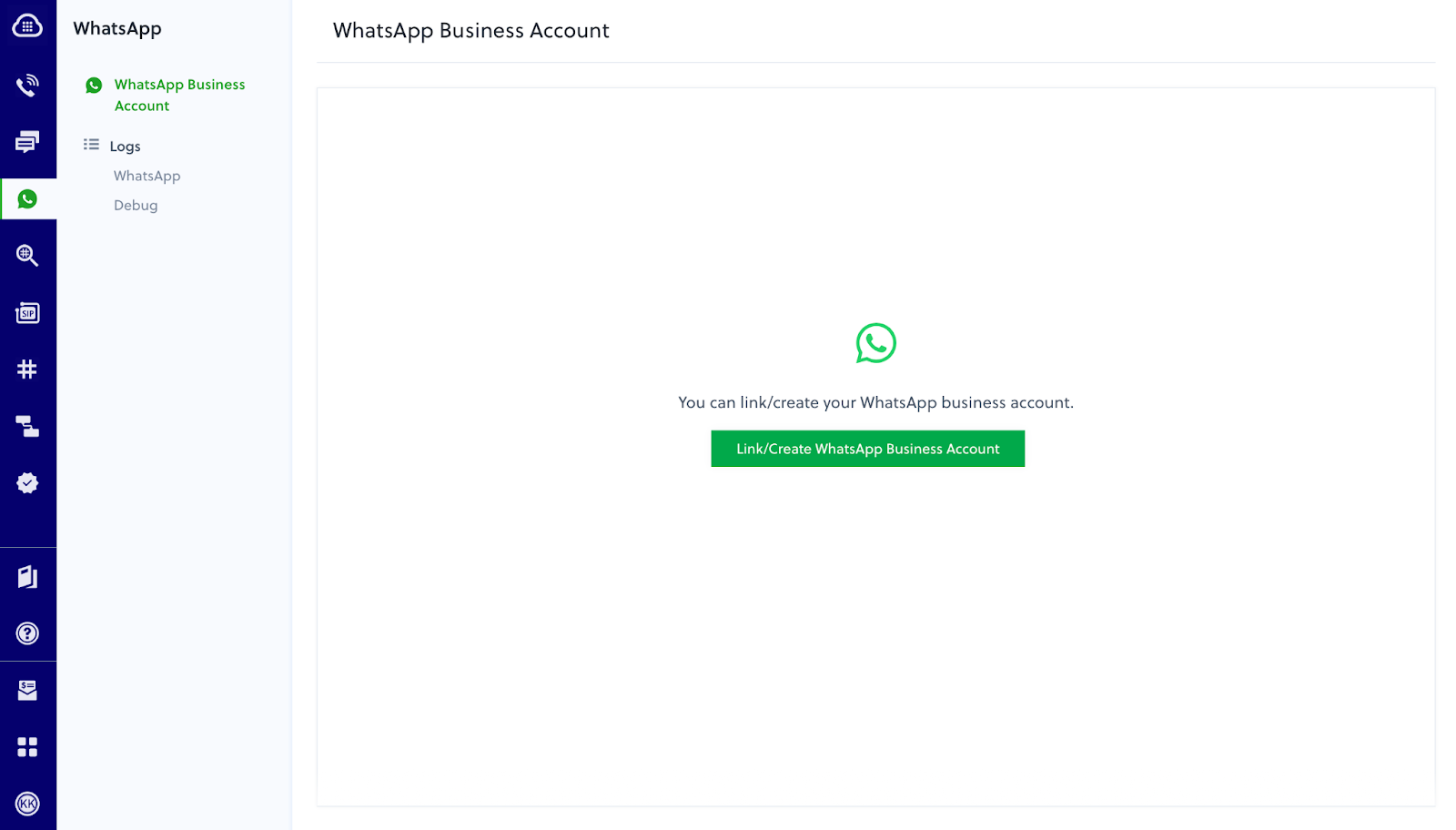
You can use your own number, rent one from Plivo, or even transfer an existing one. Just check Meta's guidelines first.
- Choose a display name for your WhatsApp Business account according to the guidelines.
- Grant Plivo the necessary permissions to manage your WhatsApp communication.
- To confirm that everything is set up correctly, head to your Meta account.
- In Business Settings, select WhatsApp Accounts and check the Partners tab — Plivo should be listed there as one of your partners.
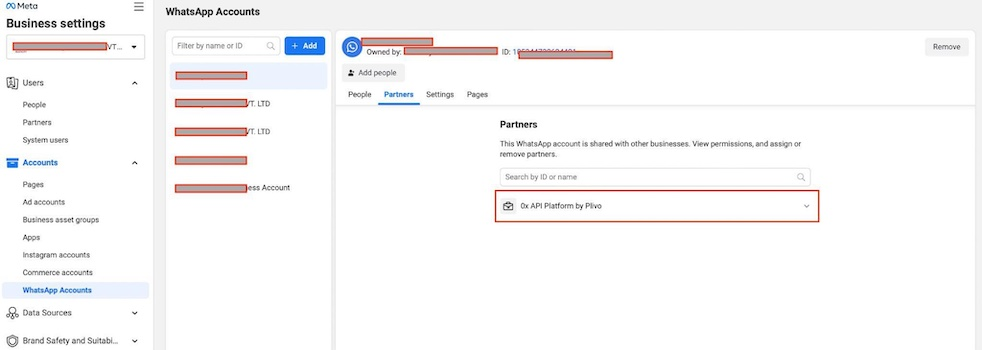
- Next, go to the Settings tab and look for 'PLIVO INC' listed as a payment method.
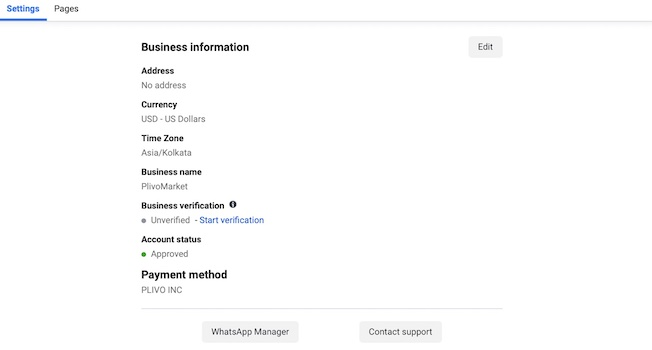
- Finally, when you open ‘WhatsApp Manager,’ the phone number you added should appear as connected.
Register WhatsApp templates
To manage your WhatsApp templates right from the Plivo console, go to Messaging > WhatsApp Business Account > Your WhatsApp Business Account > Templates.
Under the second tab, ‘WhatsApp Templates,’ click ‘Sync Templates from WhatsApp’ to pull the latest template details from Meta.
This view will show not only the language and status of each template but also insights into why users might be blocking your messages.
Keep an eye on the ‘Top Block Reason’ to identify trends and refine your messaging approach.
Types of WhatsApp message templates
WhatsApp provides a variety of message templates to help businesses connect with their customers. The two most common types are:
Simple template message
This template works great for various uses, from customer support to event announcements. Send plain text or add images, videos, and other media elements to make your messages more engaging.
Interactive template message
This template lets you directly add buttons and other interactive elements to your messages. These buttons can prompt users to visit your website, call you, or get directions — all without leaving the chat.
Interactive templates are perfect for boosting your conversion rates.
Location message
This template allows customers to share their precise location with businesses, whether through templated or non-templated messages. It further streamlines location-based interactions, making it easier for businesses to provide timely and relevant services.
WhatsApp message template categories
WhatsApp categorizes message templates into three main types, each serving a unique role in business communication:
Marketing templates
Marketing templates are versatile, helping businesses achieve objectives ranging from brand awareness to driving sales.
Here are some use cases:
Utility templates
Utility templates are triggered by a user’s actions or requests. They must be directly related to transactions, accounts, subscriptions, or interactions.
For example, an order confirmation message must include details like the order number.
Utility templates can be used for the following purposes.
Authentication templates
Authentication templates verify users with OTPs during logins or when recovering forgotten passwords. These templates are highly restricted and must adhere to the following rules:
- Use WhatsApp's pre-approved templates so you can add security warnings or expiration reminders.
- Include an OTP button (either a copy-code or one-tap option).
- Follow content restrictions: no links, media, or emojis, and length restrictions apply to certain parts of the message.
Tips & best practices to create message templates
Effective WhatsApp templates require more than just good copy — they must adhere to WhatsApp’s guidelines and meet strategic needs.
Here's how to make sure your templates hit the mark.
Be clear and concise
Prioritize clarity and conciseness above all else. Your messages should be easy to understand, even for someone unfamiliar with your industry or product.
You can use emojis to make your messages more fun, but don't go overboard. One or two is usually enough; too many can look unprofessional.
If you want your customers to take action, be explicit. Use clear, direct calls to action like “Reply YES” or “Tap to learn more.”
Name your message templates
Stick to short, descriptive names that are easy to remember and understand. Keep the name concise, ideally under 512 characters.
Use only lowercase letters, numbers, and underscores, and avoid spaces, special characters, or emojis. For example, appointment_reminder and shipping_update are good names because they contain acceptable characters.
On the other hand, Appointment_reminder and re$et-password are not good names because they contain uppercase letters and special characters.
Format the template properly
Use proper punctuation — commas, periods, question marks — so your message is easy to read. Add some space between lines of text. This makes your message less overwhelming, especially on mobile devices.
And before submitting your template for approval, double-check that everything is clear and that all variables, such as placeholders, are correctly formatted.
Understand your customer's journey
Consider how your customers interact with your brand.What information do they need at each step?Create messages that give them exactly what they need, when they need it.
For example, send an order confirmation after they buy something or an appointment reminder before their visit.
Always ensure you have their permission before sending messages, and provide an easy opt-out option.
A/B test your templates
Try out different message copy and calls to action to see what works best for your customers.
Consider sending different versions of your message to a small group and see which version gets a better response. This information helps you fine-tune messages for best results.
Tips to getting your Whatsapp template approved
When creating a template for approval, keep these guidelines in mind:
- Adhere to the rules: Make sure your templates comply with the WhatsApp Business Policy and Commerce Policy.
- Choose the right message type: Understand the difference between session messages and templates. Make sure you're using the right one for your purpose.
- Number your placeholders: If you're using {{1}}, {{2}}, etc., make sure they're in order. Skipping numbers could lead to rejection.
- Avoid sensitive info requests: Don’t request sensitive personal information like full bank account numbers or ID numbers.
- Be respectful: Use polite, non-threatening language.
- Keep it unique: Every template you submit needs to be original. Duplicate templates are likely to be rejected.
- Stay in the loop: WhatsApp's policies can change, so always stay informed and keep your templates compliant.
Automate your WhatsApp communication with Plivo
Plivo offers a robust, enterprise-grade communication platform to ensure your messages reach customers reliably, even at high volumes. We streamline the onboarding process, making it easy to get started with WhatsApp Business.
Businesses can easily sign up and register for the WhatsApp Business API directly through Plivo's platform. For effective customer engagement, Plivo enables automated WhatsApp messaging campaigns throughout the customer journey.
Additionally, Plivo's transparent pricing model includes a single rate for all conversations. Volume-based discounts ensure WhatsApp remains a viable, affordable channel as your business grows.
Ready to create a customer-centric WhatsApp experience? Book a demo today to learn how Plivo can transform your customer communication strategy and boost your business efficiency.
It’s easy to get started. Sign up for free.
Create your account and receive trial credits or get in touch with us.
