


Although AI voice agents initially started as cool weekend experiments, in 2026 they’re answering support calls, booking appointments, qualifying leads, and doing so much more. That means the wrong platform for building them is not just a bad tool choice, it’s what results in higher call abandonment, missed revenue, messy follow-ups, and teams doing manual cleanup.
Having established that, it’s a given that choosing the right platform is harder than it looks. Pricing models vary, some tools need engineers to run them, others are no-code but limited, and the platforms that feel identical in a demo can behave very differently once you hit real call volume. Demos are easy. Day 30 in production is where the truth shows up.
This guide is written from a business buyer’s lens: time-to-value, reliability at scale, total cost (including people time), and how well the agent fits into your existing workflows.
How to Choose the Right AI Voice Agent Platform for Your Business
Every tool in this list can make a call. The question is what happens after the call connects; and what happens six months later when your call volume triples. Before diving into the full comparison, use these criteria to filter what actually fits your situation:
- Who owns the infrastructure?
Platforms that depend on third-party telephony providers (Twilio, Vonage, Telnyx) add vendor risk, pricing complexity, and additional failure points. Look for platforms with built-in carrier-grade voice infrastructure.
- Do non-engineers need to make changes?
If your ops team or marketing manager can’t update a call flow without filing a dev ticket, your deployment will stall. Look for a no-code builder that doesn’t sacrifice depth.
- Is voice your only channel?
Most customer journeys aren’t voice-only. Customers call, then text. Or miss a call and reply on WhatsApp. Platforms that only do voice create gaps, and gaps create manual work.
- What’s the real cost at scale?
Base per-minute rates are marketing numbers. Add third-party STT, TTS, LLM, and telephony costs, and “cheap” platforms often become the most expensive. Ask for a full cost estimate at your projected monthly call volume.
- How fast can you go from idea to live?
Some platforms take weeks or months to configure. Others can have a working agent up in hours. Time-to-value is a competitive advantage, not a nice-to-have.
AI Voice Agent Platform Comparison: 10 Tools at a Glance
Use this table to quickly identify which platforms align with your business type, what each does best, and where each one falls short. Detailed reviews follow below.
Now for the deep dive.
1. Plivo: The Complete AI Voice Agent Platform Built for Business, Not Just Developers
One platform. Voice, SMS, WhatsApp, and AI, with carrier-grade infrastructure already underneath.
Best For: Businesses that need voice, SMS, WhatsApp, and chat in a single unified platform
Pricing: Usage-based pricing starting around $0.05/minute for the AI agent platform
Standout Feature: Vertically integrated voice AI stack with sub-500ms latency and built-in global telephony infrastructure
Why Plivo Leads for Business AI Voice Deployments
Plivo has evolved from a pure Communications Platform as a Service (CPaaS) provider into a full-fledged conversational AI platform. Its Vibe Agent product brings no-code agent building to teams that want results without waiting on engineering for every change. You can describe your use case in plain English, and the platform generates the logic and flow needed to launch.
What sets Plivo apart is that it is not trying to “bolt voice AI onto something else.” Plivo already runs global voice and messaging infrastructure. On top of that foundation, it integrates proven AI components like Deepgram (speech recognition), OpenAI (language models), and ElevenLabs (text-to-speech), with regional co-location across multiple global points of presence. In many deployments, teams report latency under ~500ms, which is fast enough for conversations to feel natural and not awkward.
What This Means for a Business
- Fewer vendors to manage, fewer outages to explain internally
- Faster rollout without waiting on engineering for every tweak
- Cleaner handoffs across channels so leads and customers do not fall through gaps
- One bill, one SLA, one escalation path when something goes wrong
Key capabilities
Multi-Channel Native Orchestration
Plivo supports voice, SMS, MMS, WhatsApp, and chat from one unified API. That matters because most business journeys do not end in a call. A lead might call, then confirm by text. Similarly, a customer might start on WhatsApp after missing a call. Plivo keeps those workflows inside one system, eliminating the context loss that happens when you stitch multiple vendors together.
Global Carrier-Grade Infrastructure
Support for 190+ countries across both voice and messaging, with direct carrier relationships across 1,600+ networks. This is especially important for businesses operating internationally where deliverability and call quality cannot be “best effort.” Plivo’s 99.99% uptime SLA is backed by its own infrastructure, not a third party.
Vibe Agent Builder: No-Code to Full API
A no-code interface for non-technical teams, plus APIs and code-based builders when you need deeper control. This avoids both extremes that slow businesses down: purely no-code tools that can’t scale, or developer-only platforms that create engineering bottlenecks.
CRM and Business System Integrations
Plivo agents connect directly to CRMs, ticketing systems, calendars, and custom APIs mid-call. This means the agent can look up a customer’s order, update a record, or book an appointment during the conversation — not after. The result is fewer follow-up tasks, fewer errors, and an elevated customer experience.
Enterprise-Grade Security and Compliance
SOC 2 Type 2, HIPAA-ready infrastructure with BAA support for eligible enterprise customers, plus ISO/IEC 27001:2022 and PCI DSS Level 1 compliance. For businesses in regulated industries, like healthcare, finance, and insurance, this means Plivo can go live without a multi-month security review cycle.
Plivo Is the Right Fit If...
- You need multi-channel workflows, not just a voice bot
- You operate across countries and care about call quality and deliverability
- You want enterprise-ready compliance without long security review cycles
- Your ops or CX team needs to make changes without opening a dev ticket
- You want to launch fast, then scale without re-architecting
Limitations
Plivo’s conversational AI platform is newer than its telephony stack, so expect continued product evolution. Community content is also smaller than developer-first tools, although that matters less for businesses prioritizing stability and support.
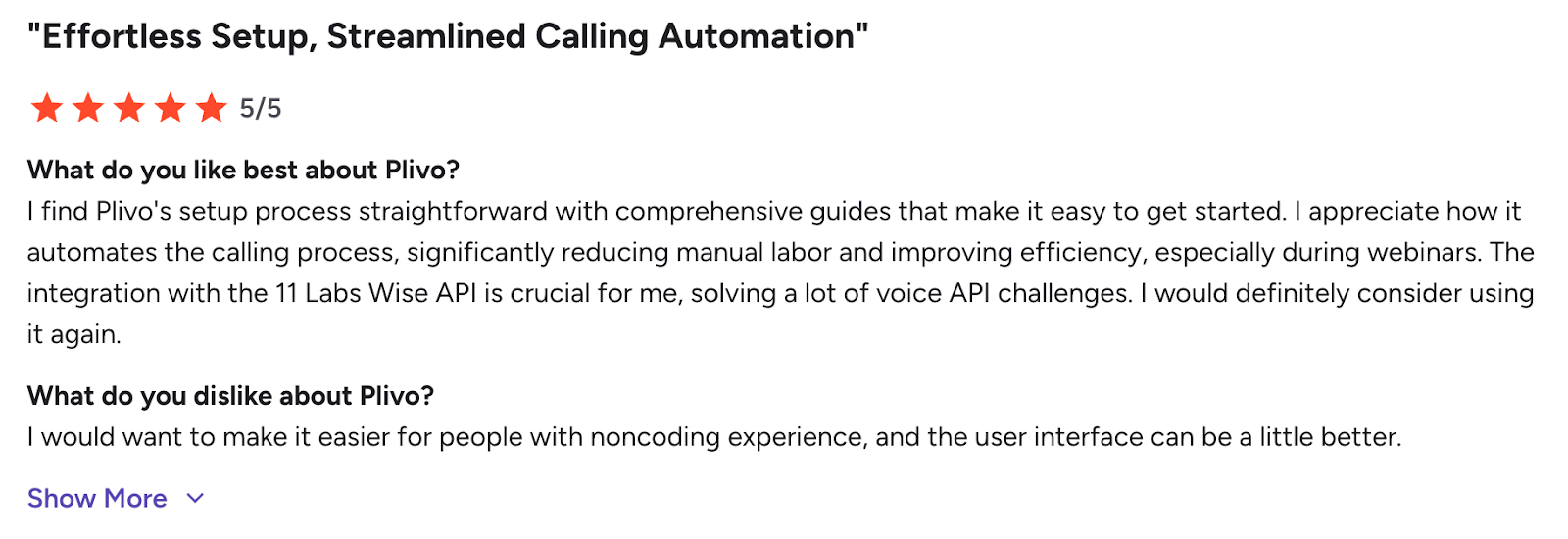
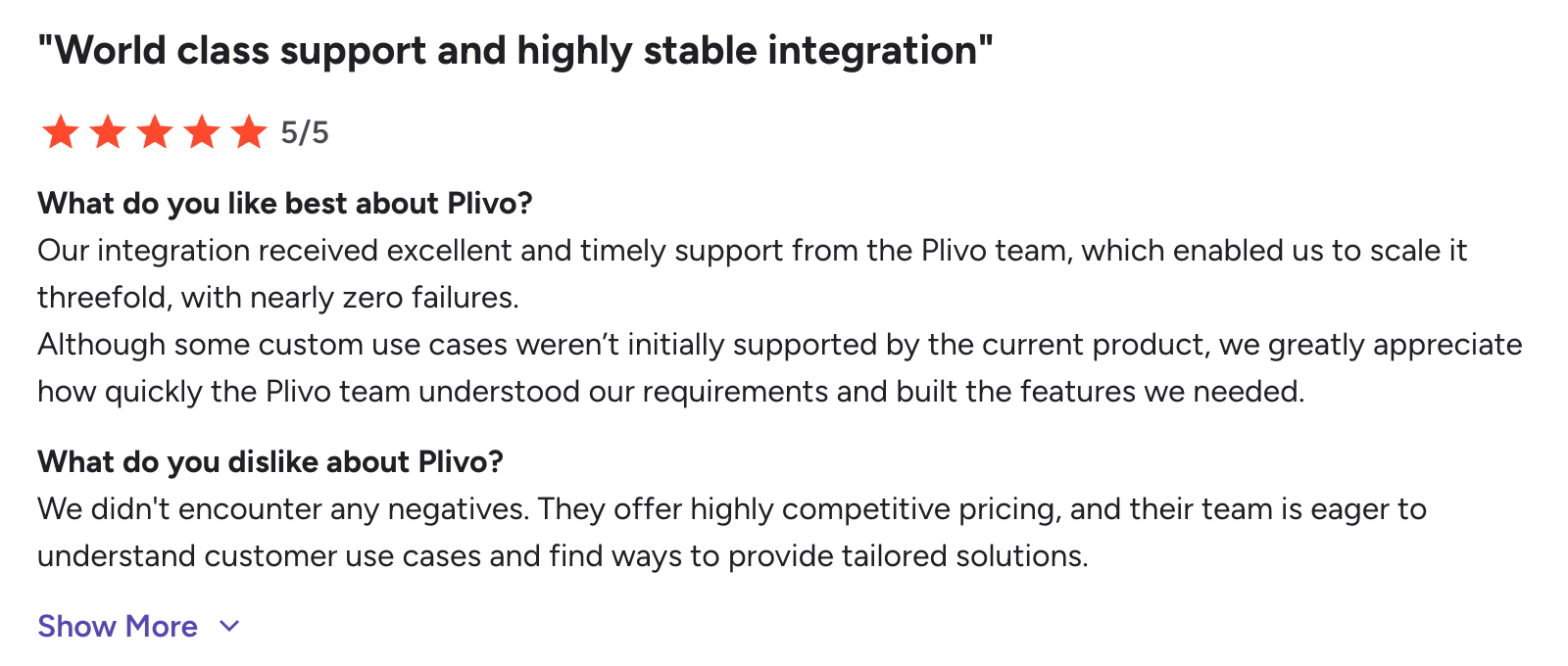
Source: G2
2. Vapi: Developer-First Voice AI with Maximum Customization
Best For: Engineering teams building custom voice AI products, not business operations teams
Pricing: Platform fee starting ~$0.05/minute, plus third-party STT, TTS, LLM, and telephony costs
Standout Feature: “Bring Your Own Model” architecture with 1000+ configuration options
What Vapi does well
Vapi is the platform for teams that want to swap LLMs mid-call, use custom speech-to-text models, or implement complex business logic that no-code platforms can’t handle. Its modular BYO architecture gives engineers complete control over every layer of the voice stack. If voice AI is your product (something you are shipping to customers or building proprietary IP around) Vapi is a credible engineering foundation.
Key capabilities
- Model agnostic; mix LLMs, TTS, and STT providers across any vendor combination
- Flow Studio for visual prototyping; full API for production-grade logic
- Advanced tooling including interrupt handling, backchanneling, and dynamic routing
- Sub-500ms latency achievable with the right configuration and provider choices
Where Vapi Falls Short for Business Teams
Vapi is explicitly built for engineers, not operators. There is no intuitive no-code builder for business users, no built-in analytics dashboard, and no omnichannel orchestration. If your ops or CX team needs to update a call flow, adjust a script, or add a new use case, they will need to open a dev ticket every time. For growing businesses where speed and agility matter, this becomes a recurring bottleneck.
Additionally, Vapi does not own any telephony infrastructure. Every call routes through a third-party provider that you manage separately, which adds vendor complexity, an additional failure point, and a separate billing relationship. At scale, this operational overhead often exceeds the cost savings from lower base rates.
So when should you choose Vapi?
Vapi is excellent if voice AI is a product your engineering team is building from scratch. But if you want voice AI to improve CX or revenue operations without becoming an ongoing build-and-maintain project, Plivo is the lower-risk choice with infrastructure, multi-channel, and compliance already built-in.
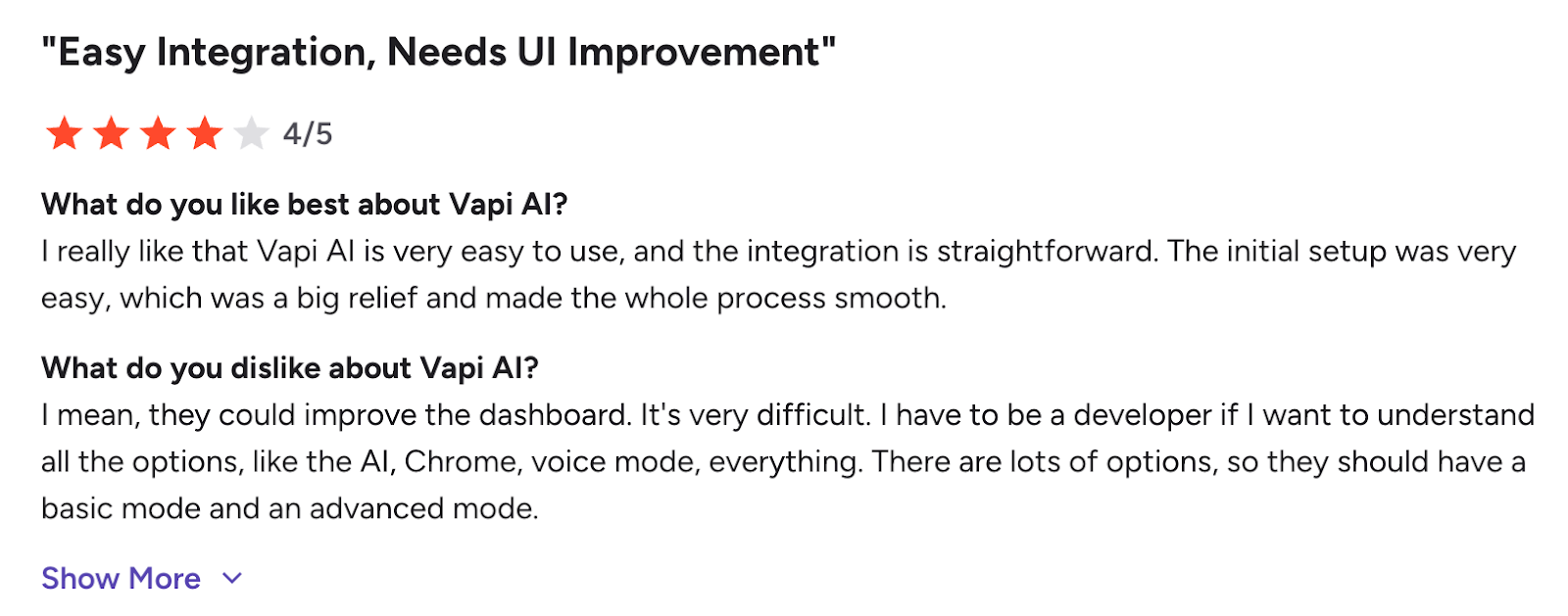
Source: G2
3. Bland AI: High-Volume Outbound Calling for Developer-Staffed Enterprises
Best For: Enterprises running large-scale outbound campaigns with dedicated engineering support
Pricing: $0.09/minute for connected calls; Build plan $299/month, Scale plan $499/month
Standout Feature: Enterprise-scale outbound throughput, up to ~20,000 calls/hour on enterprise plans
What Bland AI does well
Bland is a strong outbound specialist. If your primary requirement is reaching a large list quickly with structured flows and warm transfers to human agents, Bland is purpose-built for that scenario. Its infrastructure handles massive concurrent call volumes, and its security posture (SOC 2 Type II, HIPAA, PCI DSS) makes it viable for regulated industries running outbound campaigns.
Key capabilities
- Massive outbound scale; designed for thousands of simultaneous attempts with enterprise rate limits
- Voice cloning for brand-aligned custom voices ($50+ add-on)
- Warm transfers with full context when the agent identifies a qualified lead
- Self-hosted infrastructure options for strict data residency requirements
Where Bland Falls Short for Most Business Teams
Bland AI is English-only, runs at approximately 800ms average latency (which creates audible pauses in conversations), and is developer-dependent for even minor flow changes. If a campaign script needs updating, a non-technical ops manager cannot do it unassisted. The platform also lacks a visual sandbox for testing, meaning quality checks require live calls.
Beyond outbound voice, Bland offers limited support for inbound handling, messaging follow-ups, or consistent cross-channel context. If a prospect doesn’t answer an outbound call, there is no native way to automatically follow up via SMS or WhatsApp within the same workflow. For businesses where the full customer journey matters, not just the initial dial, Bland forces you to add more vendors.
So when should you choose Bland AI?
Bland AI is a strong outbound dialer if you have engineers and only need outbound voice. If you need inbound, messaging follow-ups, multi-language support, or consistent customer context across channels, you will end up adding more tools. Plivo covers the broader customer journey in one place, without English-only constraints or developer dependency for every script change.
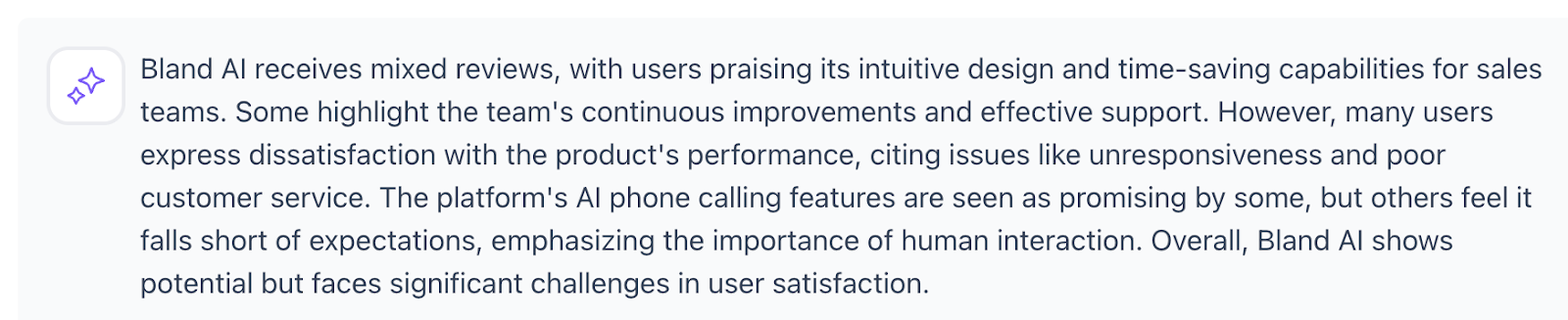
Source: Product Hunt
4. Retell AI: Production-Grade Voice Agents with a Low-Code Lean
Best For: Mid-market teams wanting enterprise voice capabilities without enterprise complexity
Pricing: Starting at $0.07+/minute with no separate platform fees
Standout Feature: Drag-and-drop builder with production-grade capabilities
What Retell AI does well
Retell AI sits in the sweet spot between the simplicity of no-code, and developer flexibility when you need it. Non-technical users can build sophisticated agents using the visual builder, while developers still get full API access when needed. With starting rates around $0.07+/minute and no separate platform fees, pricing is refreshingly more straightforward.
Key capabilities
- Real-time variable extraction; agents capture names, budgets, account IDs mid-conversation
- 31+ languages with native-quality speech across major dialects
- Fast deployment; agents can go live in minutes using templates, or be fully customized over days
- Built-in analytics including CSAT, latency, sentiment, and conversation outcomes
- SIP trunking support for enterprises with existing telephony infrastructure
Where Retell Falls Short for Multi-Channel Business Workflows
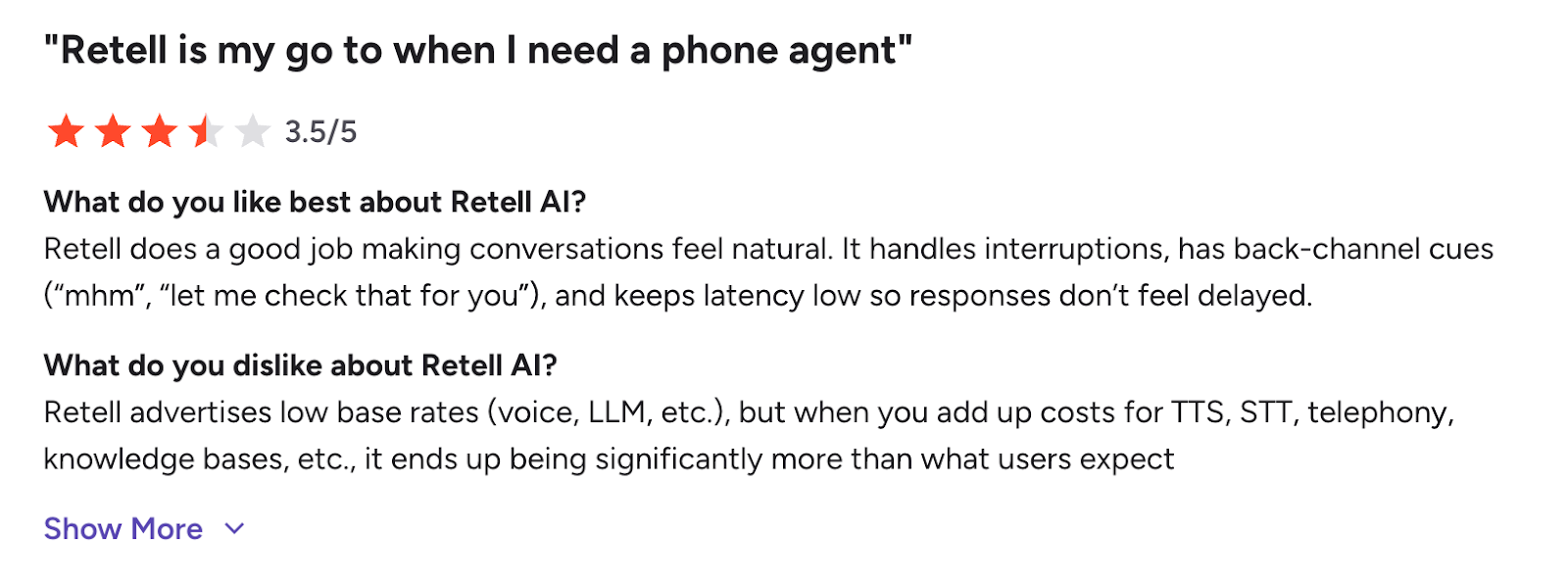
Despite its polished builder, Retell is fundamentally a voice-first platform. It doesn’t natively support SMS, WhatsApp, or cross-channel orchestration. For businesses where customers interact across multiple touchpoints, Retell requires additional tools to cover messaging, which reintroduces the vendor complexity that a platform like Plivo eliminates.
Retell also lacks persistent memory across sessions, which means returning customers may need to re-identify themselves or repeat context. For high-volume production environments, users on G2 have reported occasional latency spikes during peak hours that can affect conversation quality. Enterprise controls like role-based access control (RBAC) are also absent.
So when should you choose Retell?
Retell works well for contained support use cases within a single channel. But if you operate across regions, want WhatsApp and SMS in the same workflow, need persistent customer context, or require enterprise controls like RBAC and audit logs, Plivo is the safer long-term platform. Retell is a great place to start, but Plivo is where you land when you want to scale.
Source: G2
5. ElevenLabs Conversational AI: Industry-Leading Voice Quality, Incomplete Business Stack
Best For: Premium brands where voice realism is the primary differentiator, not operational automation
Pricing: Starting at $5/month (Creator plan); conversational AI billed separately based on call minutes
Standout Feature: The most emotionally expressive, human-like AI voice quality on the market
What ElevenLabs does well
ElevenLabs made its name with the most realistic text-to-speech on the market. Their Conversational AI 2.0 platform brings that same voice quality to real-time agents, with Flash v2.5 delivering 75ms latency, making it among the fastest voice synthesis available. If your brand positioning depends on sounding premium (luxury hospitality, high-end retail, executive coaching), ElevenLabs delivers voices that genuinely sound human.
Key capabilities
- Eleven v3 voices with emotional expressiveness, natural pacing, and breath patterns
- 75ms latency (Flash v2.5), among the lowest synthesis response times available
- Multimodal agent definitions that work across both voice and text channels
- Built-in RAG (retrieval-augmented generation) pulling answers from your knowledge base
- Celebrity voice licensing partnerships for branded premium experiences
Where ElevenLabs Falls Short as a Business Platform
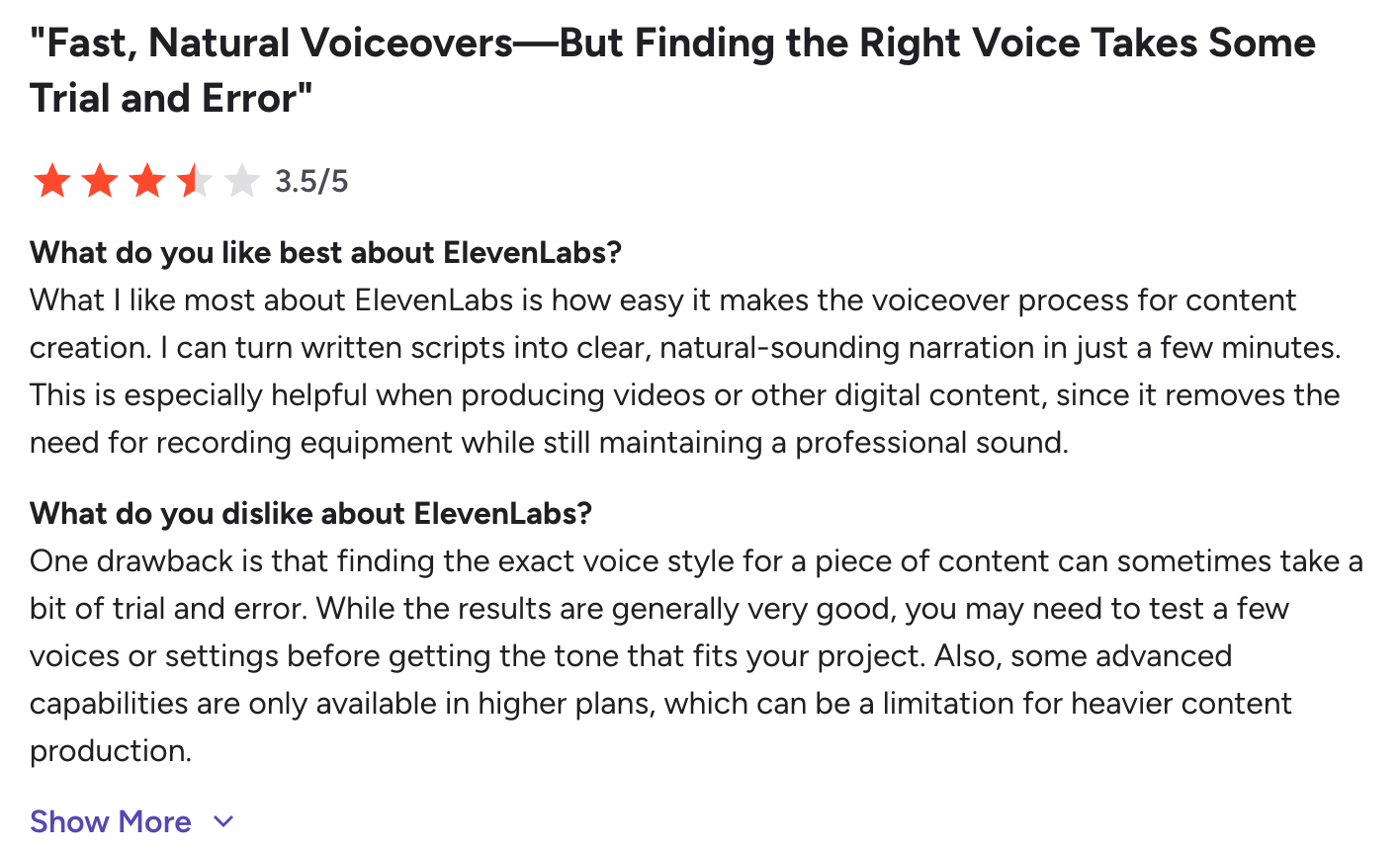
ElevenLabs is fundamentally a voice technology company, not a communications platform. Using it for business voice automation means assembling and maintaining a separate stack: a telephony provider for call routing, a speech-to-text provider for transcription, an LLM for reasoning, an analytics layer for reporting, and code for call flow logic. None of this is included. For ops teams without engineering support, this is not a viable path.
The platform is also API-first with no drag-and-drop builder, meaning non-technical business users cannot create or update agents independently. For businesses that want to use AI voice agents to improve customer service operations, not just sound good, ElevenLabs is one component of the answer, not the whole answer.
So when should you choose ElevenLabs?
ElevenLabs is a best-in-class voice layer. But Plivo integrates ElevenLabs for text-to-speech so you can get premium voice quality while also getting the telephony, routing, analytics, multi-channel orchestration, and no-code builder that ElevenLabs does not provide. Best of both worlds, without managing two separate vendor relationships.
Source: G2
6. Synthflow AI: No-Code Voice Automation That Hits a Ceiling at Scale
Best For: Agencies and SMBs without developers, building straightforward voice automations quickly
Pricing: $0.08/minute (flat rate); tiered plans from Pro ($0.13/minute overage) to Enterprise ($0.07–0.08/minute)
Standout Feature: BELL Framework (Build-Evaluate-Launch-Learn) for structured, repeatable non-technical deployments
What Synthflow does well
Synthflow built an entire no-code operating system for voice AI. Its drag-and-drop Flow Designer lets marketers, operations managers, and customer success leaders build production-ready agents without touching an API. The BELL Framework provides structured guardrails so non-developers don’t accidentally deploy broken agents. Auto-QA simulates thousands of conversations before go-live, which is a genuinely useful safety net for teams without engineering backup.
Key capabilities
- Visual Flow Builder with drag-and-drop conversational logic and subflows
- Auto-QA automated testing that simulates thousands of conversations before launch
- Version Control to roll back changes safely if an update causes problems
- White-label option for agencies deploying across multiple clients
- 200+ integrations with CRM and business tools
Where Synthflow Falls Short for Growing Businesses
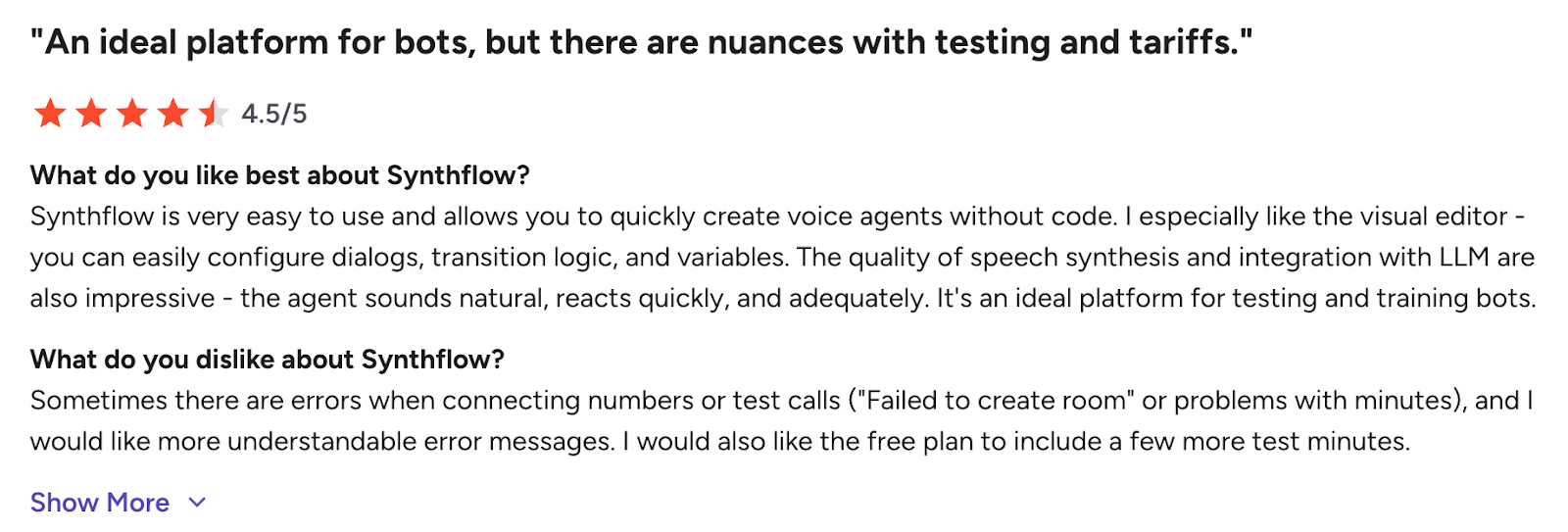
Synthflow’s no-code strength is also its ceiling. G2 reviewers consistently note that agents struggle when conversations go off-script, defaulting to canned responses instead of adapting. The platform relies heavily on predefined flow logic rather than true LLM reasoning, which limits its effectiveness in dynamic or complex conversations.
Users also report latency spikes during peak hours, limited customization of underlying models, and telephony and analytics features that are too simple for large enterprises. At scale, Synthflow’s architecture becomes a constraint rather than an asset, and migrating to a more capable platform at that point is expensive and disruptive.
So when should you choose Synthflow?
Synthflow is easy to start with, but Plivo is easier to scale with. Synthflow’s no-code guardrails work well for simple, script-driven use cases. But complex conversations, off-script behavior, international deployments, and deeper integrations are all harder to manage as you grow. Plivo gives you a no-code builder for fast starts and an API foundation for when requirements outgrow the visual builder, without forcing a platform migration.
Source: G2
7. Twilio Conversational AI: The Right Extension for Existing Twilio Customers
Best For: Enterprises already deeply embedded in Twilio Flex or Programmable Voice
Pricing: $0.10/minute for AI Assistants plus existing Twilio voice/messaging rates
Standout Feature: Seamless integration with Twilio's global communications platform
What Twilio Conversational AI does well
If you're already using Twilio Programmable Voice, SMS, or Flex contact center, adding conversational AI is a natural extension. Twilio's ConversationRelay enables AI voice agents, while Conversational Intelligence analyzes 100% of interactions across voice and messaging for sentiment, context, and performance insights. The 180-country footprint and 27.9 billion annual calls processed gives Twilio a credibility that few platforms match.
Key capabilities
- Omnichannel AI across voice, SMS, WhatsApp, and chat within existing Twilio flows
- Agent Copilot for real-time AI assistance to human agents
- Global scale across 180+ countries with enterprise compliance built in
- Full-spectrum compliance: SOC 2, HIPAA, GDPR, PCI-DSS
Where Twilio Falls Short for New Deployments
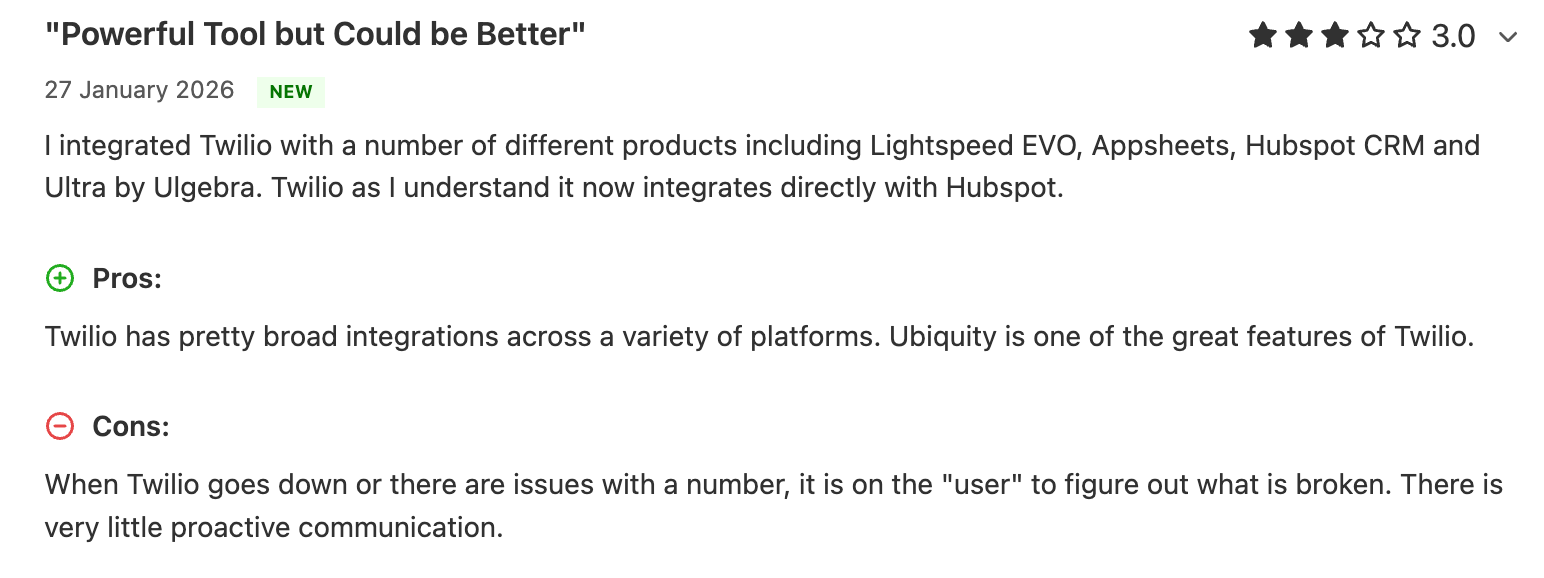
Twilio’s conversational AI is not a turnkey product, it is an add-on to an existing platform. For businesses starting fresh, the implementation complexity is significant. You need to understand Twilio’s architecture, manage multiple pricing line items (voice, AI, recording, storage, Agent Copilot each billed separately), and typically work with a Twilio partner for configuration.
For companies without an existing Twilio relationship, the total cost and time-to-deployment often exceeds what simpler platforms require. The $0.10/minute AI surcharge stacks on top of voice, recording, and other usage fees, making real-world costs easy to underestimate without careful calculation. And Twilio’s pricing structure, while documented, is notoriously complex to forecast accurately.
So when should you choose Twilio?
Twilio Conversational AI is the right choice if you are already running on Twilio and just need to add AI on top. If you are starting fresh or evaluating platforms without legacy Twilio investment, Plivo typically gets you to production faster, with simpler operations and a lower total cost. Plivo’s pricing is also more predictable; one rate structure, not seven separate line items.
Source: Capterra
8. Air.ai: Deep Conversational Sales AI with Enterprise-Level Commitment
Best For: Sales teams handling high-intent inbound calls that require long, natural conversations
Pricing: Approx. $25,000–$100,000 upfront license + ~$0.10–$0.12/minute usage
Standout Feature: Ability to sustain long, unscripted, human-like sales conversations
What Air.ai does well
Air.ai is built for deep, sales-style phone conversations. It handles open-ended questions well and keeps conversations flowing naturally over extended calls, which is genuinely rare in voice AI. If your primary use case is replacing human SDR-style inbound calls, Air.ai is one of the more capable options for that narrow scenario.
Key capabilities
- Long-form conversational handling with natural dialogue over extended durations
- Inbound lead qualification with CRM handoff after calls
- Sales-oriented dialogue designed for high-intent callers
Where Air.ai Falls Short for Most Businesses
Air.ai requires a significant upfront financial commitment, often $25k–$100k in licensing before any usage costs. This makes it a high-stakes, high-commitment decision that most growing businesses cannot justify based on a single use case. The platform is also voice-only with limited support for messaging channels, routing customization, or non-sales workflows like support or scheduling.
The onboarding cycle is long, and the platform is not designed for teams that want to iterate quickly or expand across use cases over time. If your business needs evolve beyond inbound sales conversations, Air.ai offers little room to grow without switching platforms.
So when should you choose Air.ai?
Air.ai is compelling when long inbound sales calls are the only problem you are solving. But businesses rarely stay at one use case. When voice becomes part of a larger customer journey which includes support, scheduling, follow-up SMS, WhatsApp reminders, Air.ai offers no path forward. Plivo handles the full journey from day one, without a six-figure upfront commitment.
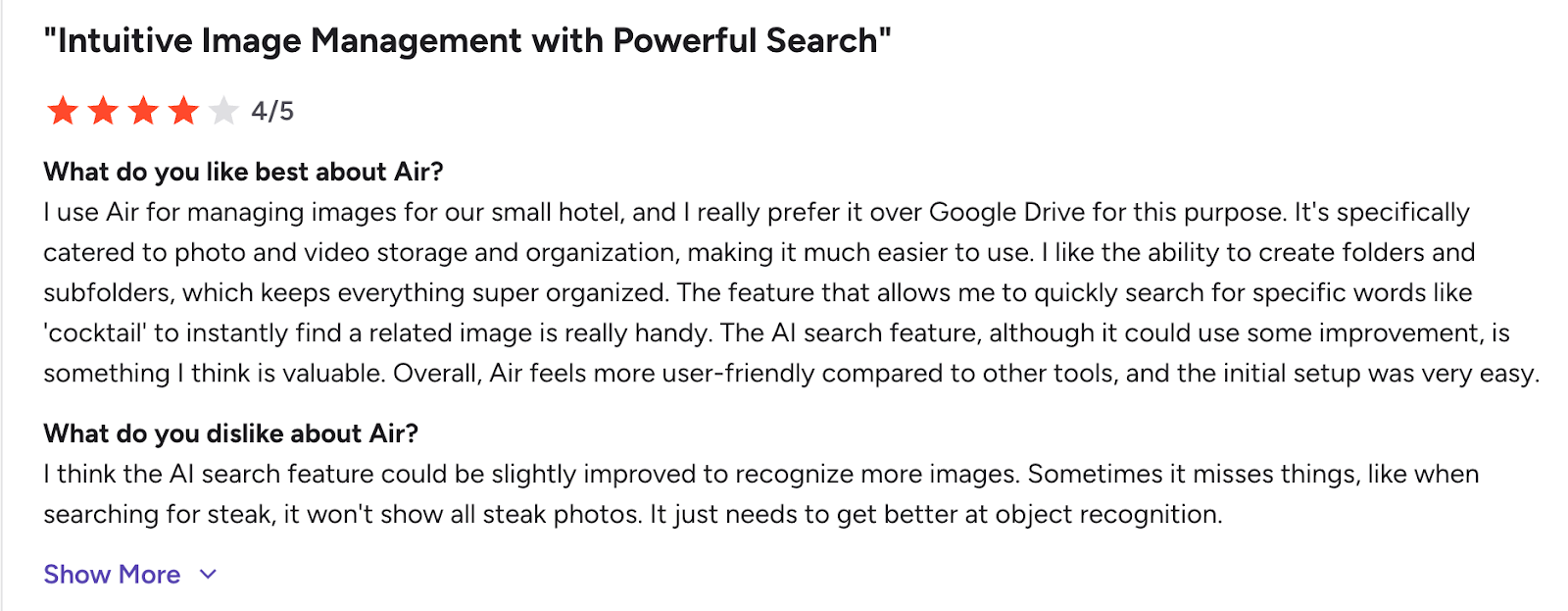
Source: G2
9. Kore.ai Voice AI: Enterprise IVR Replacement for Large Regulated Organizations
Best For: Large enterprises modernizing legacy IVRs and Tier-1 contact center automation in regulated industries like BFSI and telecom
Pricing: Enterprise contract pricing, typically ~$100,000+ annually including professional services
Standout Feature: Enterprise-grade conversational AI for regulated contact centers with 120-language support
What Kore.ai does well
Kore.ai is strong at structured voice automation inside large, traditional contact centers. It is commonly used to replace legacy IVRs and automate high-volume, repetitive support interactions in regulated environments. The XO Platform supports 120+ languages, integrates with major enterprise CCaaS systems, and has earned trust from 400+ Fortune 2000 companies. For enterprises where governance, compliance, and IT approval processes are the primary constraints, Kore.ai is built for that environment.
Key capabilities
- Intent-based conversational AI with enterprise governance and audit controls
- 120+ language support with deep integration into CCaaS platforms
- Voice automation for structured, high-volume contact center interactions
- Pre-built connectors to 70+ enterprise systems including Salesforce, ServiceNow, and Microsoft Teams
Where Kore.ai Falls Short for Modern Business Teams
Kore.ai’s average cloud latency is 800–1000ms, audibly slow in a live conversation. G2 and Reddit reviewers report noticeable delay spikes, particularly when chaining actions or making third-party API calls. The platform also carries a steep learning curve, with one G2 reviewer describing it as “an enterprise platform with an enterprise price,” and configuration requiring weeks of professional services engagement before going live.
For businesses that need to experiment, iterate quickly, or launch voice AI as part of a GTM motion rather than a traditional IT project, Kore.ai’s implementation pace is a fundamental mismatch. It is not designed for teams that want to test a use case on Tuesday and have it live by Thursday.
So when should you choose Kore.ai?
Kore.ai fits enterprises replacing traditional IVRs within existing IT governance processes, where time-to-value is measured in quarters, not weeks. For teams that want to launch quickly, iterate often, and run voice plus messaging, Plivo is significantly more agile, while still meeting enterprise compliance requirements.
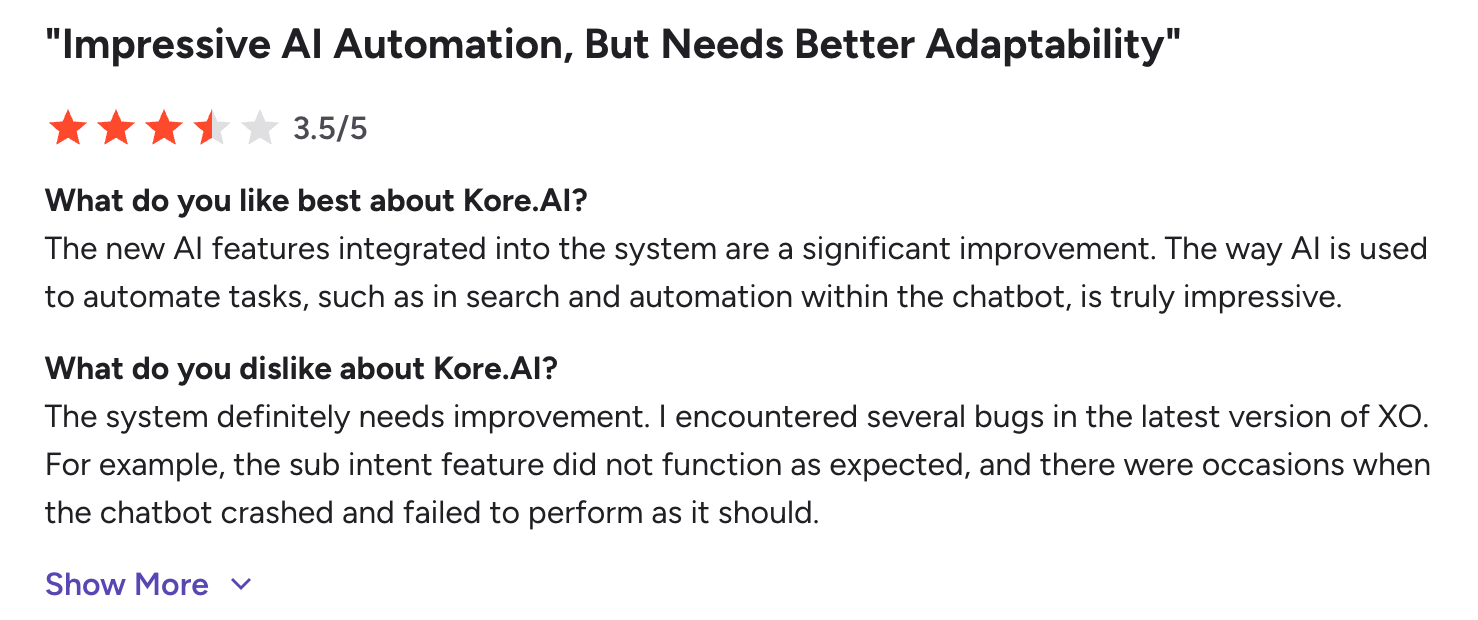
Source: G2
10. Genesys Cloud CX Voice Bots: The Right AI Layer for Existing Genesys Customers
Best For: Enterprises already running Genesys Cloud CX contact centers at scale
Pricing: Add-on pricing on top of Genesys licenses, typically ~$50,000+ annually
Standout Feature: Native voice bots tightly integrated with Genesys contact center routing and analytics
What Genesys does well
Genesys voice bots work best inside the Genesys ecosystem. They integrate deeply with existing routing, workforce management, and analytics tools used by large support teams. For enterprises already standardized on Genesys Cloud CX, adding voice bots through the native platform avoids the integration complexity of a third-party tool. The 4.4/5 G2 rating across thousands of verified reviews reflects a strong user base that values the platform’s consistency and reliability within contact center environments.
Key capabilities
- Native AI voice bots within Genesys Cloud CX with deep routing integration
- Enterprise-grade reliability and global compliance support
- Contact center reporting and workforce management integration
- Omnichannel orchestration within the Genesys ecosystem
Where Genesys Falls Short for Teams Starting Fresh
Genesys voice bots are not a standalone product; they are an extension of an expensive, complex platform. For businesses that do not already run Genesys, the barrier to entry is high: you would be adopting an entire contact center platform just to access its AI voice capabilities. The pricing model is complex, total spend is typically high, and implementation requires either internal Genesys expertise or a certified partner.
Iteration speed is also limited. Adding new voice AI use cases, or testing experimental workflows, requires working within Genesys’s tooling and release cycles. For growth-stage businesses or teams that want to experiment quickly with AI voice agents for business, this constraint alone is often a dealbreaker.
So when should you choose Genesys?
Genesys voice bots are the right choice if you are already deep in the Genesys ecosystem and want to extend what you have. For teams starting fresh or looking beyond traditional contact center workflows, Plivo delivers similar global reach and compliance with a fraction of the implementation complexity and a much more accessible total cost.
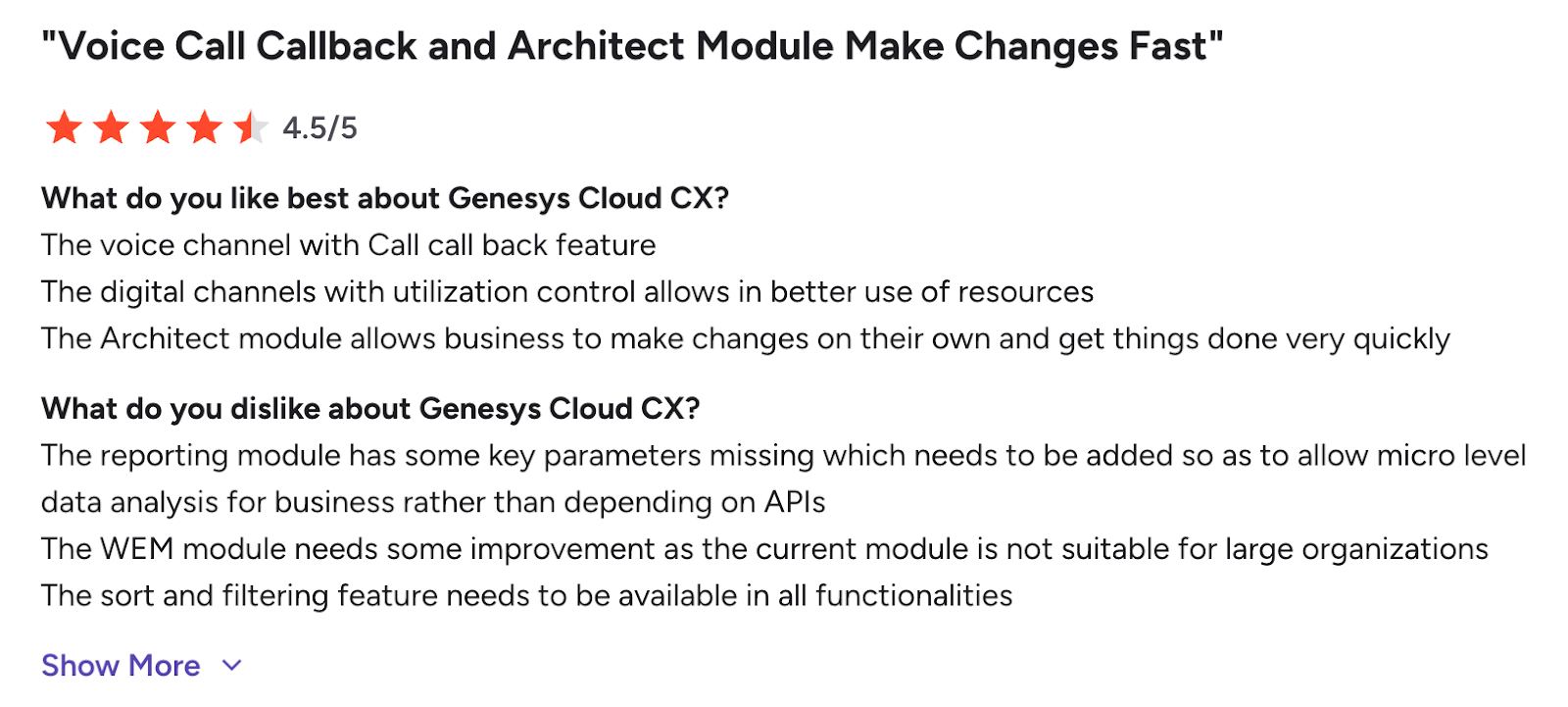
Source: G2
What Should You Actually Demand From an AI Voice Agent Platform?
Before you book a demo, ask yourself this: are you evaluating a voice agent, or are you evaluating a communications business? Because the platforms that win in production are the ones that treat voice as one layer of a larger operational system — not the whole system.
Here are the questions that separate the platforms worth betting on from the ones that look good in a comparison table.
1. Who is accountable when a call fails?
If a tool depends on multiple vendors just to place a call, things break more often and are harder to fix. When the STT provider goes down, the LLM times out, or the telephony provider has degraded routing, you will spend more time triangulating blame than fixing the problem.
A better architecture is one with:
- One platform owning the call end to end
- Fewer moving parts
- Clear accountability when something goes wrong
Plivo’s vertically integrated stack is built on this principle. When something goes wrong, there is one call to make.
2. Does it respond fast enough to feel human?
In voice, a 700ms delay between turns is the difference between a conversation and an interrogation. Most customers hang up after two or three awkward pauses, regardless of how accurate the agent’s answer was.
What matters:
- Quick back-and-forth responses
- Consistent performance during busy hours
- No noticeable lag mid-conversation
Plivo is designed to handle live conversations at scale without slowing down.
3. Can the conversation continue across channels?
Customers don’t stick to one channel. They call, then text. Or miss a call and reply on WhatsApp. Platforms that handle only voice create a gap in the journey that falls on your team to manage manually. This is how qualified leads get lost, support tickets go unresolved, and your ops team ends up doing the work that the AI was supposed to handle.
What separates a voice tool from a communications platform:
- One conversation across voice and messages
- No restarting or repeating information
- Smooth handoff between channels
Plivo keeps context across voice, SMS, WhatsApp, and chat in one system.
4. Can the agent actually do the work?
If the agent can’t update your CRM or book meetings during the call, it creates more manual work later.
What matters
- Reading customer data live
- Updating records automatically
- Triggering follow-ups without human cleanup
Plivo agents connect directly to business systems so actions happen during the call, not after.
5. Will this still work when volume grows?
Many tools work fine in small pilots. The ones that matter are the ones that handle 10x the volume without renegotiating contracts, re-architecting infrastructure, or calling your vendor to increase rate limits.
Infrastructure maturity shows up in the form of:
- Stable performance as usage increases
- Predictable costs
- Easy expansion into new markets
Plivo is built on infrastructure already used for large-scale voice and messaging globally. For businesses expecting to grow, this is the difference between a platform that scales with you and one that requires a migration when you outgrow it.
Common Questions Business Teams Ask
What’s the easiest way to get started?
Start with one simple use case like after-hours calls or instant callbacks. Prove the value in four to six weeks, then expand. Try Plivo’s Vibe Agent Builder to get your first agent live in hours without engineering support.
How do we avoid robotic conversations?
Fast response times and call quality matter more than fancy voices. Focus on platforms that consistently deliver sub-500ms latency in production, not just in demos.
What happens when call volume spikes?
This is where infrastructure choices show up. Platforms built on third-party telephony are more vulnerable to rate limits and degradation during spikes. Look for platforms with their own carrier infrastructure, auto-scaling, and published SLAs for peak load (like Plivo!).
How does this fit with our CRM?
The agent reads and updates records automatically so teams always have context. Webhook-based integrations are common but one-directional. Check out Plivo’s native CRM integrations to see how the agent acts on data during the conversation, not just log it after.
Is it safe to deploy AI voice agents in regulated industries?
Yes, with the right platform. Look for SOC 2 Type 2, HIPAA readiness with BAA support, and PCI DSS compliance if you handle payment data. Plivo meets all three, along with ISO/IEC 27001:2022, making it one of the more defensible choices for regulated industries without long security review cycles.
Try Plivo For Free
The best way to evaluate voice AI is to test it with your own calls, not demos. Plivo offers a free trial so you can try voice, SMS, WhatsApp, and chat together, connect your systems, and see how it works in real workflows.
